When you’re stuck in a rut, sometimes the best thing to do is dig deeper. So I told myself this spring as I found that I could not stop listening to Leonard Cohen’s 1988 album I’m Your Man. Each song is a dense portrait of obsession, whether political, erotic, or aesthetic, and each felt inexhaustible to me. A line from the weirdest track landed and wouldn’t leave: “Jesus taken serious by the many, Jesus taken joyous by a few.”
This month marks ten years since Cohen’s death at 82. And rather than his influence fading from cultural consciousness, if in our algorithmically siloed era we can still speak of such a thing, I was still getting glimpses of it everywhere I looked. Maybe it was a stray reference in an essay about another artist, or an allusion in a story, or an online argument about singer-songwriters. I heard the unmistakable melody of “Hallelujah” playing on a sound system in a cemetery outside Dallas as an 87-year-old from Zacatecas was laid to rest. It made me stop and consider whether Cohen, a native of Montreal, might be categorized as a Latin American artist. I should be branching out and finding new artists to explore; surely neither his themes nor his genius was strictly unique. But well after his death, Cohen has proven hard to dislodge, at least within my own bubble. He’s still the Taylor Swift of the graduate-educated middle-aged set.
Read our latest issue or browse back issues.
But deep as I might get into one album or another, and much as I had browsed here and there in his wider body of work, I had never taken on the whole thing. So I decided to listen to all of his studio albums in chronological order. And because I can only listen to music when my mind is otherwise unoccupied, I decided to do this while I went on my evening runs.
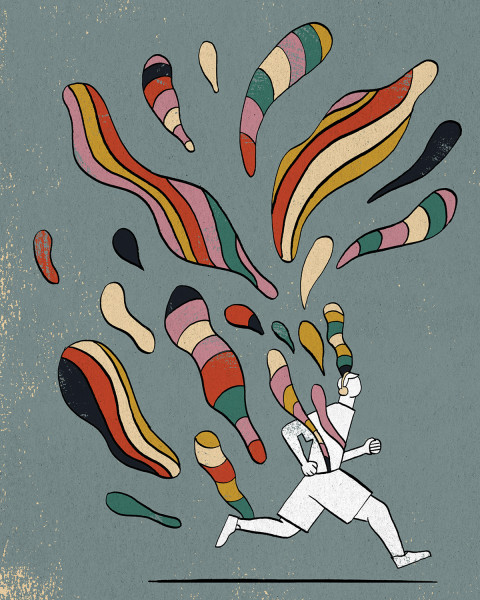
Here another rut intersected like a wagon track, joining and deepening the first. Just as I should be diversifying my musical tastes, I should be diversifying my fitness routine away from the simplest and cheapest exercise I know. I’ve tried, but I keep coming back to my short, slow, sloppy runs. Now I had the chance to try something new in the form of something old. Like multiplying two negatives to get a positive, I would push my runs to ten kilometers, two or three times my normal distance, while listening to the entire Cohen discography. Even as slowly as I run, it would take a lot of kilometers to do it.
What started as a peculiar expression of mild obsessive-compulsive disorder turned into a profound spiritual experience. Cohen’s work lends itself to immersion. His first two albums have some good songs, but I’d always found their tuneless gloom hard to swallow whole. But I did it, and then all of a sudden I heard him experimenting with melodies on Songs of Love and Hate and then breaking out of his guitar-and-vocal folkie prison with bigger instrumental arrangements. I was having to find new routes on which to experience the misery of running. Leonard and I had hit our stride together.
The mutually reinforcing strain of the miles and the lyrics put me into an unfamiliar meditative state. The songs got longer and more ambitious, gathering in references to the crucifixion and the Holocaust (there’s a self-mocking line about his reliance on these themes in “The Captain,” from 1984’s Various Positions), trying out new styles and forms, orbiting nearer and farther from any straightforward comprehension. Old favorites came back as a joy and a reprieve. Other songs I’d never especially loved managed to sound fresh. By the time I reached the God-haunted late albums, I was becoming inconveniently emotional about this person I’d never met. He never courted sympathy or made excuses for himself. He just kept scraping away at the surface of his bleak interior visions.
I made myself listen to “You Want It Darker,” the title track for the album that came out right before his death, twice in a row as I staggered toward home one night. “You want it darker,” he addresses God, “we kill the flame.” In a lesser voice the charge may sound obvious, the complaint of a depressed undergraduate escaping church or shul for the first time: “a million candles burning for the help that never came.” But by then the singer was an old, sick man, his voice bearing the strains of a long poetic striving, self-abuse, and close acquaintance with severe depression. The words kept getting deeper and the stakes higher.
We become more fully ourselves in the pursuit of our obsessions, for better and for worse. While it’s foolish to take the words of a song too much to heart as a window into the soul of the singer, I felt a sympathetic pain as I pushed myself ever harder without getting better. The artist’s art never solved anything for him, it seemed. At the last, the questions were the same as at the first. But the words and sounds were richer and stranger, more open to possibility. Leonard Cohen, like Jesus, is taken serious by many. He encouraged it. But at the end, in the last track of a collection of songs posthumously completed and produced by his son, he points the listener elsewhere. Listen to the mind of God, listen to the butterfly, he says, “Listen to the hummingbird, / Whose wings you cannot see. / Listen to the hummingbird; / Don’t listen to me.”
I did not take his counsel, but I hope I understood it. In art as in life, the race is not always to the swift. All the striving is for the sake of eventually letting go, all the deepening ruts are to help us imagine escape, all the seriousness is for the possibility of joy.