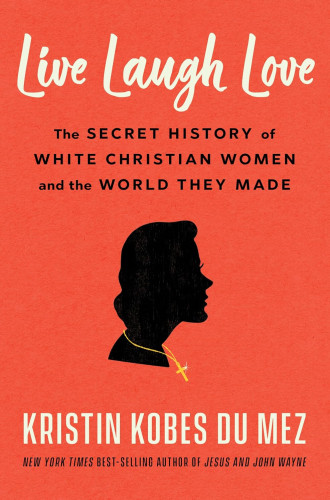
Live Laugh Love
The Secret History of White Christian Women and the World They Made
Kristin Kobes Du Mez’s 2020 runaway bestseller, Jesus and John Wayne, begins with a jolting personal anecdote. The Calvin University historian recounts the shock she experienced in 2016 as Donald Trump, then a candidate for president, stood on the campus of the Christian college she had attended and claimed he could shoot someone on the streets of New York City without losing his supporters. The book exists to unpack how such a moment could come to pass.
Du Mez’s follow-up, Live Laugh Love: The Secret History of White Christian Women and the World They Made, also begins with a crystallizing moment. Sitting at a seminar table with other scholars of evangelical Christian history, Du Mez referred to a bouquet of major touchpoints in female-centric evangelical church culture—Hobby Lobby, Rachel Held Evans—and was met with blank stares from all but one of the men present. As a church historian, Du Mez was well aware of the pervasive influence of White women on the formation of Christian culture, and as a descendant of Dutch Calvinists—one who had received Mary Kay makeup lessons at Calvinette camp as a young girl—she knew that influence at a personal level.
According to Du Mez, two seminal works established the foundations for feminine American Christianity: Hannah Whitall Smith’s 1875 book The Christian’s Secret of a Happy Life and a series of booklets published in 1922 by Louis and Loyola Grafe called (wait for it) Fascinating Womanhood, Or, The Art of Attracting Men: A Practical Course of Lessons in the Underlying Principles by Which Women Attract Men—Leading to the Proposal and Culminating in Marriage. If it seems like Smith’s treatise on holiness theology and the Grafes’ manual on how to be a delicate flower of a lady are disparate topics, Du Mez would beg to differ. Smith established the groundwork for the positivity movement that would take hold in American religion and profoundly influence the “correct” way to be a Christian wife, mother, and PTA member. Trapped in a miserable marriage to a fellow holiness evangelist whose philandering behavior brought down scandal and shame, Smith taught, according to Du Mez, that “abandoning oneself fully to God left no room for bitterness and despair.” Instead, Christians ought to be known for, in Smith’s words, “sweetness under provocation; calmness in the midst of turmoil and bustle; yieldingness to the wishes of others, and an insensibility to slights and affronts; absence of worry and anxiety; deliverance from care and fear.” The designers of Fascinating Womanhood essentially took all of this and added lipstick.