
Lower Than the Angels
A History of Sex and Christianity
If one listens to certain political figures or participates in the life of a Christian denomination, one might think that Christians are obsessed with issues of sexuality and gender. My own denomination, the Evangelical Lutheran Church in America, spent a decade studying, debating, and voting on whether to allow same-sex unions and the ordination of people who are in them. The decision to approve both prompted hundreds of Lutheran congregations to form a new denomination focused on upholding “traditional” teachings on sex and gender. The ELCA statement is currently under revision yet again because of continuing debates. My colleagues in other denominations speak about similar stories in their own church families.
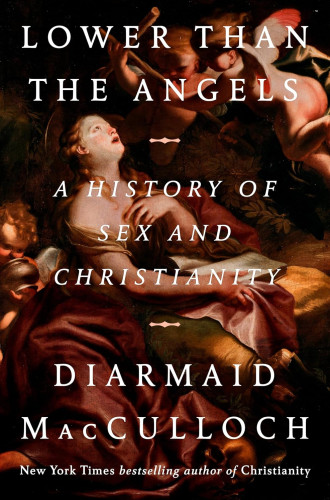
In this sweeping chronicle of Christian debates about sexuality, marriage, and gender from the New Testament until the present day, historian Diarmaid MacCulloch puts these debates in historical perspective. Beginning with Greek philosophical and Hellenistic Jewish teachings on gender, the book explores the cultural environment in which the early Christian movement and Christian scriptures took shape. MacCulloch’s decision to start with those teachings, rather than the text of the New Testament, reflects the book’s overarching argument that Christian debates about the theologies and regulations of human sexuality and gender roles always reflect or respond to the cultural environments in which Christians practice their faith.
Christianity is unique in its claim that God took the form of a human being. However, Jesus’ birth and family life are atypical. Traditionally, Christianity holds that Jesus was conceived by the Holy Spirit and born to a virgin. Roman Catholic teaching eventually claimed that Mary’s conception was special too, a claim that was only necessary because of the emerging belief that the sin of Adam was transmitted from one generation to the next by sexual reproduction—a belief not explicated in scripture, which clearly notes that Jesus had brothers and sisters. Nor did Jesus live in a typical family, since he remained unmarried, never had children, and claimed that his family consisted of those who did God’s will. Early debates over Christology proved just how difficult it was for Christians to accept and talk about the ways that earthly bodies, capable of both sickness and arousal, suffering and ecstasy, could contain the Divine.