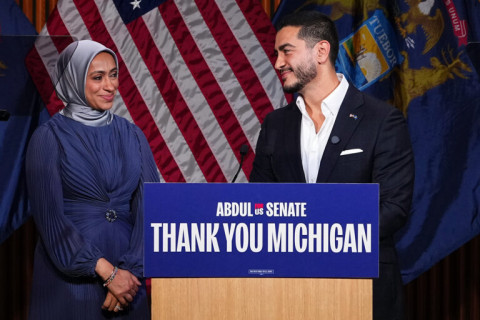
For some Jews in Michigan, the election of Abdul El-Sayed, a Muslim with sharply critical views toward Israel, as their US senator represented a stark new reality.
For others, the victory of El-Sayed—who won Michigan by 7 points over his challenger, Republican Mike Rogers, according to unofficial election results—came with a sense of pride.
“I feel really proud and deeply moved,” said Elissa Driker, a psychotherapist from Huntington Woods, a suburb of Detroit.
Driker said she watched El-Sayed’s acceptance speech and cried: “It felt so right and honest and reassuring to me. Just like, thank God, you know?”
Driker is among many Jews who worked hard to get El-Sayed elected during what turned out to be a bruising and divisive campaign within Michigan’s Jewish community of about 130,000 people. She knocked on doors for El-Sayed. She also hosted a house party to try to convince fellow Jews to vote for him.
El-Sayed, a 42-year-old former public health leader and the son of two Egyptian immigrants, promised that if elected, he would vote to cut off US military aid to Israel. He also said he did not consider Israel an ally and called Israel’s killing of Palestinians in Gaza a “genocide.” Just days before the election, his primary opponent, Rep. Haley Stevens, revoked her endorsement of him after feuding over Israel and gave her support to Rogers.
Michigan’s Jewish establishment—its leading rabbis and Jewish nonprofit leaders—engaged in public campaigns against El-Sayed, with some lifelong Democrats saying they were switching their vote to Rogers. Many of them contended that El-Sayed’s rhetoric offered people permission to harm Jews.
But in the end, most Michigan Jews, who for decades have leaned Democratic, likely voted for him, though in fewer numbers than they might have with a different Democratic candidate, according to exit polling.
An exit poll of 482 Jewish early voters in Michigan, conducted from October 25-31, found that 57 percent backed El-Sayed. But on the same ballot for Michigan’s gubernatorial vote, 78 percent voted for Democrat Jocelyn Benson, who does not hold critical views of Israel—a 21 point difference.
National exit polls suggest Jewish voters continued their historic voting pattern of casting a vote for Democrats. An exit poll of 100,000 voters conducted on behalf of major news networks by SSRS found that 68 percent of Jewish voters backed Democratic candidates on November 3.
Such findings suggest that the turmoil and divisions that roiled Jewish communities prior to the midterms—most especially in Michigan—did not result in dramatic voting changes.
El-Sayed’s victory also points to broader shifting stances among successful national politicians on the issue of US funding for Israel.
As voters went to the polls on Tuesday, President Donald Trump said the US will stop sending $4 billion in aid annually to Israel.
“The left uses the $4 billion payment that everybody knows about, when it’s no secret, as a signal of unfairness, and we can’t allow that to happen,” Trump said.
In the wake of Israel’s war on Gaza following the Hamas attacks on October 7, 2023, attitudes about Israel in the US have dropped to historic lows. A New York Times/Siena poll from May shows that three-quarters of Democratic voters opposed US economic or military support for Israel.
“It’s the culmination of a kind of a long-running process where gradually public attitudes have turned, if not completely against Israel, certainly against unconditional, no-strings-attached support for Israel,” said Dov Waxman, the presidential chair in modern Jewish studies at the University of California, Los Angeles.
In his victory speech, El-Sayed referred directly to the Israel lobby AIPAC, which he said spent $42 million in donations to Stevens and later Rogers. “Thank you for giving me the opportunity to beat you twice,” he said, referring to AIPAC’s support for his respective opponents.
The Washington Post reported in the weeks leading up to the election that AIPAC had spent $9 million on groups supporting Rogers and had spent $30 million on Stevens in the primary.
Other sharp Israel critics were also elected to Congress in yesterday’s elections, including Darializa Avila Chevalier and Claire Valdez, both in New York, and Adam Hamawy in New Jersey.
And a new group of Jewish Democrats highly critical of US aid to Israel won seats, too. In New York, Brad Lander was elected to Congress, as was Daniel Biss from the Chicago area. They will join Sen. Jon Ossoff of Georgia, who is also Jewish and a critic of military aid to Israel. Ossoff was reelected by an astounding 18-point margin over Republican Mike Collins.
The American Jewish Committee issued a press release acknowledging El-Sayed’s election as the first Muslim but added, “this historic moment has been tarnished by the Senator-elect’s continued anti-Israel rhetoric that alienates countless Jewish Michiganders and other supporters of the State of Israel, and endangers American Jews.”
Amanda Berman, the founder and CEO of Zioness Action Fund, which supported the work of NonNegotiable Michigan, which sought to get the Democratic Party to listen to Jewish concerns, said that work will continue.
“There’s this pit in people’s stomachs about the fact that someone like Abdul El-Sayed, who’s been just so unwilling to even engage with Jewish concerns, can represent a constituency without even being willing to listen to their very, very legitimate fears,” Berman said.
During the campaign, El-Sayed said he takes Jewish safety seriously and that his commitment to it was the same he had for his own daughters’ safety.
Driker, the Detroit psychotherapist, said she had a lot of really difficult conversations about El-Sayed with her own Jewish family members: her husband, Jay, and her mother, Elaine. She eventually moved her mother in her direction, and the two co-hosted a house party for El-Sayed and Biss.
Driker said she and others who supported El-Sayed want to continue to dialogue with Jews who may feel frightened by his victory.
“There are a lot of people that view this as an incredible opportunity post-election to get down to the work of, how do we bridge these very, very profound gaps within our tiny, tiny community,” Driker said. “I think the model of safe, respectful conversations across distance, across differences is the idea.” —Religion News Service