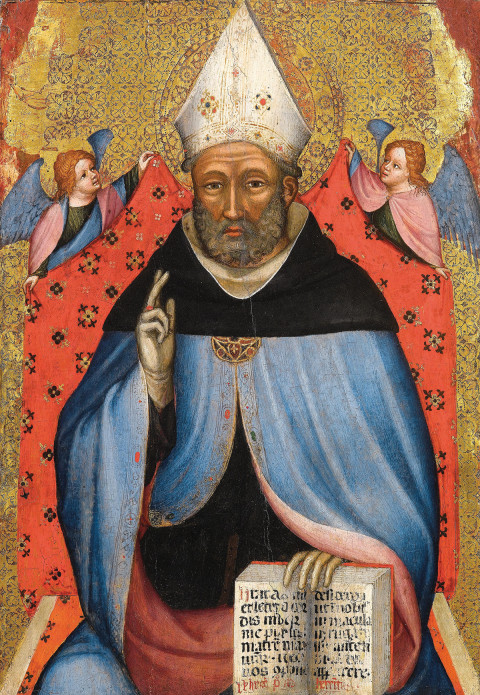
Christians often see doubt as a threat to Christian belief. However, St. Augustine described a positive, even essential role for doubt within the practice of belief: It is the recognition and acknowledgment that belief does not constitute knowledge. We might summarize his view as I do not know; therefore I believe. In order to understand the role of doubt in Augustine’s theology, we must reconstruct his theological commitments as he spoke with his beloved congregation in the North African town of Hippo.
Augustine left a large corpus of theological treatises, letters of advice and compassion, and sermons. His sermons, his largest written legacy, are accessible, thoughtful, and empathetic reflections addressed to his beloved siblings in the body of Christ. Possidius, the longtime friend who wrote Augustine’s biography and catalogued his writings, commented, “I think that those who gained most from him were those who were actually able to see and hear him as he spoke in church.”

Read our latest issue or browse back issues.
Yet it is Augustine’s midlife autobiography, Confessions, that attracts most of the current attention. College students, journalists, and scholars alike are fascinated by his vivid theatrical description of his conversion to celibacy, which is often referred to simply as “Augustine’s conversion.” He described this experience as an internal drama in which he felt himself to be the helpless victim of seductive women friends (amicae mea) who clutched at him, caressing him and whispering teasingly in his ear, “From this moment will you never again be able to do this . . . or do that?” As the scene unfolded on his mind’s stage, Continence (Continentia) appeared, smiling gently and saying, “Why do you try to stand by yourself, and so do not stand at all? Let him support you; do not be afraid that he will let you fall.” As she spoke, Augustine realized that the anxious grasping was his own—his struggle was not against external adversaries, but “about self, and self against self.” Reflecting on the experience, he recalled, “I relaxed a little from myself.”
Despite this lively account, Augustine did not urge others to expect or to seek such an experience. Of the many conversions described in Confessions, the most significant by far is Augustine’s discovery that his desire, trained to the acquisition of external objects (which he summarized as “a wife and worldly success”), must be fundamentally reoriented toward seeking God’s image within himself. “How glad I was to give up the objects I had been most afraid to lose,” he concluded his account of his conversion to celibacy. His relief was enormous:
For it was there, there in the place where I had been angry with myself, inside my own room, there where I had been pierced, where I had offered up my old self and started there on the purpose of a new life, there it was that you [God] began to grow sweet to me. . . . You true and supreme sweetness; you cast them out and you entered me to take their place, sweeter than all pleasure, brighter than all light, more inward than all hidden depths.
Less frequently noticed than his colorful description of his internal struggle with amicae mei is Augustine’s analysis of how his youthful addiction to objects of desire worked. He explained: “An eye trained to acquisitive lust” (oculus carnis) cannot see “beauty that is invisible to the eye of the flesh, beauty that can only be seen by the inner eye” (ex intimo). When the inner eye lacks training and support, he wrote, it is in a “drowned and sightless” state. Like other unexercised parts of the human body, the unexercised inner eye is sluggish, unable to see beauty for its own sake, while the eye of the flesh—socially reinforced and constantly exercised—is always on the alert, always seeking its objects.
Augustine did not acknowledge that his unrelenting pursuit of external objects is what brought him to the dead-end situation in which he turned to searching within. Nor did he recommend his route to others. Rather, Augustine’s sermons recommend the communal and lifelong practice of walking—together with others, as a member of the body of Christ—to strengthen the inner eye.
Belief, for Augustine, involves the participation of the whole person in God who is love.
As a pastor and preacher, Augustine understood that his first duty in the pulpit was to assist his hearers’ belief. He did not rely on instruction or “bishop speak” in pursuit of this goal; rather, he shared with his hearers what had helped him to believe. In a sermon on John 18:1, he confessed, “I too am walking by faith together with you; when the door is opened I am nourished with you; when it is shut, I knock with you.” Preaching on John 16:3, he invited his hearers to bring their own experience to the consideration of his words: “My dearest friends, let me tell you what I think about the subject without prejudice to anything better you may have perceived. This is my opinion and it is for you to see whether what I think is true or comes close to the truth.” In an exposition on Psalm 119:3, he asked, “Do you want to understand what I am saying? It is a matter of listening together and reflecting on our own experience.”
Belief, for Augustine, involves the participation of the whole person in God who is love. Thus, he attempted in his preaching to engage both his listeners’ intellects and their ability to hear “in the heart.” Belief, he said, is a “feeling of the mind” (affectiones animae mei). In a sermon on John 8:28–32, he attempted to describe this feeling:
God does something in us, I do not know what, in a spiritual, non-material way: it is neither a sound to strike the ears, nor a color to be distinguished by the eyes, nor a smell to be picked up by the nostrils, nor a flavor to be judged by the palate, nor something hard or soft to be felt by touching; all the same, it is something easy to feel and impossible to explain.
Hearing in the heart, Augustine recognized, is not something a preacher can produce. In a sermon on John 8:23, Augustine acknowledged, “I [God] made sounds in your ears. Am I the one who turned on a light in your heart? . . . Let the inner self listen.” Hearing in the heart is a gift from God by which God’s love “collapses into immediacy” (to use philosopher R. G. Collingwood’s phrase) so that it is felt in the heart of the hearer. Other Christian writers have referred to similar experiences. For example, in the Summa, Thomas Aquinas wrote, “Grace is a glow of soul, a real quality like beauty of body.” John Wesley’s journal includes a report of his strong experience of God’s love: “My heart was strangely warmed.”
Augustine repeatedly used the words sweetness and delight to characterize the experience of walking together in faith. In De musica he wrote, “Delight orders the soul; where the soul’s delight is, there is its treasure!” In a sermon on John 12:44–50, he described sweetness as the reward of faithful walking: “Truth has aroused us to a great desire for inner sweetness. . . . We seize it by growing, we grow by walking, we make progress by walking, so that we may be able to arrive at it.”
In contrast to Augustine’s highly personalized account of his conversion to celibacy as a struggle “about self, and self against self,” he characterized walking in faith as a communal practice in the company of fellow members of Christ’s body, past, present, and future. “Nevermore shall we be a crowd of scattered individuals,” he proclaimed in a sermon on Psalm 147. In the church’s liturgical practices (listening together, singing and thus breathing together, praying together, eating and drinking together), Augustine believed that the body of Christ is actualized, becoming what theologian Kevin Grove calls “a communally constituted identity, beyond self and interiority.” Communal self-identity draws each individual into the love of God: “When the hearts of the faithful are cemented together with the bond of love,” said Augustine in a sermon on Psalm 26:8, “it constitutes the beauty of God’s house.”
One surprising result of Augustine’s effort to assist his listeners’ belief is his recognition that doubt is an important—even essential—moment within the practice of walking together. Rather than undermining, betraying, or prohibiting belief, doubt can clarify and strengthen belief. The mature Augustine made it clear in his sermons that belief neither depends on nor produces demonstrable knowledge. In a sermon on 1 John 4:4–12, he preached, “Do you want me to tell you what I know? I won’t mislead you; listen to what I have believed. . . . If I were to say, listen to what I know, you would be hearing some pretty rash presumption.” Belief cannot be validated by experience or evidence. The fulfillment of belief, Augustine insisted, must be “left to God.”
Augustine considered this distinction between belief and knowledge essential for the preacher who aims to assist his hearers to believe. A burden is placed on potential believers’ credulity if they think that inscrutable doctrines must be understood as they—or even as the preacher—imagine. One need not claim to know in order to believe. “We believe,” Augustine wrote in his Enchiridion on Faith, Hope, and Love, “and we believe without any doubt what we admit we cannot know.”
The role of doubt in the practice of belief, Augustine taught, is precisely to acknowledge that belief neither depends on demonstrable knowledge nor produces it. Indeed, criteria for what constitutes knowledge are slippery, differing across times and places. Augustine’s education taught him that knowledge can be demonstrated by impeccable reasoning, a claim he explored in his early dialogues as a Christian. Readers of this magazine are more likely to assume that knowledge depends on testing a proposal by the steps of the scientific method—a procedure not applicable to theological belief. Augustine’s repeated injunction, “leave it to God,” clearly assists believers—now, as then. In short, we do not know; therefore, we believe.
Augustine frequently referred to the doctrine of the posthumous resurrection of the body as the “most difficult Christian doctrine.” He even called it unbelievable (incredibilis), acknowledging that it is unsupported by either experience or evidence. Yet he recognized that there are practical reasons to embrace the doctrine despite its difficulty. In City of God, he wrote that “it would be rash to offer any description” of the resurrection of the dead, given that we mortals have had no experience of it. Yet “for the sake of praising God, we cannot remain silent about the joy of our hope,” he concluded, paraphrasing Psalm 26:8. We proclaim the resurrection because doing so keeps us in continuity with the faith of our ancestors and gives God the glory that is his due.
In addition, as a pastor, Augustine recognized that imagining the bodily resurrection is comforting to those who have lost loved ones. He advised the grieving to picture their loved ones as they expect to see them again “in the flesh” on the day of resurrection. In a letter to a grieving woman, he quoted his African predecessor Cyprian: “A great number of our dear ones is awaiting us. . . . A dense crowd of parents, brothers and sisters, and children is longing for us . . . to attain to their presence and their embrace. What a gladness both for them and for us.”
In short, speaking as a theologian, Augustine urged his listeners to leave it to God; speaking as a pastor, he pictured future joyful reunions with loved ones, even as he insistently reminded his hearers that belief is not knowledge. “When I have spoken and you have understood, do not imagine that reality is anything like that,” he said in a sermon on John 5:30–40.
In the face of such challenges to belief, Augustine frequently and urgently returned to the metaphor of walking together. In a tractate on John 12:37–43, he urged: “We must walk, we must make progress, we must grow, so that our hearts may be capacious enough to grasp the things that we cannot understand now. If the last day finds us making progress, we shall learn there what we couldn’t here.”
For Augustine, walking—the practice of belief—ultimately yields holistic understanding:
What if the search itself is the way? What if the matter is so important that it cannot be found unless it is sought diligently, with all our might? What if the extreme difficulty of finding is an exercise for the mind of the searcher, leading to the full grasp and understanding of the discovery?
In a sermon on Psalm 31, Augustine encouraged his hearers: “Walk without fear, but stay on the road. . . . Only do not stand still, do not turn back, do not get sidetracked.”
Augustine had a strong sense of humans’ lifelong vulnerability. “We are so weak,” he frequently noted. Our life begins with the infant’s dependence on caregivers for care and nourishment; it ends with the helplessness of the elderly. Between infancy and old age we struggle to conceal our vulnerability, but, Augustine asked, “aren’t we more fragile than if we were made of glass?” Individual self-identity produces an urgently felt need to protect and defend the frail self. In the communal self-identity of the body of Christ, the self is not absorbed without a trace; rather, it is completed and perfected.
As Augustine was dying, he asked that the penitential psalms be copied and posted on his walls. These psalms begin with acknowledgments of the psalmist’s extreme vulnerability and prayers for God’s assistance; they conclude with gratitude for God’s love and mercy. One of Augustine’s last sermons reiterates his self-identity, no longer the sum of the personal experiences he traced so carefully in his Confessions, but as a member of the body of Christ:
What, after all, do I want? What do I desire? What am I longing for? . . . What do I live for, if not with this intention that we should all live together with Christ? That is my desire. That is my honor, that is my most treasured possession, that is my joy, my pride and glory.
This article is an adaptation of her article “Augustine: Considering Resurrection of the Flesh,” which appears in the Fall 2026 issue of Augustinian Studies.