
Features

Can this far-right Christian militia de-radicalize?

The Bratstvo Battalion was once known for its antisemitic and anti-LGBTQ rhetoric. Now it’s fighting alongside diverse Ukrainians to save the country from Russia.

One of Ukraine’s most controversial combat units, an elite special forces company named the Bratstvo Battalion, is also the country’s only exclusively Christian unit. While Ukraine was still refusing to acknowledge that soldiers were operating inside Russia, Bratstvo invited the international press to write about its sabotage missions on Russian soil. Bratstvo commanders celebrate their guerilla tactics and desire for revenge. But it’s not only this penchant for roguish attention-seeking that causes controversy. Bratstvo’s extreme Christian nationalist ideology has made the unit radioactive for many Ukrainians, even as Bratstvo soldiers carry out the most dangerous missions in defense of their homeland.

Before Russia’s full-scale invasion in 2022, Bratstvo was a private militia led by far-right politician Dmytro Korchinsky. Korchinsky preaches a Manichaean message: He believes traditional Christianity is locked in a death struggle against liberalism, and he often denounces LGBTQ people, Jews, Muslims, and others. Most controversially for Ukrainians today, Korchinsky once visited Moscow and publicly endorsed Russia’s “holy crusade” against secularism and the West.

Korchinsky no longer directs Bratstvo on a day-to-day basis. Since 2022, Ukraine’s government has taken over command of the battalion under the authority of the civilian-led military hierarchy. Recent videos distributed through Ukraine’s official news service paint a different portrait of Bratstvo’s Christian recruits, showing them engaged in good-natured disagreements about how faith helps them overcome fear on dangerous missions. A similar move to take over other right-wing militias has led to reports that Ukraine’s government is pushing these groups to de-radicalize, or at least to mute their political advocacy and foreground their practical contributions to the war effort.
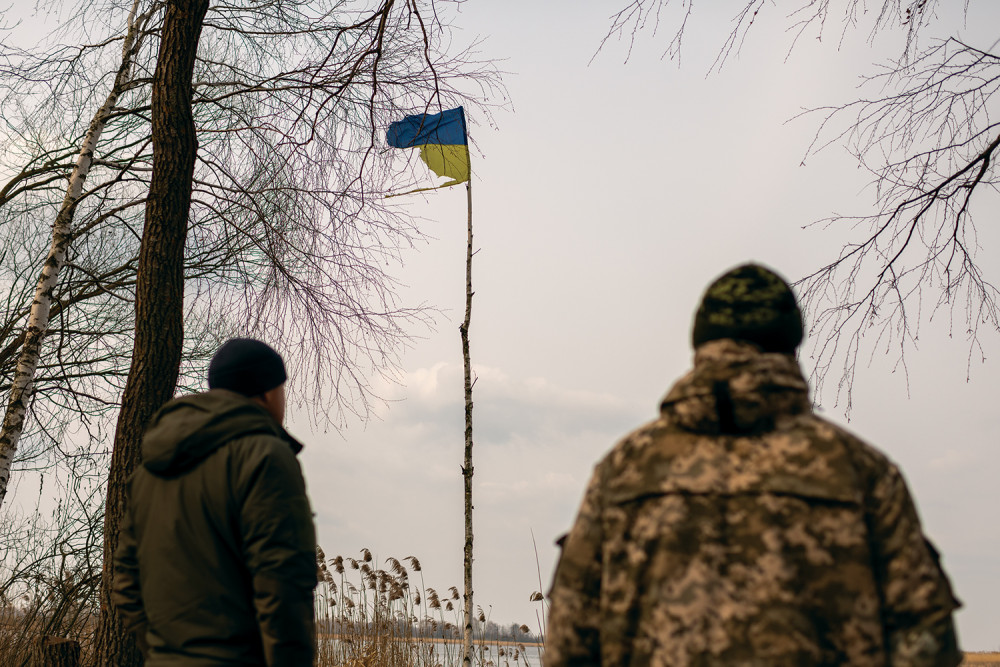
In March 2026, officials with the Bratstvo Battalion agreed to let me visit a frontline command center in Zaporizhzhia province. On the condition that I keep the command center’s location secret, they agreed to let me observe mission preparations and interview officers and enlisted soldiers.

I went to Ukraine’s front line to learn whether Bratstvo is indeed de-radicalizing, but also for another reason. I suspected that the group, back when it was still a paramilitary formation, was comparable to the proliferating extremist militias in the United States: groups like the Oath Keepers, Proud Boys, boogaloo bois, and Patriot Prayer. Amid our current struggle against a fascist US federal government, these militias have increasingly been given free rein in our communities. Some of their members even received presidential pardons after being convicted for their role in the violent attack on the US Capitol on January 6, 2021.

In these turbulent days, progressive Christians in the United States are looking around and seeing people who fear us as political opponents, and we are asking how we might become better neighbors. How shall we love our enemies?

I met with Bratstvo fighters to ask what would make a violent Christian militia present a different face to the world. I also interviewed the people whom Bratstvo once called enemies in a holy war: Ukrainian LGBTQ activists, Jewish leaders, leftist anarchists, and others. Do Ukrainian progressives trust Bratstvo’s change of heart?

The nucleus of the Bratstvo Battalion’s current leadership formed around Korchinsky in the 2000s, inspired by his far-right agenda and provocateur style. Korchinsky’s followers gained notoriety for protesting LGBTQ events and even assaulting participants. A 2019 Wilson Center report identified Bratstvo as the main group of counterprotesters at Kyiv Pride. But it was their earlier visit to Moscow that brought Korchinsky and Bratstvo the most notoriety.

Throughout the early 2000s, as part of a broader effort to build a transnational extremist movement, Russian and Ukrainian far-right activists attempted a few tentative collaborations. Korchinsky was willing to ignore Russian nationalists’ historical antagonism toward Ukraine in order to build this common cause. In 2005, he took a Bratstvo contingent to Moscow, where they appeared at a political youth rally alongside Russian politicians and called for a war “against Atlantic civilization.”

Russia’s illegal annexation of Crimea and incursion into Donetsk and Luhansk in eastern Ukraine in 2014 put an end to this coalition. At home in Ukraine, Korchinsky’s Moscow appearance became a liability, since the Russian politicians whom Korchinsky had embraced onstage were now calling for his compatriots to die. Korchinsky’s friends needed to clear their names; fighting against Russians could help. Members of Korchinsky’s contingent joined the militia groups that were emerging in this period—informal paramilitary associations that rushed to aid Ukraine’s overmatched military.

Meanwhile, the Ukrainian government was trying to formalize its control over these paramilitary militias. In a highly symbolic move, the government took over one of the largest groups, the Azov Brigade, in late 2014. After the 2022 full-scale invasion, Ukraine’s government took over all remaining independent militia groups, including Bratstvo. Today, Bratstvo is under the formal authority of the Intelligence Service of Ukraine’s Defense Ministry.

Austrian political scientist Andreas Umland has described Bratstvo’s earlier years as its “far-right prehistory.” These extremist ties continue to pose an image problem for Ukraine. Far-right militias in the military seem to give credence to Russia’s false propaganda claim that it invaded to eliminate “Nazi elements” from Ukraine’s government. Extremist paramilitary groups also distract from Kyiv’s image of a democratic and inclusive Ukrainian society led by a pro-Western government ready to join the European Union.

The Azov Brigade, maybe Ukraine’s best-known formerly far-right militia, has had mixed results countering negative international press coverage. In 2023, The New York Times reported that military officials forbade Azov soldiers from wearing patches with neo-Nazi symbols, and The Christian Science Monitor said the brigade was now admitting “Jews, Muslims, and other Ukrainian minorities.” But in the progressive magazine The Nation, Ukrainian-American writer Lev Golinkin replied that Azov had not changed and accused corporate media of “whitewashing neo-Nazis.”

Amid the fog of war, competing narratives and shifting benchmarks have prompted words of caution from seasoned analysts, including Catherine Wanner, who has studied religion and politics in Ukraine since the early 1990s. These days, the cultural anthropologist uses political labels with care. “Not only is the definition of a patriot and traitor changing,” she told me, but “what these social types can and cannot, must or must not do is also in flux.”

As I researched this article, I found that many Ukrainians were familiar with Bratstvo’s history and its Russian escapade. They also questioned Korchinsky’s loyalty, speculating about ongoing Russian ties. Ukrainian friends warned me to be careful with my questions. Mentioning Russia might offend, they said.

Their warnings were still in my mind when I walked into Bratstvo’s underground command center, but Oleksii Serediuk seemed to anticipate my apprehensiveness. “Ask me anything,” the Bratstvo commander announced with an impish smile. “I like offensive questions, because then the interview will be interesting.”

I recognized Serediuk immediately: He is a regular in Bratstvo’s online videos, in which his bald head, round cheeks, and martial demeanor make him look both boyish and menacing. Serediuk’s interviews are often given English subtitles for international audiences. In fact, Bratstvo dedicates significant resources, relative to its small size, to international media outreach, which Serediuk referred to as “information warfare.”

While recent reports from Le Monde, The New York Times, and CNN have focused on battlefield exploits, government-sponsored coverage turns the lens on the group’s open-minded embrace of faith. A video titled “Christians on Combat Missions” appeared on YouTube in late 2025, published by the official Ukrainian government media outlet United24. When the filmmaker turns to the group’s Christian identity, according to the YouTube description, the emphasis is not martial certainty but rather “inner choices.” “How do individuals guided by religious beliefs and moral principles find answers when war forces them to pull the trigger?” the film’s producer asks in the description. The film’s central scene features four soldiers discussing their faith in a relaxed atmosphere, open to disagreement and debate, while lounging on a leather sofa in a field of sunflowers.

But when I talked to Serediuk, he described a very different, much more bellicose worldview. “First of all,” he stated at the outset, “we consider this war to be a Christian campaign against Satanists, and we are waging this struggle here in Ukraine.”

He also described Bratstvo as fighting a culture war, with action on two fronts. Ukrainians are battling Russia’s “hostile spirituality,” he said. On the other front, there were invasive cultural trends from the West—he named typical far-right talking points about LGBTQ propaganda, feminism, and secularism. “We are carrying out a struggle against liberal pressures from Europe,” he said.

This anti-West rhetoric is broadly in line with the worldview of Bratstvo founder Korchinsky, who has retained ties to the unit even as it has come under formal military authority. Serediuk called him Bratstvo’s “spiritual leader.” The day before I visited, Korchinsky toured the command center and led a prayer.

Serediuk confirmed that Korchinsky and Bratstvo’s top leadership are Eastern Orthodox Christians. Korchinsky is also an Orthodox triumphalist. He regularly proclaims that the Orthodox Church should dominate the government from above, a belief that Ukrainian Protestants and Catholics find offensive. Some of these Protestants and Catholics are also in Bratstvo, according to the United24 promotional video. Since 2022, the unit has been ecumenical.

When I pressed Serediuk about Korchinsky’s statements about Orthodoxy’s dominant and authoritative position atop Ukrainian society, he dismissed my concerns. Bratstvo’s volunteers, he stressed, were just trying to be “normal Christians.” “Normal Christians follow everything that Jesus said and is written in the Bible,” he explained.

I pointed out that this statement didn’t sound particularly Eastern Orthodox—what about the authority of the liturgy, tradition, and the patriarchs?

“Maybe if Orthodox patriarchs or the pope said anything relevant, we would listen to them,” Serediuk responded. “But they don’t. We have the Bible, and we don’t care what’s happening in the world. We have our own path to God, and we follow this path—and all these nuances don’t matter.”

The United24 video portrays Bratstvo’s faith as an element of the unit’s internal esprit de corps, in contrast to Serediuk’s marked interest in holy war. But Serediuk did answer some of my questions about the group’s religious practice. Bratstvo begins every meeting with prayer. The unit has multiple chaplains. They have weekly liturgies led by an Orthodox priest, and they receive visits from evangelical and Jesuit Catholic clergy attached to the military’s official chaplaincy corps.

In years of reporting in Ukraine, I’ve met numerous religious leaders who exemplify the military chaplaincy’s official credo “to be close.” Faith leaders embrace a ministry of presence and often turn to religious practices for their therapeutic utility. But in the Bratstvo Battalion, chaplains listen to volunteers’ conversations—and then report any signs of wavering faith to the unit’s “political officer.” Serediuk compared this role to the Communist Party officials who sent soldiers to the gulags for “ideological deviationism” during the Soviet era. In Bratstvo, according to Serediuk, doubts lead to expulsion or a transfer. “When such issues arise—when he sees that a person is not of our spirit—we ask them to leave the unit.”

When I asked Serediuk if Bratstvo soldiers turned to faith for therapeutic reasons, he scoffed in response. While many Ukrainian military chaplains describe faith as a way to restore traumatized soldiers to their humanity, Serediuk dismissed this as propaganda messaging for the international press. “People love stories about how God helps people when they’re suffering,” he said. “Everyone treats these people with sympathy, but we don’t have problems with trauma here.”

Later that day I met with my press contact, a 28-year-old woman who goes by the call sign Ultika, to learn more about Bratstvo’s PR campaigns. She was unruffled when I asked about Bratstov’s Russian ties.

Everyone in Ukraine had Russian ties, she reminded me. Whether these were business or familial connections, they were ubiquitous by virtue of proximity. The real question, she insisted, is what people do with them now. “It’s only shameful if these connections continue and are not in Ukraine’s interest.”

When I asked Serediuk the same question a few minutes later, he seemed almost bored. “There are no greater enemies than former friends,” he said with a shrug. “Sometimes we’re friends with the Russians. Sometimes we kill them.”

Both Ultika’s and Serediuk’s answers were clearly practiced. They adeptly avoided the premise of the question; Serediuk even managed to come off as cocky. But Bratstvo’s ties back in the 2000s weren’t just profitable or unavoidable by virtue of birth. Bratstvo had pledged common cause with the very ideological architects of Russia’s current imperial project of cultural and physical extermination.

My final inquiry for Serediuk felt, to me, especially pressing. While researching this article, I’d also reached out to friends in Ukraine’s LGBTQ and Jewish communities, as well as activists in an anarchist/antiauthoritarian collective. Once Bratstvo’s enemies, now they were fighting side-by-side against the same invaders. They urged me to pose a particular question to Serediuk: How does Bratstvo imagine living alongside racial, ethnic, and sexual minorities in a future Ukrainian society?

“If the question is whether we should cooperate with them or not,” Serediuk replied, “then I will say definitely that it’s an effective strategy to interact with anyone. The opposite is simply not effective.”

This sounds quite pragmatic, I replied. Serediuk said pragmatism is a Christian virtue. He quoted Jesus’ admonition to be wise as snakes. “This means being able to compromise and cooperate and find mutual benefit with whomever you need to.”

But when I took Bratstvo’s statements back to my friends, many were incredulous. “I don’t trust them,” said one Ukrainian Jewish leader, who spoke anonymously out of concern for her safety. “They frighten me, and I don’t believe them when they say that they can cooperate today. Their goals and opinions are completely different from ours.”

I reached out to a longtime antiauthoritarian political activist, who also requested anonymity. She professed not to care about whether Bratstvo leaders were sincere about cooperating with minorities. It was a question of political ideology, not trust. “This doesn’t change my mind about their political values,” she said. “I respect their willingness to put their lives at risk to defend civilians like me, but I respect any soldier who does that.”

An LGBTQ activist in Lviv rejected this distinction; she said she couldn’t afford it based on her experience facing Bratstvo followers’ threats and attacks at Pride events. She recalled, first and foremost, Bratstvo’s masked counterprotesters. She called them “the perfect image of hate.” Although she agreed to be quoted in this article—again, only anonymously—she also urged me not to write about Bratstvo at all.

But I also interviewed a history professor, Nadiia Honcharenko, in a café not far from her office at Ukraine’s National Academy of Arts in Kyiv, who was surprised to know that Bratstvo was on the front line. It gave her pause, “especially when people are ready to dedicate their life to preserve the country and to defend their neighbors,” Honcharenko told me. “I think it’s the most important argument that they have changed their attitude.”

As I’ve worked alongside Ukrainian friends who are struggling against Russian invaders, I have been wondering about US pastors’ and Christian public intellectuals’ response to our own rising fascist threat. In late 2024, for example, Nadia Bolz-Weber announced a Red State Revivals tour—a series of one-off worship services exclusively in Republican states. Bolz-Weber asked her readers to invite political adversaries in particular. “Bring a friend. Or an enemy. All are welcome,” the tour announcement said. Bolz-Weber called both sides to repent of their political sins, like self-righteousness, anger, hopelessness, and despair. But the tent revival lacks staying power. After the out-of-town preacher has packed up shop and we’re back in everyday routines, it’s easy to slip into bad habits and devilishly hard to keep loving our neighbors.

In his new book Becoming Neighbors, Indian American theologian Amar Peterman suggests that regular table fellowship can help. Peterman writes evocatively about his rural Wisconsin church childhood. He and Bolz-Weber find inspiration in the same kind of memories—memories of old-time church life and its humble potluck suppers. Peterman worked at Eboo Patel’s Interfaith America, which remains a champion of the Obama-era vision of multicultural nationalism. In this vision, the Christian task is to put aside arrogance and to sit humbly at a radically inclusive potluck table.

But we are not in Obama’s era anymore. On Andrew Camp’s The Biggest Table podcast, Peterman acknowledged that MAGA extremists pose a challenge to his potluck prescription. What about wholly mean-spirited people, he was asked, and those who do the most evil and heinous things? “Those people exist, but I do not believe they are everyone,” Peterman said.

The challenge that far-right militias pose, however, has never been numerical. It is best understood through an analysis of state power. Today’s ICE agents are essentially Oath Keepers with different insignia. Under Donald Trump, Christian militias are backed by the full force of the US federal government. Their new uniforms, we learned from the killing of Renee Good and Alex Pretti in Minneapolis, also grant them effective legal immunity.

Maybe someday Americans will wonder what kind of bureaucratic and legal pressure it will take for the Proud Boys, especially those now embedded within ICE, to moderate their views and turn their skills toward building the true common good. Today, Ukrainians are asking this question about the extremist militias in their midst. This conversation is ongoing. Meanwhile, Americans should pay attention to the particular social circumstances within which Ukrainians ponder these questions.

Their conversation is taking place on the far side of a world-reversing shock to the system, on the far side of a full-scale settler-colonialist invasion, and amid daily threats to innocent civilian lives. While Bratstvo’s sacrifices on the front line are changing some Ukrainians’ views, there is still distrust and fear, perpetuated by the right-wing extremists themselves as well as by the Ukrainian government’s inattention to civil rights protections for LGBTQ communities. You would think that an existential crisis on a society-wide level would heal these culture war wounds in Ukraine. But it hasn’t, at least not completely, not yet.

That such distrust exists even now, during the war, should lead American progressive Christians to pause as we consider our proposals for building the common good. The Holy Spirit has the power to transform politically opposed hearts, but under current social conditions, such a project will be exceedingly difficult. The examples that so often appear in Christian ethical accounts of hospitality dance around the real and increasingly violent political cleavages of our day.

The point is not that revivals and potlucks are a pittance in the face of our problems and thus not worth the effort. I can think of no more valuable way to lay a groundwork, to anticipate a time when conditions have readied us to shed our political vices. But it will probably take something greater—and possibly more terrible—to effect a thoroughgoing repentance. 

********************

The Century's community engagement editor Jon Mathieu engages Marc Roscoe Loustau in conversation about what a far-right Ukrainian militia means for the US.

oEmbed URL

Marc Roscoe Loustau

Marc Roscoe Loustau is a cultural anthropologist and author of the newsletter At the Edges with Marc Loustau.

All articles »