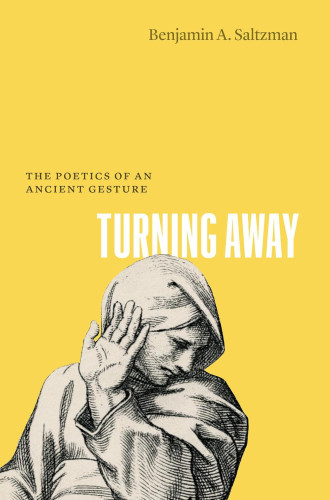
Turning Away
The Poetics of an Ancient Gesture
In a modern media climate saturated with catastrophe, we are constantly implored to watch. Often, we do so to differentiate ourselves from those who have turned a blind eye, as the saying goes. If we were to turn away from a given tragedy, we tell ourselves, we would be capitulating before those to whom we owe our attention. In Turning Away, English professor Benjamin Saltzman troubles this simple portrait of aversion and suggests that this gesture is far more conflicted, contingent, and ambivalent than we are apt to think.
For if aversion is not necessarily a sign of moral weakness, what exactly is it? Saltzman’s book takes aim at this desire for exactitude by studying a gesture that he characterizes as ultimately indeterminate. When Agamemnon turns away from the sacrifice of Iphigenia, some say he is driven by grief, but others say it’s a desire for “decency and dignity.” In depictions of Adam averting his eyes from Eve’s nakedness, one cannot be sure if it is Adam who feels ashamed or if he turns away out of respect for Eve’s own shame—or perhaps both. In every instance throughout Turning Away, the interpretations of these gestures remain unsettled.
Read our latest issue or browse back issues.
The project spans from Plato to Eric Adams and from Eden to Nicaragua, but its historiography is far from linear. Saltzman is interested in “the significance of a gesture” across time, and it cannot be neatly plotted along a linear history. Gestures have a certain “ephemeral energy,” and their influence radiates out in every direction, “like iterations fluidly contingent upon other past and future iterations.” Such fluidity is the power and peril of a nonlinear history: It demands a new way of thinking about cause and effect, before and after, now and then. In so doing, the lines connecting different examples may seem thin, but they never vanish. Saltzman’s theoretical project is successful in this regard, for it showcases how seemingly disparate media are interconnected and inter-determinate, even as the gesture itself will always remain indeterminate.
But Saltzman’s book is not limited to heady contemplations of nonlinear time; it is also an intimate study of particular individuals and their very real suffering. In fact, it manages to be both of these at once. In chapter 4, Saltzman’s material focus is the depiction of the crucifixion, but he is theoretically concerned with “the particular darkness of witnessing human suffering, the incomprehensibility of it, and the difficulty of conveying it through language and art.” One interlocutor here is Marc Chagall, whose stories of escaping pogroms and gangs of looters in late-1930s Russia are not only brought to bear on his paintings of the crucifixion but also placed in conversation with Elie Wiesel, Primo Levi, Fra Angelico, and Augustine.
The section titled “Catastrophe,” in which Saltzman discusses the Shoah through Chagall’s life and works, is especially dialectical. On the one hand, the Shoah is historicized as the “darkest and most catastrophic end” of “centuries of antisemitism” in Europe; on the other hand, paintings like Chagall’s White Crucifixion break the clean temporal distance between the first century and the 20th, surrounding Jesus not only with ancient Jewish figures like Rachel and the patriarchs but also with contemporary Jews fleeing violence in their homes and synagogues. The gestures of aversion found in White Crucifixion are thus doubly significant, both as instances of turning away from catastrophic violence and as the typical gesture which accompanies recitation of the Shema, where it is therefore “a fundamentally Jewish gesture.” The gesture is, in this sense, over-determinate: It not only can permit multiple interpretations, it must do so.
Saltzman’s book is certainly addressed to a disciplinary audience; it assumes a general understanding of the medieval European canon and a certain comfort level with technical terms like parataxis and extensive discussions of Greek and Latin syntax; it is littered with footnotes, features an extensive bibliography, and is published by a noted university press. Yet at certain points, the book is almost dialogical: a conspicuous “you” features throughout the book, and Saltzman even uses “I,” which is rare in academic writing. In fact, the last chapter, “Exodos,” named for the final scene in a classical Greek drama, tells a brief story from Saltzman’s own life—one in which he did not look away—that makes himself an object of the book’s own analysis, and indeed its final gesture. Framed almost like a conversation in the second person, Turning Away does much more than merely draw in the reader: It implicates the reader, just as it implicates its author. The book insists that your act of spectating is never ethically neutral, and neither is your act of turning away.
By turning his theoretical attention to you, Saltzman himself performs a similar temporal shift to the one he seeks to describe. For while the book itself is situated at a precise historical moment, as are the subjects of its analysis, “you” are not. “You” will always drift further from the text, occupying the ever-changing present while it remains anchored to its publication date. But of course, with each new reader that anchor is pulled up yet again, and Saltzman’s historical subjects become tangible once more in the great nonlinear transtemporal dance that is the reading and writing of history. It is precisely this dance to which Saltzman’s book draws your attention and from which you cannot look away.