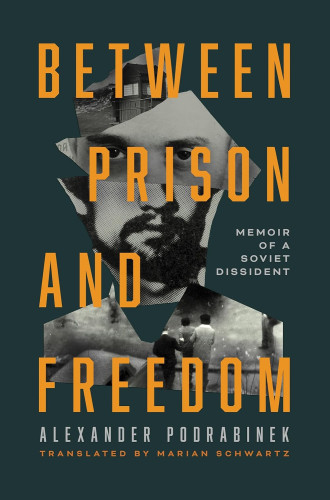
Between Prison and Freedom
Memoir of a Soviet Dissident
Leonid Brezhnev’s premiership of the Soviet Union during the 1970s is usually regarded as benevolent, compared not only to Stalin’s brutal regime but also to Khrushchev’s liberalizing “thaw” (his repression of religious rather than political groups). Neither the Wikipedia nor Encyclopedia Britannica articles on Brezhnev mentions any political crackdowns. In fact, Richard Nixon met with Brezhnev in Moscow in 1972, urging his efforts at détente by way of increased cooperative trade and the signing of the first Strategic Arms Limitation treaty. With the publication of Alexander Podrabinek’s Between Prison and Freedom, we now know the cruel truth beneath Brezhnev’s humane surface.
On August 15, 1978, Podrabinek was arrested under article 190.1 of the Russian Criminal Code: “The dissemination of erroneous falsehoods besmirching the Soviet state and public order.” It was not his first clash with Communist repression. In 1977, he had managed to have his manuscript Punitive Medicine secretly smuggled out of Russia and published, first in Russian and later in English. There he recorded what he had discovered while working for an ambulance service. Though he had been denied entrance to medical school for political reasons, his medical expertise gave him access to psychiatric hospitals. He discovered that they were populated not so much with deeply disturbed souls as with perfectly sane people being punished for their political dissidence. Podrabinek’s subversive act caused the KGB to threaten his arrest, together with his father and brother, if they did not emigrate to Israel. They refused.
Podrabinek describes himself as a “Jew out of a sense of contradiction.” Russian nationality is determined in relation to one’s father, and he couldn’t call himself a Russian because his father was a Jew. But because Jewish identity is defined as being born to a Jewish mother, neither was he an authentic Jew. Thus, Podrabinek professes no religion at all. Yet he is deeply sympathetic to two religious groups who rejected any cooperation with the Soviet regime.