Theophanies
Poems
In the Minneapolis spring of 2025, poets and their apostles sit in the beloved local press Milkweed’s bookstore. We’ve gathered to hear four poets conjure beauty in hopes of chasing away the demons haunting the nation. Out the storefront window displaying a row of poets perched on stools, I watch as city birds gargoyle the brick building across the street. Swooping and diving, they nearly miss the metro bus windshield. Elegant heralds of lives carried out amid structures designed for other species, they seek to nest despite the hostile architecture of spikes in windowsills.
Sarah Ghazal Ali begins to read from her debut collection in subtle eloquence. Angels, cranes, bees, dead sparrows, and raptors all flood her dreams as augury. She can see where “lies appear feathered in truth.” Wings and mothers and sisters flutter in and out together. In her reciting, birds mourn and shriek dirges. As in The Conference of the Birds so treasured in medieval mystical Islam, and as in Qur’anic accounts of the prophets David and Solomon, avian epiphanies flock.
Read our latest issue or browse back issues.
When the poet intones “Like God, I’ll create in my image,” we instantly believe her. She longs ardently for divine encounters—hence the title Theophanies—and summons them to the listener’s enchantment and prayer. “Desire made a door of me / and I kept it ajar.”
The poet proclaims her “faith in the feminine,” offering litanies of ripe, embodied language of belief, faith, and love. This is no seamless fit, and she knows it. While this faith may be “inevitable,” in her telling it “gets grime under its nails.” As she invokes the sacred, she also offers a spiritual autobiography, with confessional rawness and a faith that startles: “What I believe bewilders me.” She wrestles with angels and receives a blessing. She reveals theophanies vexed, desired, and honestly rendered.
Scriptural and familial matriarchs guide her. In the end, though scorched with human failings, she trusts that in a life lived with God, “punishment must be / ancillary to mercy.” There is a purity to this faith, an enviable hope. Hers may be less defiance than pious ardor as she works out what it is to love God while in a female body that bleeds and births and desires—“and weren’t we all / once slick / girls in the bath, knees / to chest, thinking / of Maryam, effigy / of maidenhood?” The Magdalene, both lauded and demonized in Islamic and Christian traditions, arrives on the regular. Such a woman knows firsthand the feminine lineage: “We bleed as penance for the curious first.” This Mary merely wishes to “hair dry His feet.” We wonder, can people and their unworthy assumptions just back off for a bit and let the women speak?
Ali nurtures a special fondness for Hagar and Sara (the poet’s namesake), the Magdalene, the Virgin Mary, and her own mother. Defiant, the poet chooses the veil when her family challenges her, “where does it say to?” Their fierce protection and worries shine through, even as they call her “ugly” and “brainwashed” and even “not my daughter.” Anyone who has drifted from the version of religion lived in their childhood home to choose other beautiful forms will relate to the tension in Ali’s gradual maturation into full calling.
She asks hard questions of women under patriarchy without heavy-handed diatribes. She simply puts their lives next to hers and asks honest questions. To the Virgin Mary, “O Maryam, / is birth not its own inhumation, / did your child not emerge / perfectly alive / and written to die?” Her Magdalene knows, “The one bright / gift of my life is that I was / witnessed. The only thing / God asks of me is to bear it.” Never glossing over the consequences of misogyny and religious hatred, Ali asks us to hope that the 17-year-old murdered in Virginia during Ramadan will find her mother again “resting in the sweet shade of mercy.” Brutal, quotidian womanhood weaves together with holy promise.
The Qur’an’s poetic beauty shines from these poems. The “I” is the congealed blood clot of all humans in creation. Unexamined masculine images for deity expand by their very nearness to feminine bodily experiences. Like the Divine Creator, the poetic voice creates life. “Unashamed I cramp. Between my legs / a clot. From a clot / I’ll make men. Hollow / myself holy.” Such power is divinely directed.
The direct address through “you” arises sometimes conspiratorially (“They visited me first, / you know”), sometimes accusatorily (“But / all you remember / is what came next / I hung my head and laughed”), and sometimes provocatively (as when the biblical Sara challenges, “tell me– / what would you have done”). “Listen,” Sara demands, “if I’ve learned anything from men, / it’s that their tongues are bare / and motherless. . . .
My hunger for fresh language carries me / closer to violent shores, gravel voices.”
Other language amazements follow. True to her name, the poet gives us ghazals, reveling in the way a contained couplet can launch mystic longing and freedom. Nouns verb themselves: “I walk through an orchard / and choir its fruit into the basin I make of my blouse,” and “voices lake / behind my eyes.” Even while astonishing us with language, Ali reaches beyond “the lattice of this language” until at last “there were no letters left / to taste in the chosen language of God.”
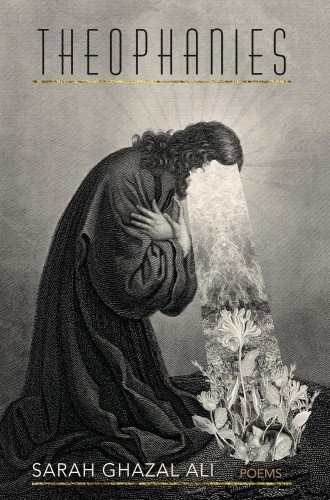
Since that day in 2025, strangers have stopped me at cafes and on planes to ask which book Dan Hillier’s stunning cover art adorns. His art and the feminist mission of Alice James Books cohere with the poet’s words. Verses from Ali’s debut collection fly to the reader from the pages, fledging throughout a day of ordinary tasks to make miracles. Short, rhythmic, and laden phrases take up residence in the reader. They flutter out at random moments and sightings; these theophanies are a manifestation of something most holy.