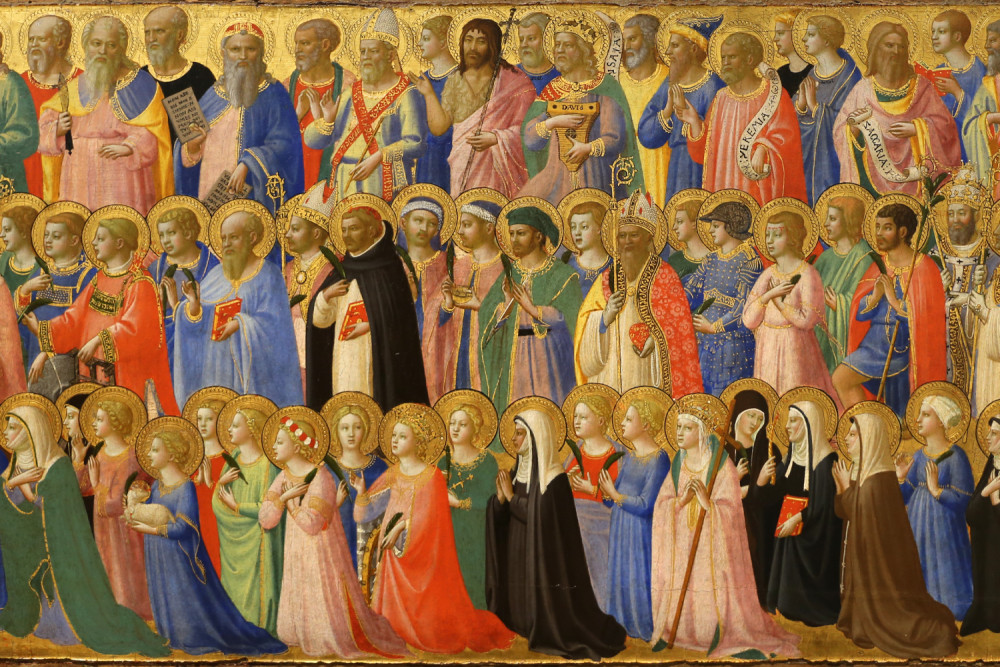
New Year’s Day usually feels anticlimactic, and this one likely will be no different for many people. I find myself looking for a spark of inspiration, a great cloud of witnesses to show me the way forward. Yet the sobering truth is that the simple turn of a calendar page isn’t enough to lift the fog of an overwhelmingly difficult year.
When the world feels like too much, I look to those who bore even greater burdens in ages past. It’s hard to contemplate figures like Phillis Wheatley, Samson Occom, Olaudah Equiano, Jarena Lee, David Walker, Pandita Ramabai, William Wadé Harris, Shoki Coe, and Kosuke Koyama and still believe the world has sunk to a new low or that hope is beyond reach.

Read our latest issue or browse back issues.
Phillis Wheatley (c. 1753–1784), the first African American to publish original poetry, wrote with a lyrical mastery that has captivated readers and confounded interpreters for generations. Scholars have marveled at the literary genius of her “double voice” (Henry Louis Gates Jr.), her political agency (David Waldstreicher), and her reclamation of relational joy (Tara Bynum).
Samson Occom (1723–1792) was one of the most celebrated Indian converts to Christianity in the 18th century. A Mohegan minister and teacher, he played a crucial role in the founding of Dartmouth College (though he is rarely given credit) through his highly effective fundraising tour across England. Throughout his life, he worked hard to pave the way for his people to survive the onslaught of British colonialism.
Olaudah Equiano (c. 1745–1797) made his mark on the 18th-century British Atlantic world as a brilliant entrepreneur and the author of a best-selling book that narrated his journey from enslavement to freedom. He used his story to gain wealth, status, and a position from which to argue for the abolition of slavery. A savvy marketer who knew how to navigate the complicated world of public relations across a sprawling empire, he took the tragic hand that was dealt to him and found a way to flourish.
Jarena Lee (1783–c. 1855) heard the voice of God telling her, “Preach the gospel; I will put words in your mouth, and will turn your enemies to become your friends.” This call inspired so much courageous resolve in her that even when Richard Allen, the founder of the African Methodist Episcopal Church and her pastor, told her that Methodists “did not call for women preachers,” she pursued the ministry of preaching without wavering.
David Walker (1796–1830) gained fame as the writer of a revolutionary tract that incited uprisings by the enslaved. Those uprisings overshadowed something else notable in his writing: his deft use of the Bible. Appeal to the Colored Citizens of the World (1829) drew heavily from scripture and called out the hypocrisy of White slaveholding Christianity. With an audacity that bordered on recklessness, Walker declared: “America is more our country, than it is the whites—we have enriched it with our blood and tears.” Less than a year later, he was found dead near the doorway of his shop in Boston, leaving behind a wife and young son.
Pandita Ramabai (1858–1922) was a Sanskrit scholar and a convert to Christianity under British rule in India who issued unflagging criticism of British Christianity. Her feminist arguments decried Christian as well as Hindu patriarchy. Despite her origins in a Brahmin family, she labored tirelessly for the education of girls and women as a way to overcome the strictures of a caste system.
William Wadé Harris (c. 1860–1929) tired of Methodist and Episcopal authorities in his West African context telling him how to conduct his ministry. He became a founder of modern African independent Christianity by pioneering the use of African cultural idioms in Christian worship. Instead of waiting for permission from mission agencies, which required lengthy catechism classes, he baptized tens of thousands of converts—some say more than 100,000—in Liberia, Côte d’Ivoire, and the Gold Coast (modern Ghana).
Shoki Coe (1914–1988) coined the term “contextual theology” as a way to assert the prerogative and responsibility of Christians in Taiwan to do the work of theology on their terms. Along the way, he developed sharp critiques of Western Christianity’s captivity to a “cathedral mentality” that prized permanent religious systems, control, and power over spiritual freedom and vitality.
Kosuke Koyama (1929–2009) extended the legacy of Coe—his teacher—and held up the example of the water buffalo’s patient slow pace in contrast to the imperial speed and “fast theology” of Western Christianity. His emphasis on local life and culture led him to prize the unhurried wisdom of rural peasants.
When the world feels like too much, I remember these heroes. Each of them pursued faith in Christendom contexts heavily influenced by the witness of White Christians participating in imperial structures. In the face of staggering odds, they nevertheless challenged, subverted, and paved their own way to flourishing faith.
They remind me that Christian faith has always stood in the shadow of death—and yet, time and again, people of faith have found their way toward life. They are the great cloud of witnesses I am looking to at the beginning of a new year.