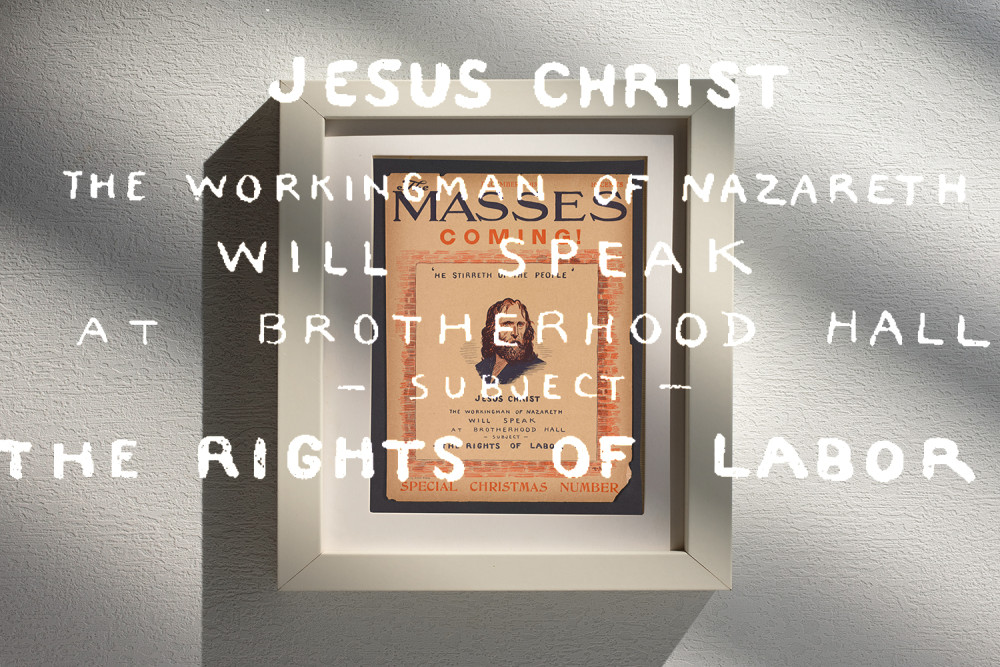
About four miles from Nazareth, where Jesus was born, was the Roman imperial city of Sepphoris. Rebuilt starting in 4CE, the city is never mentioned by name in the Gospels or any materials that we have access to, and yet scholars think that it may have played an important role in the young Jesus’ life. Cities being rebuilt need laborers, and Joseph was a tekton—not a carpenter, but an artisan in various materials, including stone. It’s possible that Jesus tagged along to the city to help his father.
While it’s impossible to know what may or may not have happened in Jesus’ adolescence, we do know that the crowd in Mark 6:3 refers to him by the same title as his father—tekton. “Is this not the tekton?” they ask. Even in the ancient world, there seems to be a little bit of derision, since it is being used to undercut Jesus’ claim to religious leadership, a bit like asking, “who died and made you our leader?” Regardless, these brief glimpses that we see in scripture tell us that Jesus was likely trained in his father’s profession. He worked with his hands, and not just to perform miracles. For generations of Christians in our history, this identity was a source of pride and a way to sacralize the fight for fair working conditions and wages.
I have one such relic hanging in my office—the cover of a 1913 issue of The Masses, a socialist magazine that ran during the early 20th century and rallied support for workers’ rights. Dubbed “the workingman of Nazareth,” the cover depicts an image of Jesus inviting its readers to attend an event where he will “speak at Brotherhood Hall on the rights of labor.” It is that epithet that interests me so—“the workingman of Nazareth.” Here is a detail that the artist, Art Young, evidently found a good deal of pride in and thought others might too.
And he was not the only one. For generations of Christians engaged in the social gospel movement aimed at ameliorating poverty, the fact that Jesus was also a laborer was an important connection between God and humanity. And why not? From the Corvée labor system that built the pyramids, to the artisans that lent Isaiah the metaphor for his “refiner’s fire,” or the rules against oppressing one’s servants, labor is everywhere in scripture. Read those parables again: They are not just about yeast but about the baker. All those scared servants who are making decisions for their masters are not just characters—they are workers.
It’s only natural that labor would be so prominent in the Bible. Work was as ubiquitous, if not more so, then than it is now. We spend a good deal of our lives at work. According to one study the average American will spend 90,000 hours at work over the course of a lifetime. Whether we swing a hammer or type at a keyboard, work is a primary place that we make meaning.
And yet, we live in a moment where the nature and value of work are changing rapidly. If you believe Elon Musk, this is all for the best. Artificial intelligence will usher in a new era of prosperity in which work will be “kind of like a hobby” because the government will be giving us a universal basic income due to the excess, one might even say limitless, value produced.
Regardless of whether you see Musk’s prediction as credible or as more hot air from someone who has been known to stretch the truth, the monetary bets on artificial intelligence will produce big changes whether we like it or not. A new world is already taking shape as corporations fire workers to make room for AI-assisted automated systems. The promise is that these sacrifices, always from the workers and never from the CEOs, are worth it, even as some creators of AI have warned us that it will produce “mass unemployment.”
Let’s face it, our pre-AI work landscape was not exactly a thriving ecosystem. In 2024, CEO pay reached 281 times the typical worker at America's 350 largest firms. Diversity, equity, and inclusion initiatives have been systematically rolled back in order to comply with presidential fiat. Gallup found that only 20 percent of workers are psychologically engaged at their jobs, and that’s if you can even find a job—one study found that between May and June, about 700,000 workers gave up on the job hunt entirely.
Artificial intelligence promises to do away with that landscape, either ushering in a utopia or a nightmarish hellscape, depending on who you ask. Either way, human beings will be doing much less work, and that ought to give the church pause. Work is so fundamental to our nature as human beings that its reduction to a hobby—or its scarcity that reduces us to poverty—is a theological issue.
I know I’m not breaking any news, but we don’t have socialist magazines with Jesus on the cover anymore. At the same time, I wonder if it might not be time for us to take a leaf from their book and delve into Jesus’ nature as a laborer. The Son of God was not so removed from us that he did not work. Even the creation story shows God’s labor and God’s subsequent rest. Maybe it’s true that work is also a part of God’s nature as well.
Such perspectives ought to make us value work more. That’s not to say that we should sacralize the type of exploitation that often occurs in our economy, but we ought to strongly state that the work and worker possess an inherent dignity. Certainly that is a challenging perspective in today’s AI-driven age, where workers are either about to be free forever to live lives of leisure or consigned to poverty after being replaced by automation. And yet, it feels close to not only the life of Jesus but his message too.
Work is not merely a means of producing wealth; it is one of the places where humans participate in creation with God. As Christians, we are called to look beyond productivity. The kingdom of God arrives through tradespeople—fishermen, vineyard workers, domestic workers, and sex workers. It assumes that labor isn’t just an unfair economic transaction, although that is in there too, but one of the ordinary places where human beings serve their neighbors and make meaning out of the world. Labor is even where we can catch a glimpse of grace, if we are lucky.
Just because we don’t know how it will work out doesn’t mean that we can’t predict. The rich are likely to get richer. A theology that takes seriously the holiness of labor must stand alongside the workers who are facing an uncertain future by demanding that we create frameworks that protect their rights and safeguard families’ access to resources that are tied explicitly to jobs in our framework. It must also state clearly that just because we have access to a technology does not mean that we must use it. Restrictions on artificial intelligence that protect workers are not just common sense, but a reflection of the church’s belief in the fundamental dignity of labor.
This Labor Day, as the meaning and future of work are increasingly uncertain, we can turn back to the life of Jesus and the way that previous generations of Christians have used that biography to buttress support for workers. The church cannot predict exactly what artificial intelligence will do to the economy, but it must get one thing right. It must insist that no technology should cause harm to the dignity of workers. Jesus was many things—a teacher, a healer, a messiah—but he was also a tekton, a working man from Nazareth. Whatever the future of work looks like, we should be wary of any economy that no longer has room for people like him.