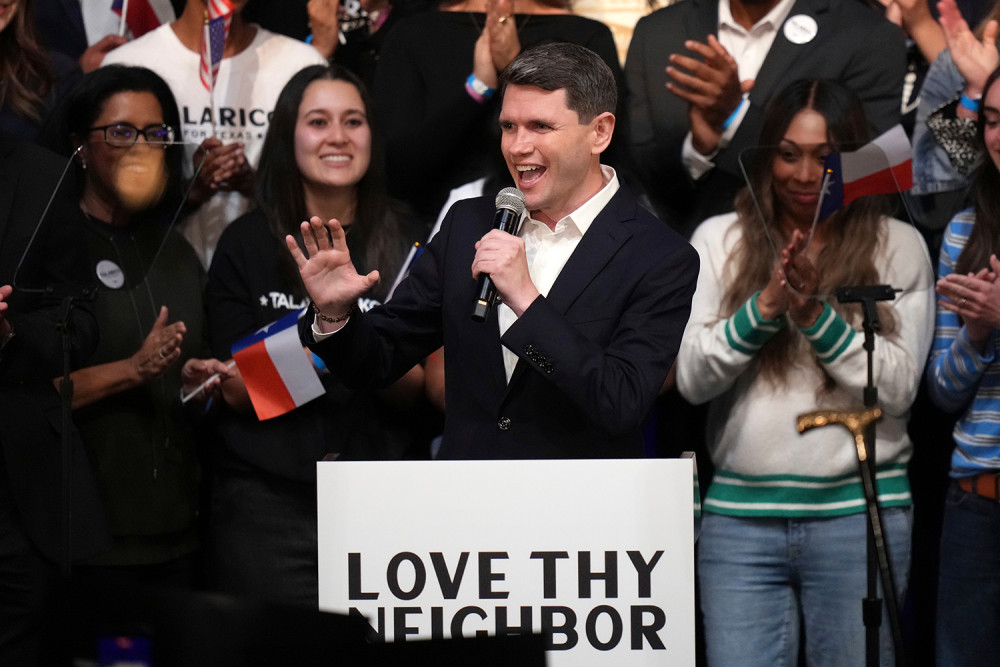
Asked Tuesday night about state Rep. James Talarico’s victory in the Texas US Senate race, Jim Rigby, who has long pastored the Presbyterian church Talarico grew up in, said he was still grappling with the moment.
“It’s just too surreal,” Rigby said, who was watching the returns from home. “It’s going to take a while to completely take that in.”
But Rigby also reflected on what he sees as the broader dynamic of election night, which saw Democrats such as Talarico—himself a Presbyterian seminarian—win sweeping victories across the country.
“There’s an awakening taking place,” he said. “It’s not even so much one religion as opposed to another religion, but an idea that everybody counts.”
The victories marked a striking moment for the religious left, which has long struggled to match the influence and visibility of conservative Christians. Across the country, candidates and faith leaders embraced a message that put values like compassion and inclusion at the center of their campaigns.
“Two thousand years ago, when the people at the top hurt his neighbors, that barefoot rabbi didn’t stay in his room and pray,” Talarico said in his victory speech, as he stood in front of a placard that read “Love Thy Neighbor.”
Jesus “walked into the seat of power and flipped over the tables of injustice,” he said.
In addition to Talarico in Texas, who made his religious beliefs a centerpiece of his campaign, Democrats saw a faith leader trigger an upset in the Kansas US Senate race: There, Adam Hamilton, who pastors a United Methodist megachurch, sailed to a resounding win in a state that hasn’t elected a Democrat to the US Senate since 1932.
Hamilton’s popularity—spurred in part by his church, which boasts more than 20,000 attendees on an average Sunday—was rooted in a centrist message intertwined with faith: While critical of incumbent Republican Senator Roger Marshall and President Trump, Hamilton has said he intends to lead from the middle and that he can work with colleagues on the other side of the aisle.
And while Hamilton’s campaign focused on economic issues, he also made a point to reference his faith throughout. During one of his final campaign events on Monday, the pastor cited scripture no fewer than three times in his stump speech.
Among the passages he referenced was Micah 6:8, which reads: “And what does the Lord require of you, but to do justice and to love kindness and to walk humbly with your God?”
It was a religious message that appeared in various forms among the nine pastors, former pastors, and seminarians who ran for Congress as Democrats this cycle. Still, Republicans and their religious allies tried to cast aspersions on the faith of the Democratic clergy and seminarians—for instance, framing their support for LGBTQ+ people as evidence that they weren’t true Christians.
At campaign events, the president dismissed Talarico as “Talafreako,” and called Hamilton a “possibly perverted pastor.” Vice President JD Vance suggested that Talarico is attracted to men and accused Hamilton of wearing the “skin suit of our religion”—referring to Christianity.
Robert Jeffress, a longtime Trump supporter who leads the megachurch First Baptist in Dallas, said in an interview last month that Talarico’s views “disqualify him from being a Christian, and especially a Christian pastor.” Kyle Lammott, who leads a church in Kansas affiliated with a conservative denomination known as the Communion of Reformed Evangelical Churches, condemned Hamilton in public letters and prayers, calling on him to “repent.”
The same pattern showed up in other races. In Iowa, Republican Joe Mitchell, who was running in the state’s second district, said his opponent, Presbyterian minister and state House member Lindsay James, was not a “real pastor.” He said the same was true of Sarah Trone Garriott, a Lutheran minister and state senator running for Congress in Iowa’s third district, and said neither pastor professes “the true gospel of Jesus Christ.”
But as results rolled in on election night, it became clear that the attacks didn’t work. Like Talarico and Hamilton, James and Garriott won their seats, too—both pickups for Democrats.
And religious Democrats keep winning: Frederick Haynes III, who leads Black Protestant megachurch Friendship-West Baptist Church in Dallas, was elected to be the next US congressman from Texas’s deep-blue 30th district. And Rep. Emanuel Cleaver, a longtime congressman in Missouri’s 5th congressional district, defended his seat. Along with Georgia Sen. Raphael Warnock, there will now be three Black pastors in Congress come January—all of them Democrats.
Meanwhile, Democrat Amy Acton was elected Ohio’s first Jewish governor, and Abdul El-Sayed, a Michigan Democrat, became the first Muslim US Senator in history. El-Sayed ran a campaign that did not shy away from his Muslim faith, despite being falsely cast as a “jihadist” by Trump.
“You might have noticed I always say ‘Inshallah,’ or God willing, whenever the outcome of this race is mentioned,” El-Sayed said in his victory speech. “Tonight, we can turn that ‘Inshallah’ into ‘Alhamdulillah.’”
As the crowd cheered, he added: “For the right-wing ops, that just means ‘praise be to God.’”
Not all of the faith-forward Democrats were victorious. Anna Golladay, a former Methodist pastor running as a Democrat in Tennessee’s third district, fell short. She faced long odds in the deep-red area, which has one of the highest percentages of evangelical Christians of any district in the country, according to a recent analysis by political scientist and researcher Ryan Burge.
Her opponent, incumbent Republican Rep. Chuck Fleischmann, who is Catholic, won a decisive victory.
Another democratic challenger, Robb Ryerse, a progressive evangelical running in Arkansas’s third district, lost to incumbent Rep. Steve Womack by nearly 13 points.
As the hours ticked by Tuesday night, the mounting defeats handed out to Republicans spurred elation among Democrats, and some expressed a sense of catharsis at finally seeing their own approach to faith reflected in the halls of power.
Among the crowd at a Texas Democratic watch party was Emma Borders, Travis County precinct chair 294 and Austin Young Democrats membership director. She is also a member of St. Andrew’s Presbyterian, Talarico’s church, and said his victory felt like an extension of a faith community she has come to know.
“They have a food pantry. They have a homeless ministry. They built showers into the church so people can come in and take showers, and we serve them hot meals,” Borders said, referring to St. Andrew’s.
When asked if the church embodied Talarico’s “love thy neighbor” platform, she said: “It is very much that way.” —Religion News Service
Ellie Ashby contributed to this story.