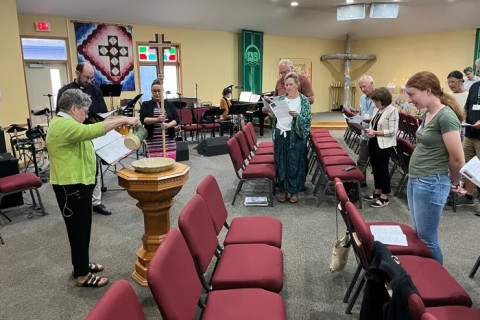
Barb Bowers and Sue Sachs are both longtime residents of Stevens Point, Wisconsin—a college town in the center of the state. And both are active in their church, Beloved Community, on the east end of the city. On a recent Sunday morning before the congregation’s 8:15 a.m. service, both were in the church’s kitchen area assembling finger food for post-worship coffee hour.
What may set the two women apart are their denominational roots—Bowers comes from the Evangelical Lutheran Church in America, while Sachs is Episcopalian—yet they and their congregation now blend both traditions. The former Redeemer Lutheran Church and the former Intercession Episcopal Church joined in October 2024 to become one Beloved Community. The congregation is officially Episcopal and Lutheran, part of both the Episcopal Diocese of Wisconsin and the ELCA’s East Central Synod of Wisconsin.
As Sachs removed grapes from stems and placed them in a bowl, she recalled the financial challenges at Intercession Episcopal Church that prompted the two congregations’ initial partnership. “We could not afford to maintain our church,” Sachs said, and at that time, in 2017, Redeemer Lutheran Church was looking for a new pastor.
“Redeemer needed some help, and we needed some help,” Sachs said. Intercession’s rector, Jane Johnson, agreed to serve both congregations, and Redeemer invited Intercession to worship in Redeemer’s building.
Combining their congregations was possible because the ELCA and the Episcopal Church have had a full communion relationship for 26 years, meaning the two denominations are able to share clergy and worship together. Beloved Community also is one of a growing number of blended congregations, sometimes referred to as “Lutherpalian,” that are finding ways to survive and even thrive by drawing on both churches’ traditions.
“I was comfortable with pews and kneeling and all of that good stuff,” Sachs said of her past experience attending Episcopal services. Beloved Community now offers an early service that is mostly based in the Episcopal Church’s Book of Common Prayer Rite II for Holy Eucharist, followed by a late-morning service that is more Lutheran and more contemporary. Total Sunday attendance averages about 80 a week.
The initial transition was “very difficult” for Sachs, but “I’ve totally settled in now,” she said. She has made friends with members of the former Redeemer congregation.
The blending of Episcopal and Lutheran congregations spans the United States, from Epiphany Lutheran-Episcopal Church in Valdez, Alaska, to Lamb of God Church in Fort Myers, Florida. Some date back more than two decades. There is no precise record of all the Episcopal and Lutheran congregations engaged in various levels of collaboration under full communion, though the number of combined congregations is a more defined and much smaller subset.
The most recent list maintained by the ELCA on cooperative agreements, as of 2025, counts 16 “federated” Lutheran-Episcopal congregations and eight “union” Lutheran-Episcopal congregations. Federated is defined as two congregations that remain separate entities but function as one church for worship and to conduct other activities together, while union congregations are single entities and members of both denominations.
The breadth of these joint congregations likely is not fully represented even by the ELCA’s 2025 list. Beloved Community, for example, is not yet listed there. The number, however, appears to be growing—up from 14 federated and union Lutheran-Episcopal congregations listed in 2017.
Leaders of other merged congregations said the decisions to combine often were rooted in practical concerns about both congregations’ viability, and now they happily identify as both Episcopal and Lutheran.
“We’re coming to a point where we can do so much more together than we can separately, and I think we’re better when we can learn from each other,” said Joyce Partyka Staib, pastor of Spirit of Grace Church in the Detroit suburb of West Bloomfield, Michigan.
Like Beloved Community in Wisconsin, Spirit of Grace Church has a foot in both denominations, as a member of the Episcopal Diocese of Michigan and the ELCA’s Southeast Michigan Synod. Spirit of Grace was created about a decade ago when an Episcopal congregation needed a new worship space and arranged to share the facilities of a Lutheran congregation.
After initially worshipping separately at different times on Sundays, the two decided to try worshipping together. They discovered they enjoyed the joint services, and “at the end of the summer, they didn’t want to separate,” said Staib, who was ordained in the ELCA and has led the combined congregation for the past three years.
Spirit of Grace is listed as a federated congregation and makes decisions as one body. “I am their first jointly called pastor,” Staib said. There are some differences in the polity and governance of the two denominations, but their theologies are quite similar, she said.
Spirit of Grace worships at one Sunday service that combines the two traditions. “In my experience, it’s really not difficult to do that because they’re really not that different from each other,” Staib said.
Other joint Episcopal-Lutheran congregations still try to offer members elements familiar from both traditions. One example is the Church of the Nativity and Holy Comforter in Baltimore, Maryland, which describes itself as “an Episcopal-Lutheran community.”
The Episcopal Church of the Nativity and Lutheran Church of the Holy Comforter became a federated congregation of both denominations in 2018, and since then, they have worshiped as one. The 8 a.m. Sunday service mostly follows the Episcopal Church Book of Common Prayer’s Rite I for Holy Eucharist “with a few Lutheran embellishments,” said Annette Chappelle, the church’s bridge pastor. The 10:30 a.m. service is larger and follows a liturgy that is about half Episcopal and half Lutheran.
Blended liturgies are just right for this blended congregation. “I think many of the people in the congregation by now pretty much regard themselves as ‘Lutherpalians,’” Chappelle said.
Sachs and Bowers credit Johnson for her leadership in bringing the two congregations in Stevens Point together as Beloved Community. “She has done an amazing job,” Sachs said.
For a merger like this to work, “you have to have the right council, vestry, congregation, as well as the leader,” Bowers said, as she rolled deli meat and arranged it on a plate for coffee hour.
Before the merger that formed Beloved Community, Intersession Episcopal Church’s building had been in serious need of repair, and the members began discerning whether investing in the old building was really how God was calling them to use their time and money.
Intersession already had a relationship with Redeemer Lutheran Church; Johnson had been leading a regular Wednesday night meal and Christian education session with members of both congregations. The two churches reached an agreement to share Johnson as rector-pastor and to allow Intercession to share Redeemer’s church building starting in August 2017.
The two congregations gradually grew closer to the point that, two years ago, they were ready to formally become a union congregation. They haven’t tried to erase the old Episcopal and Lutheran identities, but rather are incorporating both into their worship and ministries together.
“Humanity does the parsing out, not God,” Johnson said.
After decades of ecumenical dialogue, the Episcopal-Lutheran full communion agreement, “Called to Common Mission,” was adopted by the ELCA’s General Assembly in 1999 and by the Episcopal Church’s 73rd general convention in 2000.
“Our churches have discovered afresh our unity in the gospel and our commitment to the mission to which God calls the church of Jesus Christ in every generation,” the agreement’s introduction says. Now more than two decades later, the two churches are still finding new ways of living into that call.
In the Episcopal Diocese of Maryland and the Delaware-Maryland Synod of the ELCA, Nativity and Holy Comforter are among at least a dozen active partnerships between the two denominations. Such efforts have been encouraged by Episcopal Bishop Carrie Schofield-Broadbent and Lutheran Bishop Bill Gohl.
“Congregations and communities remain committed to come together to address pressing concerns including racial reconciliation, poverty, care for creation and most recently housing justice,” Schofield-Broadbent said in a recent diocesan article about the Episcopal-Lutheran partnerships.
“Unity in Christ is both a gift and a calling,” added the Rev. Kristofer Lindh-Payne, the Diocese of Maryland’s canon to the ordinary for leadership. “Christian unity is not simply something we hope for in the future. It is something we can live into today – through friendship, shared ministry, worship and service.”
And even at a church like Nativity and Holy Comforter, which has brought Episcopalians and Lutherans together for years to worship as one, differences persist. Communion elements include the option of either wine following Episcopal practice or grape juice, which is a Lutheran option, Chappelle said, and the two denominations have different rules for lay Eucharistic ministers.
But these are not major stumbling blocks. “We just get through it with goodwill and talking our way through it,” she said.
In Stevens Point, during the coffee hour between Beloved Community’s two services, members of the congregation spoke of their own work in drawing the two congregations together.
“It’s been a wonderful thing for us,” Harry Rice, 78, said. He had been a member of the Episcopal congregation and now thinks the combined congregation has more energy, more people connecting with each other.
“There are challenges whenever you make a change in any church,” he said, but Beloved Community has done well so far as one congregation.
Stan and Ann Carlson agreed. They were longtime Intersession members—for 52 years—and have remained active in Beloved Community.
“It’s been a really good fit,” Ann Carlson said, and whether Episcopalian or Lutheran, the church’s members “all worship the same God.” —Episcopal News Service