Early this year, the US military’s capture of Venezuelan leader Nicolás Maduro made international headlines. Months prior, the United States prepared for this action by beefing up its military presence in one of the country’s most strategically located territories in the Caribbean: Puerto Rico, which is less than 500 nautical miles from the coast of Venezuela. Puerto Rico has become—once again—a military stronghold for the US, this time as part of President Trump’s effort to gain control over economically and politically valuable portions of the Western Hemisphere. This summer, the US again increased its presence there amid tensions with Cuba.
Puerto Rico is the world’s oldest colony: It has been under continuous foreign rule for more than half a millennium. Christopher Columbus first landed on Borikén—the name given to the island by its Taíno inhabitants—on November 19, 1493. Puerto Rico soon became a colony of Spain and remained so for 400 years. In 1898, it instituted a more autonomous form of government, in cooperation with Spain. But later that year it was surrendered to the US, along with Guam and the Philippines, effectively ending the Spanish-American War.
Recently, the sights and sounds of military aircraft have become more frequent in Puerto Rico’s blue skies. In the second half of 2025, both Ramey Air Force Base in Aguadilla and Roosevelt Roads naval base in Ceiba were reactivated after being closed for decades. The US military now actively occupies five different locations across an island of just 3,500 square miles. Puerto Rican political leaders have emphasized that the reopening of the bases means increased economic opportunity and stable employment for residents. Indeed, many Puerto Ricans recall a time when these bases brought stable employment, commerce, industry, and educational opportunities to their communities.
But for whom, and at what cost?
The history of modern Puerto Rico is inextricably intertwined with the US military industrial complex. In 1917, Puerto Ricans were granted a limited form of citizenship through the passage of the Jones-Shafroth Act, enacted at the height of World War I. It remains in place to this day. Pedro Albizu Campos—a Harvard graduate, World War I veteran, and fierce advocate for Puerto Rican independence—argued that the US did this because it needed more soldiers, who it soon began conscripting. He urged Puerto Ricans to resist this yanqui citizenship that required them to fight foreign entities on behalf of a colonial power.
Generations of men in my family served in the military. Here’s what I know, though it’s piecemeal: My great grandfather, Asisclo Lizardi Lebrón, born in Caguas in 1878, signed his draft card in 1918. I do not know whether he served. My grandfather, Fernando Lizardi Tabernas, born in Cayey in 1907, signed his World War II draft card in 1940 but was never drafted. He had served in the army in his younger years and been honorably discharged. My uncle, Robert Lizardy (notice the “Americanized” spelling change of the last name), born in New York City in 1933, served in active duty in Korea; at his funeral in the early 1990s, his military flag was presented to his life partner, my Uncle Freddy.
My father never served. Still, for him, as for my grandfather and uncle, military service was what solidified one’s status as an American or, at minimum, visibly expressed one’s loyalties to the US. Part of the American dream required giving one’s body (if not mind and soul as well) in defense of a nation that had not—that still has not—granted Puerto Rican residents full voting rights. Journalist and scholar Ed Morales writes in Fantasy Island that his own family’s military service formed in them “a kind of dual allegiance, with the benefits of the military safety net and its legitimizing stamp on the one hand and Puerto Rico’s national identity and culture on the other.”
I suspect that many of us with racially marginalized identities have complex family histories regarding military service. Empires generally see human costs as more tolerable than financial or political costs, and they don’t tend to discriminate when it comes to recruiting bodies to labor for their cause. Indigenous people have served in the US military for more than two centuries, both in integrated and segregated units. Many Puerto Ricans of African descent were placed in racially segregated units alongside Black soldiers from across the US. There is often a great sense of pride and honor in serving one’s country in the name of its values and ideals—in the US, those include freedom, equality, and justice. But for many individuals, these rights were not fully promised or granted even in the midst of their honorable service.
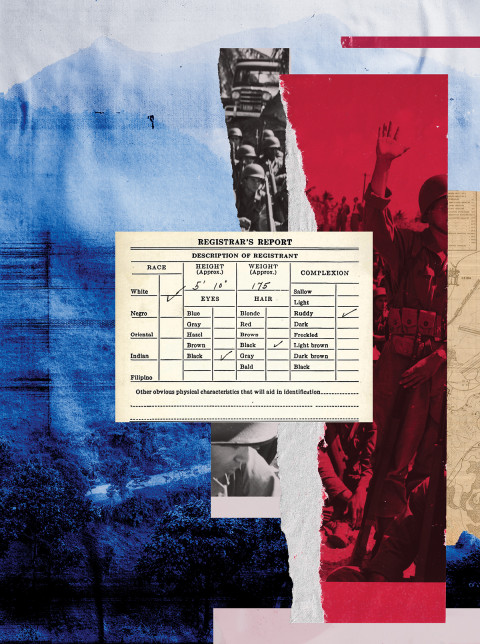
Years ago, I found my grandfather’s draft card on an ancestry website. On the back, two peculiar demographic headers scaffold more mundane details of physical appearance such as height and weight: race and complexion. The racial categories include White, Negro, Oriental, Indian, and Filipino. There is no category for anyone from the Caribbean or from Central or South America, so the check mark rests just below White, edging into Negro—neither this nor that, but somewhere in between. The complexion categories include sallow, light, ruddy, dark, freckled, light brown, dark brown, and black. My grandfather is clearly marked ruddy.
How was light distinguished from ruddy or sallow or freckled? How was dark different from dark brown or black? What constituted light, if not sallow? I imagined all those men, waiting in lines to be defined by their appearance, which also determined their assignments if they were drafted. I wondered what my grandfather thought and felt at that moment. By 1940, my grandfather identified himself as Fred Lizardy, not Fernando Lizardi Tabernas, perhaps hoping this would secure him a slightly more favorable rung on the ladder of colonial racial ordering.
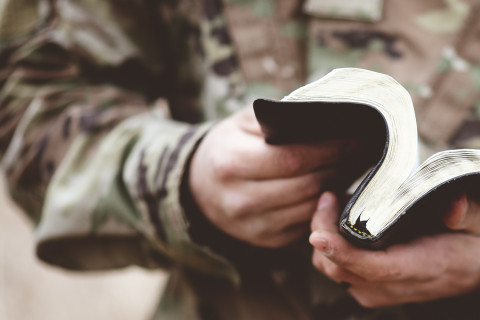
The desire to serve one’s country—as fraught as the notion of country is for Puerto Ricans—is further complicated by religion. “For God and Country,” from the Latin Pro Deo et Patria, is still the motto of the US Army Chaplain Corps; it’s also the founding principle of the American Legion, the government-chartered veterans service organization. Of course, the intertwining of religion and military might long precedes the US, and it is not unique to Christianity. But the Christian faith dominates modern US militarism, and Christian nationalism is present within current military culture.
Puerto Ricans, both on the island and in diaspora, possess deep roots in both Catholicism and evangelicalism. This is a result of conquest and missionization, much of which has been subject to these religio-nationalistic confluences in the US.
Still, given the human and environmental destruction past military activities have wrought on Puerto Rico—perhaps most notably the explosives testing operations on and around the tiny Puerto Rican island of Vieques from 1941 until 2003—many Puerto Ricans are less than thrilled about this recent buildup of force. Islanders have staged protests, just as they have always done. Trump clearly sees Puerto Rico as a strategic military outpost—the flight carrying Venezuela’s Maduro even stopped at the air force base in Aguadilla on the way to New York—and this increased militarization signals that the US is doubling down on keeping Puerto Rico as a colony in perpetuity.
Puerto Ricans have a proud history of fighting against imperialism—from the tribes who resisted the conquistadors in the 15th century; to defiant displays of the Puerto Rican flag, banned by the US government from 1948 to 1957 to quell independence movements; to the rise of the Young Lords in the 1960s and 1970s; to the occupation of the Statue of Liberty in 1977; to protests that eventually ended military operations on Vieques in the early 2000s. The only time in history that the US bombed its own citizens was in Puerto Rico in 1950, part of an effort to suppress revolutionary activities on the island.
Over the last 125 years, the US government has created legislation at every turn to limit the economic, political, and environmental freedoms of Puerto Rico and its residents, including tax laws bringing benefits only to US mainland investors and the post–Hurricane Maria privatization of the energy infrastructure, which has been nothing but disastrous for Puerto Ricans. Militarization is only one component of the larger project of colonization, a never-ending hurricane wrought by a US government that relies on the corruption and co-optation of local authorities and federal laws at the expense of self-determination, cultural reclamation, and justice.
The Puerto Rican independence movement has gained renewed momentum in recent years, both on and beyond the island. Younger people are taking up the struggle from previous generations, particularly through the rising influence of the Puerto Rican Independence Party, whose core principles are self-determination, economic development, cultural preservation, democratic values, and environmental stewardship.
Most non-Latines in the US are unaware of Puerto Rico’s history and its present struggles for dignity and justice, but we Puerto Ricans know our history. Whether we are islanders or diasporans, our focus now is on our legacy. What will the Puerto Rico of the present and future be? How are we working collectively toward decolonization? Communities of faith can play a role in this work, coming alongside those who have been in the struggle in order to lend support, amplify voices, create greater awareness, and resist. They can become more attuned to the continuing colonizing actions of the US and join in the struggle for greater self-determination for all who continue under colonial rule, including Puerto Ricans and Indigenous peoples throughout Turtle Island.
For those of us with complex histories of military service and a culture of militarization within our families and cultures of origin, any espoused commitments to God and country require us to challenge our nation to make good on the values it claims. Part of being a citizen—with or without full citizenship rights—includes holding ourselves and our institutional structures accountable to those same values. I know that my own ancestors would ask for nothing less from me, a US citizen with no limits, a biracial Puerto Rican with a terminal degree, and a member of the clergy. Because of the discrimination they endured throughout their lives—without and within the military—and the discrimination I and so many others continue to experience today, I can do nothing less.
This article was produced in partnership with the Narrative Project, an initiative of the century.