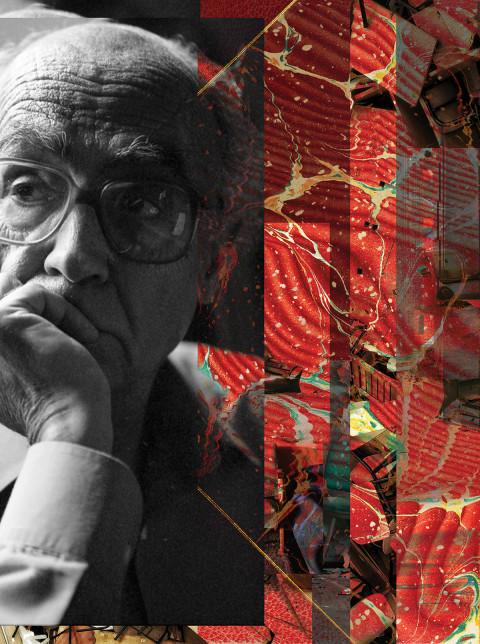
There’s little in my digital footprint and less in my reading habits that could have led me to certain writers I now read with slow fascination. José Saramago is one of them. The man’s narrative gaze should have seemed too dour and hopeless for my constitution. In the novels I have read, Saramago rolls out plots possessed by characters that seem more summoned than drawn, and with patience they trap you deep into fictive hypnosis. Beneath it all, coursing in the plasma of his compelling storywork, is a deadpan disdain for the supernal and scorn for the very idea of revealed scripture, prophetic luminaries, and hope in the great and vast unseen. These are things I have not given up on and don’t see myself doing so.
But despite Saramago’s nihilism, I can’t stop reading him. And there are good reasons for this.
To confess, I had never heard of the late Portuguese writer until I walked into a now bygone Borders bookstore in Chicago many years ago, around the time monetize stormed our modern vulgate and enrolled us into a digital partnership with money culture. In the front of the store, I saw on display Saramago’s thinnest book, with a cover caricature of a woman bulging breast-deep in a sea, a ship full of tall trees resting on her behemoth and misshaped head, and closed eyes. Above the ship were words that have a way of trip-wiring primeval escape conjurings. I had no choice but to pick it up.
The Tale of the Unknown Island, the ideal shelf-leaner and Saramago starter, begins as simple as a story can get: An unnamed man knocks on one of the doors of the king’s house, and the unnamed king ignores the knocks by pretending not to hear. But the man doesn’t stop, and his knocking grows louder, until the king, embarrassed by the noise, fearing it may make him seem weak, finally asks his “first secretary” to handle things. Saramago goes on:
Then, the first secretary would call the second secretary, who would call the third secretary, who would give orders to the first assistant who would, in turn, give orders to the second assistant, and so on all the way down the line to the cleaning woman, who, having no one else to give orders to, would half-open the door and ask through the crack, What do you want.
Never a question mark or a quotation mark for Saramago. You get used to it. As it turns out, the cleaning woman and the man who knocks are at the center of the story. They are the island seekers, and all the man wanted was a boat.
So it began: an allegory of fraught escape from crippling apathy and wounded conscience, along with my 20-year association with the works of the Nobel Prize–winning writer, who died in 2010 as a committed atheist. The discovery was fronted by a soft-lit bookstore with some world music playing above and a congregation of reasonably polite people observing the pieties of a temporary book culture. It’s an interior setting that draws people to bookstores in the first place and seduces us into thinking, for a sublime hour or two of random browsing and smiling at strangers for no reason, that the world outside is doing just fine.
But the world is not doing fine. People who live with their eyes open would probably agree. For those serious enough to confront our active dystopia and seek out its disguises and hideouts, there are plenty of writers to consider for inspiration. They are a covey of disruptive writers, seemingly raised or revived in every generation, who offer up fiction to tell us what’s terribly off with our nonfiction world; they are artists who ring their warnings as a tithe for their gift of uncanny storytelling.
Saramago’s observations ring true not because he is right about God but because he is right about religion’s terrible entanglement with political power.
Through top-shelf absurdity, fantastical plots, and enchanted magical realism, their artistry shows us indirectly (as if there’s a better way) how new moods, groupthink, and moral sloth can move into souls and societies like imps; how, without perceivable ruptures, they become accepted, defended, and celebrated by important parts of elite society.
Even activists, those who fancy themselves as off the grid and ostentatiously progressive, shapeshift into vanguards of newly minted norms, norms sprung upon us with breakneck celerity and hurriedly let in without the dignity of a safe and open public debate. Whenever something new catches the attention of public discourse, we are often pressured to accept it, as if our liberal credentials are at stake—most of us coerced into a line dance of performative enlightenment and mental routines that become so normalized we don’t notice the coercion.
Saramago’s critiques land serious body blows to religion, and to the Catholic Church in particular. But his observations are valuable to me because his diagnoses of the malaise of the modern world—the indomitable rise of unfaithful power structures (religious or secular) and savage money appetites—all ring true. His critiques are devastating because his plots are beautifully strange, and they slowly make legible the wordless conditions that leave us with vague feelings of resignation. So, over time, I found myself reading him not less but more. This is where things get complicated for a reader like me. I am a Muslim who studies religion academically and practices it personally. So reading Saramago over the years created a surface tension: how an atheist Nobel laureate and critic of religion became one of the most meaningful literary companions in my spiritual thought life.
Saramago’s observations ring true not because I believe he is right about God but because he is right about what sanctimonious religious institutions and silver-tongued clergy so often become: instruments of the very material domination they were charged to oppose. Religion is not only ritual and creed. It is a perch of social critique and advocacy, a point of view rooted in the sacred that fearlessly calls out the systems of wealth and the cosplay of faith that leave good people manipulated or in hiding. But that perch has been terribly hobbled by its entanglements with political power—never more visibly than now, as thespians of end-times prophecies tilt a nation toward corrupt war in the Persian Gulf. The megachurch, the Christian Zionist complex, the misguided reform movements of Muslim milieus I have spent years researching—these are not perversions of religion so much as its recurring temptation: charismatic authority veiling the original gaze and spark of the whole religion project, mistaking performative rigidity for right guidance and petrol dollars for comfort pets.
The plot of Saramago’s novel The Cave is the clearest map of what I mean. The story follows Cipriano Algor, an aging potter of modest livelihood. He lives with his daughter Marta and son-in-law Marçal in a small village. His living relies on a kiln and his handmade ceramics, which he sells to the Center, a sprawling new commercial and residential complex that signals modern advancement and enlightened living.
The Center abruptly informs Cipriano that his wares are no longer wanted. Plastic figurines, produced in a factory, are cheaper, lighter, more uniform. And best of all, no signs of human hands. The decision arrives without malice or explanation; it is presented as simple fact in the evolution of commerce. Handicraft is not outlawed; it is rendered obsolete. What is displaced is not only Cipriano’s pottery but the very logic by which value, usefulness, and progress are understood. Anything newer, cheaper, smoother, and mass-produced is, by epistemic presumption, better for everyone.
What keeps the novel from becoming a polemic is Saramago’s deliberate restraint and his subtle centering of a love story that sneaks up on the reader. Cipriano falls for a widow named Isaura. Their bond grows through small acts: conversation, silence, a mutual awareness that they are both remnants of a world the Center has rendered primitive. The love between Cipriano and Isaura embodies a decidedly anti-Center aesthetic: the relationship is too slow, patient, reciprocal, and embarrassingly human for the Center philosophy.
When Cipriano and his family eventually move into the Center, the shift is not merely spatial but epistemic: life reorganized around prefabricated yearnings and managed realities. Nothing is coerced. Everything is encouraged. No one in the novel is evil, and yet everything is terribly off. This is what makes The Cave so unsettling, so honest. There’s no epicenter or villain. It is an indictment of our shared complicity in systems that present diseases as inevitabilities—as progress.
Reading Saramago, like reading Edward Said’s scholarship, clarifies something. Two sides of the same coin, they both refuse to quarantine political and economic domination inside history, as if it were a settled archive and not a living cognitive threat. I have learned that The Cave is not a metaphor for other people’s failure to see. It is the passive purchase of our condition, and naming it, from whatever coordinates you occupy, is the whole of the prophetic task. My coordinates are not neutral. I am heartbroken by ethnic cleansing and genocide, by wars prosecuted with eschatological self-assurance and managed by magnates of unearned privilege who confuse certainty with wisdom. Against all of that, a Portuguese atheist and the character of an aging craftsman and the love of his life remain, for me, clarifying company—just like Saramago’s unnamed island seekers in The Tale of the Unknown Island.
Just to recall, the only thing the man wanted was a boat. Me, too.