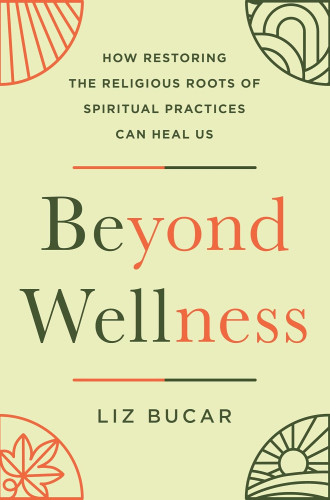
Beyond Wellness
How Restoring the Religious Roots of Spiritual Practices Can Heal Us
Spiritual but not religious. It’s been a truism for at least two decades: the rise of a cohort of people who are unaffiliated with any historical religious tradition and yet drawn to practices that offer an entrée into transcendence, or simply a way to feel more fit and whole. In Beyond Wellness, Liz Bucar argues that if the people who take up these practices go deeper—deep enough to understand their religious roots—they will find that the practices do more for them and ask more of them.
Bucar addresses seven practices many of us will recognize from contemporary culture: yoga, mindfulness meditation, twelve-step programs, religious foodways, fitness activities like SoulCycle, sound baths, and psychedelics. Each chapter opens with an overview of how the practice appears in American life. Some—like yoga—Bucar already engages in; the rest she takes up herself for at least a season. She then investigates how each practice has roots in a religious tradition or sensibility, and how popularizing the practice obscured that tradition. Her introduction frames this as a three-step process: learn how a practice’s religion was hidden from its practitioners, restore it by reconnecting the practice to its traditional meaning and communities, and apply those insights to our lives. The book, Bucar promises, goes deeper than the wellness these practices offer, pointing instead toward well-being—something that requires “conviction, discipline, and community.” In short, religion.
Each chapter stands alone, connected only by the book’s introduction and conclusion, and each offers an intriguing look at its practice—especially the history by which the religious roots were obscured. Bucar’s treatment of yoga traces how South Asian religion vanished from the American understanding of the practice; she examines Sedlock v. Baird, the 2013 California case (upheld on appeal in 2015) that found the yoga taught in one school district to be secular, with no religious underpinnings. For Bucar, this demonstrates how thoroughly Americans equate religion with belief rather than practice. She shows instead how yoga inculcates religious understanding through posture and stance, a reading the ritual theorist Catherine Bell would endorse.