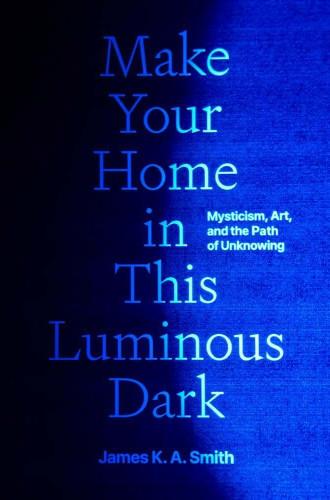
Make Your Home in this Luminous Dark
Mysticism, Art, and the Path of Unknowing
As a former Twitter obsessive, I vividly remember the weeks after I deleted social media for good. I read books in one sitting for the first time since childhood; I felt binary extremes fade from my mind; and a deeper peace settled over me. Reading Make Your Home in This Luminous Dark, I found myself thinking of those weeks and what it meant to rediscover attention and calm. Philosopher Jamie Smith takes on the spiritual malaise of our day—extremism, anger, loneliness—and turns to the timeless wisdom of Christian mysticism. Ultimately, he argues, we need to let go of black-and-white absolutes and dwell in the serenity of the luminous dark that faithful unknowing can bring. Yet frustratingly, with his own stark dichotomies between mysticism (good) and reason (bad), Smith doesn’t quite escape the problems he so well diagnoses. What results is a book that wavers between dazzling and disappointing.
The core of Make Your Home is its faith in the value of mysticism, rooted in Smith’s own life story. As a philosopher, Smith spent most of his life honing fine-pointed distinctions and ultra-abstract arguments. Then he went through a period of depression, and all his knowledge was no help at all. Instead, he found solace in his family’s support, as well as in the Christian mystics, who spoke of unknowing, of the powerful places that lie beyond human reason. It’s a moving, vulnerable conversion story from a lifeless philosophy to one that breathes, or, in Smith’s words, a journey from “either-or” philosophy to “both-and” mysticism. Smith learned to trust in humility and intimacy rather than mastery and analysis.
Read our latest issue or browse back issues.
Now, Smith wants to bring “a mystical attunement back to philosophy.” He admires philosophers like Edmund Husserl but draws more from Christian mystics like Teresa of Ávila, as well as artists of all stripes. Smith makes a compelling case that philosophy has been too narrow-minded. A good painting can teach just as much as a Platonic dialogue, so why don’t we value both as sources of wisdom? And Smith practices what he preaches. Academic philosophy can sometimes treat gorgeous ideas with the dull prose of a science textbook, but Smith’s writing flows smoothly. Sometimes he is elated over love (where “subtraction is gain”), sometimes caught in tranquil wonder over our “infinite cosmos.” Make Your Home demonstrates that the mind cannot flourish without the heart.
Through this mystical lens, Smith powerfully confronts the most pressing problems of our age. On polarization, he counsels that “being right is a sorry substitute for being loved.” On social media: “No one ever finds wisdom by doomscrolling.” On the tech algorithms hijacking our lives: We should never let our attention be “bought by venture capitalists.” In case after case, Smith shows how much of what ails the modern world is spiritual. Mass production and commercialization in the internet age have alienated us from each other and from ourselves. Still, he believes, it is always possible to seek after the same “darkness” the mystics sought, a space in which knowing gives way to a deep unknowing and love rules all.
Unfortunately, Smith’s zeal against the philosophers goes too far. He rightly criticizes philosophy for its inability to admit the limits of human knowledge. But he veers dangerously close to relativism, casting doubt on the law of noncontradiction (the principle of logic which states that if something is false it cannot be true). Yes, we are finite and error-prone; yes, we seek a God beyond our knowing; but can truth really be falsehood and falsehood truth? Smith rails against philosophy because it “polices knowledge,” but when alternative facts and conspiracies abound, might there be some value in policing knowledge? At times, Smith borders on anti-intellectualism, simply taking it as given that “either-or” reason is mistaken. Mind without heart is dangerous, but so too is heart without mind.
Here, Smith also misunderstands the mystics. Philosophy, Smith says, forms a false binary between true and false, right and wrong, while mysticism embraces contradictory ideas with ease. But the mystics do not view things so starkly. Historically, mystics and philosophers were allies. Catherine of Siena, for example, drew heavily on Thomas Aquinas, who may as well be the prince of either-or rationality. Thomas, for his part, cites the mystic Pseudo-Dionysius more than almost any other theologian. Some people naturally feel more drawn to reason and others to contemplation, but the luminaries of church history recognized that we need both to better love God and one another. Likewise, Smith casts doubt on “dogmatic” thinking, but the mystics he cites most (John of the Cross and Teresa of Ávila) were doctors of the church who vigorously defended Catholic dogma. Their mysticism didn’t emerge fully formed; it grew from the soil of church teaching. And at that—who’s to say that mystics like Catherine and Teresa aren’t philosophers? In drawing an ironclad line between either-or and both-and, Smith has created a false binary of his own.
That’s a shame, because Smith’s talents are rare: he is vulnerable, charitable, and humble in an age that is none of those things. His experiences have brought him a great deal of wisdom, and at its best his book is a beautiful and profound counterweight to the cynicism of our times. Make Your Home in This Luminous Dark is worth reading for these very qualities. Yet balance, too, is a virtue. The world does need more comfort with uncertainty, more tranquility, and more love. But it also needs more careful thinking, more care in separating true from false, more cool heads to prevail when anger and fear steer us wrong. The story of mysticism is more complex than Smith’s telling. And in its complexity—where reason and contemplation, analysis and silence, heart and mind come together—is a home for us all.