

Voices

American Decius

The Roman emperor staged a patriotic revival to win back the gods’ favor. The empire fell anyway.

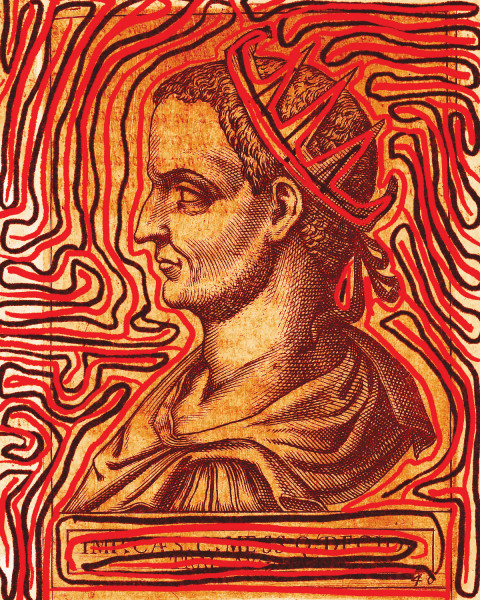
In 250 CE, the Roman Empire was under strain, burdened by the constant need to defend its expansive frontiers. The population was frustrated by the cost of goods and the cost of the legions sent to defend the borders. But Emperor Decius blamed the civic discontent on something else: the disfavor of the Roman gods. He believed the gods were particularly displeased by those who practiced the Christian faith, a new religion that, while illegal, had been tolerated by recent emperors.

With the millennial anniversary of Rome’s founding at hand, Decius launched a campaign to revitalize Roman patriotism and idealize the city’s past. The people were summoned forth for religious rituals, required to offer sacrifices to the gods of the empire, for which they would receive a libellus—a certificate of compliance. Through his campaign, Decius believed the glories of Rome would be remembered and the favor of the gods restored.

This year the United States celebrates the 250th anniversary of its independence from Great Britain. A bipartisan committee established a series of celebrations and concerts across the nation. In my own town, the public library is holding a series of lectures and book studies, including a retrospective about American enslavement of Africans and an evening of Native American storytelling. The series examines the whole scope of American history, not just the glorious or proud.


The US president, however, was not content with these celebrations of America’s diversity and remembrances of the complexity of its history. He scheduled his own concert. He planned a cage fight on the White House lawn, angled to put his countenance on a commemorative $250 bill, and determined to build a Roman-style triumphal arch in Washington.

His administration organized Rededicate 250, held in May on the National Mall. Given the First Amendment, one might have expected the faith-themed event to be ecumenical and interfaith. Instead, it was a specifically fundamentalist Christian event, emphasizing America’s Christian roots and petitioning God’s blessing on the nation.

The administration takes pains to tell the story that the United States was founded as a Christian nation, despite the fact that the Constitution states otherwise. A multimillion-dollar ad campaign revised manifest destiny, the contention that it was God’s will that 19th-century White settlement press from sea to shining sea. Those in power have stoked White Christian nationalist fervor, which is embraced by some who are eager for a story of innocent American foundations.

But the truth always abides. The world has seen plenty of colonial powers, Robin DiAngelo observes in Nice Racism, but the United States is the only one founded on the claim that that all men, self-evidently, are created equal. This claim has inspired and haunted us ever since. As DiAngelo notes, we’ve attempted to reconcile our claims to human equality with evidence to the contrary—the enslavement of Africans, the erosion and attempted extermination of the Indigenous population—by relegating these inequalities to the distant past, without tracing that past into the present and fully accounting for it.

The administration and its supporters would not need to try so hard to ignore the ghosts of the past if they were not haunted by them. Heather McGhee describes the situation as one in which the United States bears “the moral cost of racism,” which causes “contradictions and justifications, feelings of guilt, shame, projection, resentment, and denial.” She notes that all Americans pay for White Americans’ moral conflict. In the past two years we have paid with the reelection of a blatantly racist president who has done exactly as promised via executive order and a Supreme Court he had already stacked: enact a cruel campaign of immigration enforcement, seek to end birthright citizenship, and gut the Voting Rights Act. Some Americans celebrate this; others have been caught off guard, struggling to believe that civil rights and habeas corpus could be so easily eroded.

In the long run, the campaign to ignite patriotic fervor will probably prove about as successful for Trump as it did for Decius. The emperor ignored important demographic and economic facts. He did not understand the depth of discontent among the populace. He underestimated the number of Christians and the strength of their commitments. Persecution of those Christians continued under Valerian and Diocletian, who like Decius were trying to gain the favor of the gods.

But by 313, Constantine had granted religious freedom in the empire. By 330, he had relocated the imperial capital to Byzantium. Theodosius I made Christianity the imperial religion in 381. The city of Rome fell to the Vandals in 455, and by 476 the Western Roman Empire collapsed altogether. Decius did not prevail in the long run, but nevertheless, great numbers of people suffered during and after his reign. Christians were arrested, tortured, executed. But this also served to produce a cult of martyrs, and to strengthen Christian conviction.

In the near term, many Americans are going to suffer from these ongoing attempts at political disenfranchisement. While the excesses of the fall and winter’s deportation campaign are no longer in public view, they continue. The Supreme Court has yet to rule on birthright citizenship. An administration with no qualms about atrocities will commit more.

But we have also seen citizens rise up to protect their neighbors and resist authoritarianism. I serve a church jurisdiction that includes Minnesota, where our ecumenical Christian witness has only been strengthened. As we meet this moment, we can learn the lessons of the past. 

Stephanie Perdew

Stephanie Perdew (Cherokee Nation) is director of the Damascus Project, the theological education ministry of the Wisconsin and Minnesota Conferences of the United Church of Christ, and affiliate professor of Christian history at Garrett-Evangelical Theological Seminary.

All articles »
