

The United States is about to mark 250 years of independence. And with our institutions and our global dominance seeming to teeter more than they have in my lifetime, I’ve been focusing on what I think of as my Ken Burns patriotism: I love jazz, baseball, Union generals in the Civil War, national parks, the civil rights movement. I love local public libraries, a legacy of America’s unique strain of do-gooding busybodies who wanted everyone to read. I love our literary tradition, which isn’t centered in one or two big cities, a dominant ethnic group, or the social elite but reflects and refracts our intrinsic hybridity. I love the Reconstruction amendments to the Constitution, with their lawyer’s theology of universal freedom, citizenship, and access to the franchise. And I love our rich and diverse legacy of weird Christianity.
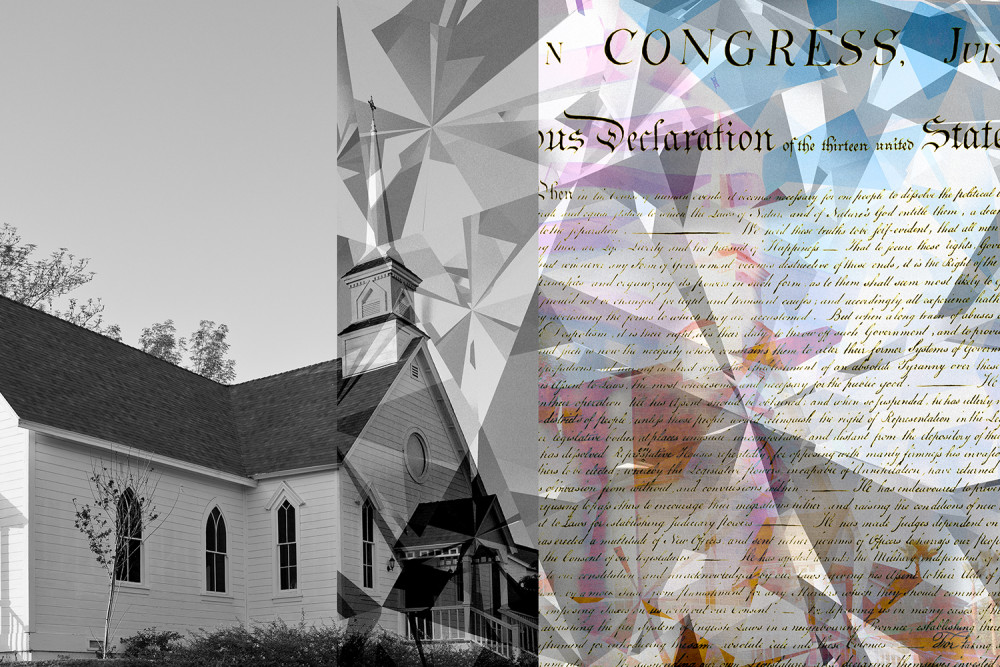
This is something that Christian nationalism doesn’t capture. Christian nationalists aren’t wrong to claim that Christianity was extraordinarily influential in the founding and throughout American history. But what they offer in tribute to that influence is a thin gruel of Bible fan fiction. Liberals and secularists talk about Christian nationalism as a threat to liberty and pluralism, and I suppose it is that. But more importantly, it’s dull. To listen to an interview with a Christian nationalist worthy like Doug Wilson is to feel yourself trapped on a long-distance bus next to a talkative passenger who is at once an obvious lunatic and an utter bore. Leave aside the comic-strip history the Christian nationalists rely on, with a covenantal founding at Jamestown in 1607 and with all the signers of the Declaration of Independence having religious views that would fit neatly into any suburban megachurch. Would anyone have crossed the seas from the Old World and braved all the deprivation, disease, and subpar carpentry of the New in order to follow the visions of Wilson or Eric Metaxas?
American Christianity was splintered from the start. Catholic missionaries and religious orders got to work before any Protestants did, a ticklish fact for evangelical Christian nationalists today. The Jamestown clergyman who supposedly dedicated the whole country to God was from the Church of England, which even then was considered stodgy, literally an establishment church. I don’t think Anglicans then were much for the idea that you could make a covenant with God on your own initiative. But more enthusiastic sects of Christians followed soon enough. The Puritans, fleeing that same established church which planted a cross at Jamestown, made it to New England and promptly divided into different camps. Methodists, Quakers, Shakers, Baptists, and Unitarians all followed, spawning endless combinations of revival movements, new denominations, speculative philosophies, and utopian communal experiments. A distinctive Black Christianity developed too, of course, taking various forms and dispersing vast influence on American culture. Americans found new ways to fuse Christianity with health obsessions, pioneered idiosyncratic readings of the Bible, and sometimes found themselves talking to angels, foretelling an imminent Second Coming, or being struck with a thunderbolt of revelation and taking off into the wilderness to find the lost tribe of Israel, found a new godly community, or set up a financial scam.


