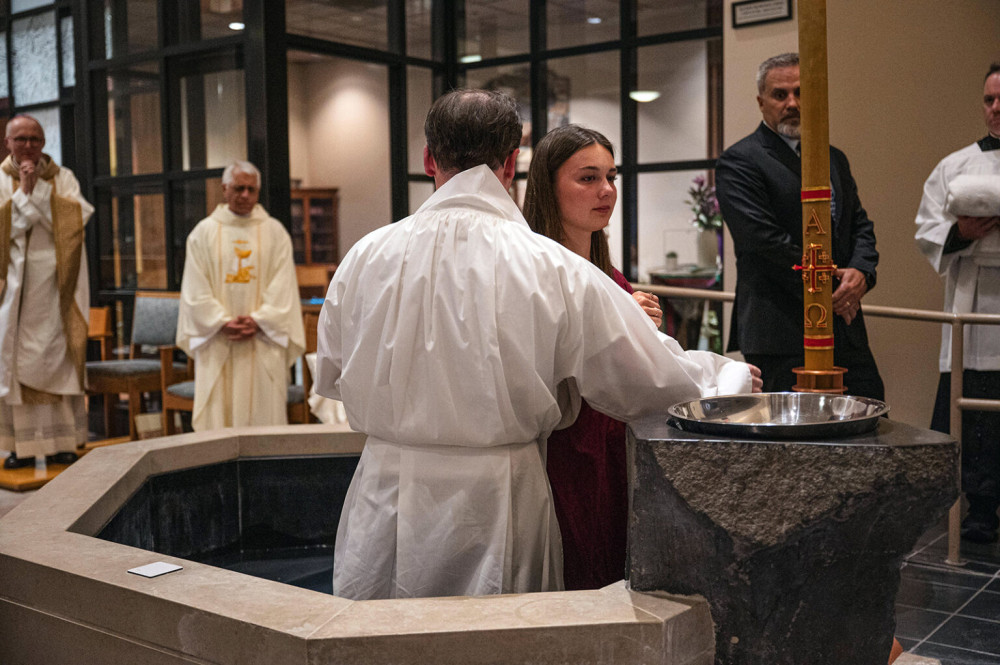
Catholic dioceses across the United States are reporting a notable increase in adults entering the church this Easter, with some reporting the largest Christian initiation classes in history.
A recent report by the Hallow app, which aggregated diocesan data from more than 140 of the 175 US dioceses, found that more than 80 percent experienced an average increase of 38 percent in people entering the church through the Order of Christian Initiation of Adults compared to last year. The Archdioceses of Los Angeles, New York, and Chicago experienced the most growth, with LA increasing its membership by 139 percent, followed by Chicago at 52 percent, and New York at 36 percent.
Leading up to Easter, some religious and secular media outlets considered whether the rise amounts to a Catholic revival, particularly among Gen Z, who make up a noteworthy portion of people converting or returning to the faith. But researchers caution that it is too early to make broad conclusions.
“I don’t know if I could call it a big revival at this point, but call back in three to five years and we’ll let you know,” said Thomas Gaunt, executive director of the Center for Applied Research in the Apostolate, a Georgetown University-affiliated research center that studies the Catholic Church.
“It’s not clear to us whether these are isolated increases or part of a larger pattern,” he added, noting that long-term data, including studies from Pew Research Center, have shown a steady decline in Catholic participation.
Gaunt said the recent uptick may reflect a post-COVID-19 pandemic rebound rather than a sustainable trend. The number of people who received sacraments in 2019 still remains higher than the averages seen in dioceses today. “It’s our job to be cautious,” he said.
Some coverage has suggested that the recent uptick is driven primarily by young men, but available data indicates the pattern varies substantially by region and parish. At St. Mark’s University Parish near Santa Barbara, California, women make up the majority: 56 adults received sacraments this Easter—38 women and 18 men. St. Joseph’s Church in New York City showed the opposite pattern, with 52 men and 36 women in its OCIA class.
Elsewhere, the split was more even. In the Diocese of Venice, Florida—which reported a more than a 40 percent increase in candidates—participation is closer to balanced, at 56 percent male and 44 percent female. And at St. Francis Xavier College Church, which is connected to St. Louis University, eight people were in its OCIA class, two of whom were male, according to OCIA director Joseph Milner.
“There is strong, active participation of Catholic women,” Milner said.
The Pew Religion Landscape Study from 2024 found that young adults generally are less religious than older generations—a trend that has been relatively steady. This year’s OCIA classes, however, stood out, showing that young adults are now among the most likely to convert or rejoin the church.
At St. Mark’s University Parish, located on the campus of the University of California, Santa Barbara, Ryan Thornton, the pastor and a Franciscan priest, said the number of adults who were preparing to receive sacraments there this Easter was nearly double that of the average parish in the Archdiocese of Los Angeles.
Thornton said the church needs to be re-configured to accommodate the college-age catechumens. “What we’re seeing is that younger parishes are having explosions,” he said.
He attributes its record number, in part, to the United States Conference of Catholic Bishops’s recent Eucharistic Revival, a nationwide initiative aimed at renewing devotion to Catholic belief in the real presence of Christ in the Eucharist. It began three years ago and moved across the country, ending in California last summer.
“Theologically, when you focus on this sacrament, which is about the union of the church in Christ, you would expect to see the church strengthened and more alive as a result,” Thornton said.
Gio Cangiano, 20, who entered the Catholic Church this Easter at St. Mark’s University Parish, said what excites him most about being a Catholic is the Eucharist. He said he made the decision to become Catholic after he prayed for his mother, who was struggling with fentanyl addiction, to get clean. “Now she’s been clean for two years,” he said. “That was the first time I really prayed.”
He also said he wanted to become Catholic before he ever went to mass, largely due to online content from Catholic creators like Trent Horn, Shameless Popery, and Voice of Reason, all on YouTube.
“I felt almost as if I knew I wanted to be Catholic before I even stepped foot into the church,” he said. “I do think that’s kind of due to Voice of Reason.”
Last year, Alex Jurado, the influencer behind Voice of Reason, was barred by a Byzantine Catholic bishop from church events after allegations surfaced accusing him of inappropriate conduct with a minor. Jurado denied the claims and has largely fallen from public view, now posting primarily on the paid platform Patreon.
Cangiano said he no longer watches much of Jurado’s content, but he appreciated having it as a resource. “I would hear an argument, and I’d be able to look it up and really see what they are talking about,” he said.
Compared to other young adults in his OCIA class, Cangiano said he felt he had done more independent research. “I’m almost surprised sometimes, when talking to the people in my class, by how little they know about Catholicism,” he said.
Thornton echoed those sentiments, noting that in this OCIA class, several had been learning about the very basics of Catholicism for the first time, which is unique. “They’ve had some of what I call an experience of faith, and they’re trying to make sense of it, absent even a language,” Thornton said. “Some could not even associate the word Bethlehem with Jesus.”
At St. Joseph’s Church in Greenwich Village, social media influencers and national publications have noted the parish’s sky-rocketing popularity among young adults. The church has been heralded as the preference for Gen Z men. Regularly, at each mass on a Sunday, a line forms out the door and onto the street with young people.
Jonah Teller, St. Joseph’s OCIA director who hosts the immensely popular In Vino Veritas wine and discussion meetings for young adults after mass on Sunday evenings, said participants in OCIA and mass attendance are growing massively.
“Last year, I think we had less than half what we had this year,” Teller said, noting that 88 young adults received sacraments this Easter. “There were 35 people in our OCIA class last year, and then the year before that, we had like 15.”
Ben Cook, 33, who recently moved to New York with his young family, said he was “one of the older people” in his OCIA class at St. Joseph’s. He said he was sent an article titled “How Catholicism Got Cool” from the Free Press about the parish, and, after visiting a Presbyterian church and feeling unsure, he asked to audit Teller’s class.
Raised by “hippie” parents in California, Cook said he didn’t think much about God until his daughter was born with complications. Since then, he’s started reading the Bible and seeking out faith. He began following the popular Catholic YouTube channel Ascension Presents and enjoying longer-form videos hosted by Bishop Robert Barron.
Now, he said he has instructed AI software to act as a Dominican friar to answer his questions about faith.
“You’ve got to be very specific, though, otherwise it’ll just kind of go off the rails,” he said. “But with that, then, it actually works really well.”
Savannah Green, 23, who also attends St. Joseph’s, said she was not raised religious and now also follows Barron and the Ascension Presents YouTube channel. She said when she moved to New York City from upstate, she was worried about finding a community but quickly found one among the crowd at St. Joseph.
“I am really surprised how much I have been able to find new adult friends,” she said.
She added, “There definitely does seem like there’s a lot of guys. If anything, it gives me hope for future families.”
Beyond building community, Green said she knows a lot of friends who have met their boyfriend at an event at the parish—although, for her, that’s not a deliberate purpose of attending. Another reason was baptized this Easter was the overwhelming sense of calm and joy she experiences when reading the Bible, she added.
“I kept running after and chasing that sense of joy and calmness, which is what brought me to church,” she said. —Religion News Service