Rebecca Sue
A Sister’s Reflections on Disability, Faith, and Love
Most of us probably haven’t had occasion to learn about perinatal hypoxia. Like many other forms of suffering, this one can escape our notice until it becomes intensely, persistently personal. Oxygen deprivation in the womb or during birth, when it isn’t fatal, redirects the entire life course not only of the child but of the whole family. The brain damage it causes can result in developmental delays, cognitive impairments, behavioral disorders, and physical challenges ranging from epilepsy to cerebral palsy.
Effects less frequently named or acknowledged include the wakeful nights, emotional stress, bewilderment, spiritual wrestling, and the social shaming that brain damage brings for both the affected person and her family members. Those chronic challenges generally leave little energy for creative work in addition to caregiving. But now and then, a parent or sibling or loving witness finds the words and the time to tell stories about the long aftermath of perinatal hypoxia. We need those stories to deepen our understanding of what sustained care and spiritual resilience require.
Read our latest issue or browse back issues.
Kathleen Norris wrote more than a dozen books, several of them widely acclaimed, before deciding to write and publish her sister’s story. Rebecca Sue is not so much an illness narrative as a series of reflections, vignettes, and recollected epiphanies gathered from 60 years of intimate relationship with a sister whose brain damage became a formative factor in the writer’s own life. To call the book a loving tribute would be true, but that way of putting it would gloss over Norris’s sometimes gritty honesty about what it took to live with Becky’s recurrent periods of rage, dissociation, despair, and wild public behavior—all of which coexisted with reciprocal affection, emotional vulnerability, and a surprising capacity for faith in a God who seemed so fundamentally to have let her down. Loud noises upset Becky, but her own outcries and angry monologues penetrated walls and kept family members wakeful and troubled many nights. She longed for a boyfriend and tried in complicated ways to be attractive, but abuse by a ship steward as the family traveled to their new home in Hawaii when she was a teenager left her confused, unstable, and uncertain about how to invite and enjoy male company. The family learned of that abuse only after she had been haunted by the memory for years.

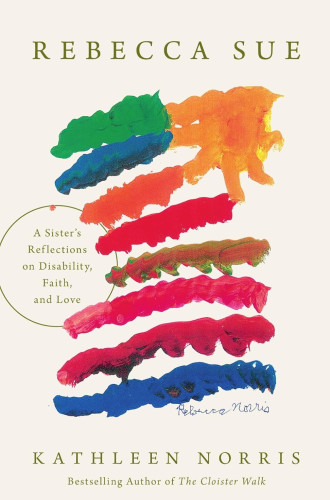
In taking stock of how many dimensions of Becky’s experience came to light only after years—or decades—of puzzlement, Norris reminds us how little we may really know about those given us to love. Threading together someone else’s story involves a process of revision, revaluation, and humbling awareness of how much of any life remains a mystery. We tell the stories we need to tell or feel compelled to tell, at every turn resisting or succumbing to the “narrative pressure” that makes us want it to be tellable—comprehensible, meaningful, engaging, coherent, instructive. The disarray of disrupted lives in which “normal” remains a cruel measure of permanent loss doesn’t lend itself to interesting plot construction or a gracefully curved narrative arc. Hence the appropriately interruptive telling: few of Norris’s chapters are more than a couple of pages long, and many of those are divided by intrusive swaths of what we later learn are images of Becky’s brushstrokes—she loved to paint—reproduced on the book’s cover in full, bright colors.
The stories come to us in much the way they must have resurfaced for Norris, the older sister Becky relied on and resisted throughout her life: one at a time, each moment its own testimony to surprising satisfactions or to the relentless frustration of hope that persists in being “hope for the wrong thing.” Hope for a particular kind of healing or resolution, as many of us have learned, can blind us to what kinds of healing may be happening all along in small moments of grace.
But Norris is not one to miss moments of grace. Even her accounts of the most challenging times when efforts to accommodate, calm, or engage her sister seemed almost self-defeating are laced with the tough-minded spiritual wisdom she gained from both her faithful parents and the adopted Benedictine spirituality she writes about so thoughtfully in Dakota and The Cloister Walk. In the latter, she makes a wry comment about the people in the cloister that might apply equally well to moments in Becky’s life that reconfigured her family’s expectations and rerouted their best-laid plans: “Only Christ could have brought all of us together, in this place, doing such absurd but necessary things.”
When, late in her life, Becky, then hospitalized, shared that she’d had visits from a “secret husband,” Norris realized that “in her psyche she had found a husband who had visited her when she needed him most.” She goes on to reflect, “In her raw need she’d tapped into a deep archetype. Oh, Jesus Christ, I thought, you come when you are called.”
In the final months of Becky’s life, Kathleen, who had only recently buried her own beloved husband, attended to her almost daily. She often picked her up from her group home for a movie outing—much needed, as Becky found living with nonfamily members (as necessary as that had become) stressful. Of those outings, Norris writes,
Years of sitting through dreadful movies with my sister has convinced me that this is one thing Jesus had in mind when he exhorted his disciples to go the extra mile. It’s also proof that asceticism finds you where you are, and it can mean sitting through a so-called romantic, so-called comedy without complaint.
Norris’s account of her sister’s life inevitably contains also an account of her own. With Rebecca Sue, a thread is added to the weave of autobiographical reflections that runs through Norris’s other, more theologically focused books. It may leave us wondering whether any life story can be told apart from what is hardest to own and tell. This hard story is told with a humility and honesty Norris’s readers have come to expect from her, but also with a tenderness that comes only from a long, close, and loving encounter with a person whose value many overlook—but whose worth Norris knows is far above rubies.