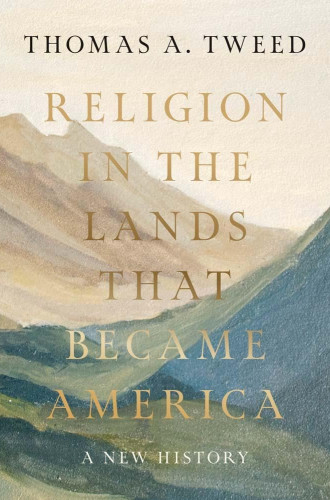
Religion in the Lands That Became America
A New History
The Horn Shelter Man ranks as one of the oldest identifiable inhabitants in the lands that became America. He lived near a river now called Brazos and a place now called Waco more than 10,000 years before Captain John Smith allegedly charmed his way into Pocahontas’s heart.
Thomas Tweed makes the Horn Shelter Man one of the first actors in his masterful new survey of American religious history. Tweed describes him on page xiii as “a medicine man buried with 100 grave gifts in a rock shelter in Texas about 11,000 years ago.” The artifacts suggest that when he died, his community felt “metaphysical anguish.” After multiple appearances in the volume, he turns up a final time on page 367 in an archaeology exhibit in a county museum in Clifton, Texas.
Read our latest issue or browse back issues.
The text stretching from the Horn Shelter Man’s first epiphany on page xiii to his last on page 367 is graced with luminous prose, staggering erudition, and uncompromised sophistication. Already reviewers have favorably compared Tweed’s Religion in the Lands That Became America with Sydney Ahlstrom’s iconic A Religious History of the American People (1972). Since specialists have long deemed Ahlstrom’s hefty tome the benchmark for defining the field, the comparison should be regarded, as we say in the South, as tall cotton.

Tweed’s overarching aim lies in his subtitle: A New History. Most surveys of American religion move from the early modern era to the present, focus on European traditions (especially English-based Protestants), scrutinize life in denominations, and pay close attention to theological trends. The contrast with Tweed is dramatic. Starting with the earliest known human inhabitants, he takes all the geographic areas that became the United States (including Alaska and parts of the Caribbean and Pacific Oceania) as his canvas. Besides White Anglo-Saxons, Tweed gives sustained attention to people of Native, Black, Latino, and White ethnic heritage. Drawing on a variety of faith traditions, he guides readers to the cultural niches in which religious people have composed the music of their lives.
A word about what religion is and does in this book might be helpful. Tweed’s well-known image of religion can be captured by the two gerunds in the title of his 2006 book, Crossing and Dwelling. He skirts the usual starting point of supernatural beings intervening in the natural and historical realms. Rather he argues that religion is more fruitfully understood as symbolic acts that facilitate life’s transitions (crossings) and others that facilitate a satisfying sense of coming home (dwellings).
On the ground, religion has worked in diffuse ways. Sometimes it has helped legitimate the displacement of Natives, the enslavement of Africans, and the commodification of countless others. Conversely, it also has helped heal those wounds, provide justice for the immediate present, and hope for the distant future. Given this complexity, four features of Religion in the Lands That Became America seem particularly helpful for the task of understanding religion’s role in American history.
The first feature is the lineup of actors. Who were they? The answer reveals a tragic thread running through all of American history. Tweed showcases the class of people that slept on national park grounds but never in national park lodges. The class that ran the machinery that printed American National Biography but never saw their names in its pages. Indeed, with few exceptions, the class whose names were not preserved anywhere at all except in the hearts of those who loved them: women, children, minorities, migrants, seniors, the disabled, the diseased, the dying.
Tweed’s actors also include folks who suffered the pain of exclusion. He tells us that when he first read Ahlstrom in college, having grown up as a Catholic kid on the streets of Philadelphia, he did not see himself in the pages. He was not alone. When I first read Ahlstrom in graduate school in 1972, having grown up as a Pentecostal kid in the Ozarks, I did not see myself either—even though by then Pentecostals numbered nearly 60 million worldwide.
Yet the question is this: Does the inclusion of marginalized people in Tweed’s book materially change our view of their historic role in American society? To be sure, the picture grows more variegated: more colors, more sounds, more life in all its richness. But variegation is not influence. Showing that the marginalized were present—always a democratic ideal—is not the same as showing that they mattered in the halls of power. Historians like Ahlstrom who wrote about White male urban Protestant elites knew perfectly well that their subjects, though small in number, controlled the levers of power that opened doors of opportunity for millions—and just as surely closed them for millions of others.
Tweed is not overtly political, but it is easy to see where his heart lies. If we run a search for the number of times the term elites appears in his book (32 by my count), it turns out that a volume dedicated to illuminating the shadowy role of the disinherited is forced to pay a lot of attention to the extraordinary power of the privileged, past and present. Tweed’s desire to give a voice to the voiceless continues to call.
A second major feature of the book is Tweed’s creative use of the concept of narrative. Religion in the Lands offers a macro-narrative that connects “eco-cultural niches” of people, culture, and nature across great arcs of time and space. They run sequentially from foraging to farming to factories to fiber optics. These four metaphors constitute the book’s internal road map. The view is breathtaking, for the period under examination is 11 millennia long and a continent wide. Yet this conceptualization of narrative is fundamentally conservative, for it keeps the past, including the extremely distant past, not only within reach but also intelligible to the modern eye.
Tweed imagines and deploys narrative in another sense too, and this one is fundamentally radical. He seems to want to disavow linear or garden-variety Western understandings of storytelling and replace them with ones that project ambiguity, fragmentation, and ideological uncertainty. Truncated or micro-narratives of this type—and the book teems with them—place cultural experiences in their unique contexts, sometimes in tandem with each other and sometimes not. One example is Tweed’s handling of Thomas Jefferson and the Declaration of Independence. Rather than tracing the story backward in time into the realm of Deist metaphysics and epistemology, Tweed traces it outward in space into James Watt’s simultaneous commodifying of steam power in Birmingham, England.
When it comes to narrative, Tweed’s intent is admirable (and is burnished by his track record of multiple prize-winning books along the way). Still, tradition matters. I think of a line from C. S. Lewis that calls readers “to keep the clean sea breeze of the centuries blowing through our minds.” Every innovation comes with a price tag, and the pesky “so what?” question is one of them. Tweed is not an imperialist. He does not hint that his use of narrative is superior to Ahlstrom’s or anyone else’s. But he does argue with considerable persuasiveness that its time has come, and we need to use it to complement the others.
One more point about Tweed and narrative merits comment. The sheer massiveness of his research shows that while he may have been touched by postmodernist skepticism about linearity and airtight documentary proof, that influence did not replace late nights in the archives. Puritans would say that Religion in the Lands That Became America “smelt of the candle.”
A third major feature of the book is Tweed’s writing style. Historians tend to undervalue the importance of polished prose. But if we agree with Karl Marx that the point of studying the world is not to interpret it but to change it, then we need a style that brings others on board.
Tweed’s does. Reading aloud, we hear cadences that rival Francis Parkman’s echoing down the centuries or Jill Lepore’s echoing down the decades. In Tweed’s hands, each word bears the marks of careful consideration. Readers encounter deceptively simple sentences consisting of common words (probably not a single one longer than four syllables), colorful adjectives (sparingly deployed), and energetic verbs with punch—all unfolding like the work of a fine novel attuned to the rhythms of everyday speech. Tweed’s prose contains abundant flashes of wit, a refreshing absence of jargon, adroit deployment of governing metaphors (“multi-steeple Pennsylvania” versus “meetinghouse Massachusetts”), and an eagle eye for the choice quote: “Thomas Paine claimed the Revolution was ‘the birthday of a new world.’”
Most important is how Tweed writes about his subjects’ intentionality. A case in point is the book’s clunky title, Religion in the Lands That Became America. It’s not eye-catching like Molly Worthen’s new Spellbound or haunting like William R. Hutchison’s classic Errand to the World. But its very clunkiness serves a redemptive purpose: to honor the indisputable fact that many of his actors may have used US postage stamps but hardly considered themselves Americans. Calling someone an American doesn’t make it so.
Tweed’s respect for his subjects’ intentionality reflects the advice that another giant in the field, Richard Bushman, reportedly gave to his doctoral students at Columbia: “Someday we will meet in heaven the people we write about, and when we do, we will have to . . . account for ourselves. Have we told their story as fairly as we know how? Have we told their story without distorting it in order to serve our own agendas?”
And then there is the economy of words. Despite the book’s girth, Tweed has a gift for avoiding prolixity. Consider the dedication. Reviewers rarely say anything about dedications, perhaps because they assume they are off limits, private. But Tweed makes his gratitude to his wife, Margaret L. McNamee, a matter of public record. “It seems insufficient to dedicate the book to her,” he allows. “But, for now, it will have to be enough.” A severe economy of words can be a powerful vehicle for conveying not only profound thought but also profound feeling.
A fourth major feature of the book is that it compels us to ask, Where do we go from here? It is worth noting that Religion in the Lands That Became America was not published by a commercial powerhouse like Basic or Scribner’s. Rather, it was published by Yale University Press—the essence of respectability, the blue-blooded heart of the American religious history mainline. But the plot thickens: Yale also published Ahlstrom’s A Religious History of the American People. Ahlstrom’s book represented both a brilliant summation of a generation of scholarship that preceded him—beginning with Perry Miller in the 1930s—and a pioneering vision of the road ahead. The same is true of Tweed. He offers both an unassailable summation of the two generations of scholarship that preceded him and a pioneering vision of the road ahead.
So, will Tweed’s work constitute a new Ahlstrom, a fresh benchmark by which other publications in the field will be measured? I won’t predict, as historians are often wrong about the past and always wrong about the future. Even so, it seems altogether possible that this book, which looks like dynamite tucked into the cracks of the old foundation, might become the cornerstone of a new one. What one critic recently said of James Baldwin applies to Tweed: “His was not the voice of a generation. He belonged entirely to himself.”
Harvard historian Catherine Brekus has joked that the main difference between the American Society of Church History (1916) and the American Academy of Religion (1963) is that the former studies Jonathan Edwards while the latter studies bodies. Brekus’s quip neatly captures the difference between an older tradition of American religion scholars represented by Ahlstrom (who was president of the ASCH) and a newer one pioneered by Tweed (who was president of the AAR).
Yet Tweed is too quick on his feet to let any camp capture him. I can well imagine Religion in the Lands That Became America soon serving as a flag for a new society dedicated to the study of Jonathan Edwards’s body.
This review is adapted from a presentation at the Jay P. Dolan Seminar in American Religion at the University of Notre Dame’s Cushwa Center in September 2025.