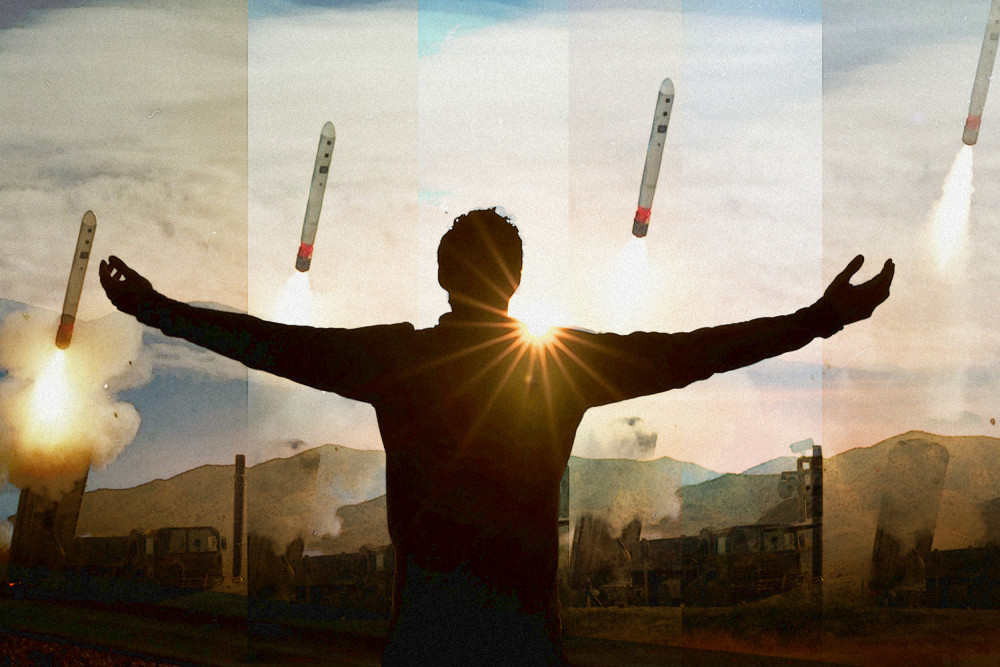
As missiles rained down on Tehran on February 28th, prominent evangelical Jack Graham tweeted: “May God give our military total victory as we liberate the Persian people and end decades of oppression and terror in the region… This is a just war and a noble operation.”
This attempt to sacralize military action as ordained and supported by God gives an opportunity for a different sort of Christian witness: for peace. At the end of the day, we need Christians to bear witness to the fact that war can never be holy; it is always a failure and cause for grief.
Those marshaling religious language to support this conflict often link the war to prophecies of Christ’s return. Christian musician and activist Sean Feucht said that “when this regime is prayerfully removed and the people are able to freely worship Jesus … we’re going to see the gospel go forth like never before.” Christians United for Israel founder John Hagee said that “prophetically, we’re right on cue,” and Greg Laurie, pastor of Harvest Christian Church in Riverside, California, connected ancient Persia’s role in a conflict with Israel to modern-day Iran and urged his followers to follow Christ’s command to “look up,” a reference to Luke 21:28.
These Christians look to apocalyptic texts as a guide for foreign policy, with the most important position being unequivocal support for Israel. Such a reading simplifies complex conflicts into good versus evil, with Israel—and by virtue of our allyship, the US—always representing the good.
We ought to question whether we deserve such an elevated moral position. It is hard to imagine a moral actor bombing a girls school, killing at least 168 students, 26 teachers, and four parents, though that’s precisely what preliminary reports show. And that’s just the most damning loss of civilian life so far. Are we sure we are the good guys?
Senator Lindsey Graham called this conflict a “religious” war. Franklin Graham posted on Facebook: “Pray for our military in the operation against Iran, for President Donald J. Trump and that the people of Iran will be set free from the bondage of Islam.” That is perhaps the most glaring example of framing the conflict as a religious war between Christianity and Islam, which can scarcely be ignored when Defense Secretary Pete Hegseth has the crusader motto, “Deus Vult” (God Wills It), tattooed on his body and reportedly once shouted “kill all Muslims” at a bar.
But much of the rhetoric is subtler, casting the United States and Israel as secular, rationalist democracies in a fight against what Secretary of State Marco Rubio called “religious fanatic lunatics.” I do not wish to defend Iran’s theocracy, but I do think it bears pointing out that we are going through a theocratic turn of our own. Hegseth invited Doug Wilson, a Christian nationalist pastor in favor of establishing a Christian theocracy in America, to lead a worship service at the Pentagon in February, and several other departments have hosted Christian worship services since the start of this administration. More than that, Christian nationalists have been openly plotting how to come to power in America, aided by the White House. As Hegseth puts it in his 2020 book, American Crusade: “Voting is a weapon, but it’s not enough. We don’t want to fight, but, like our fellow Christians [the Crusaders] one thousand years ago, we must.”
Christians generally view the Crusades as one of the bleakest chapters in our history, where theology was marshaled to kill people who believed differently than us. The witness of scripture stands against this idea, squarely.
When the Israelites are contemplating choosing a king, instead of the judge system set up in the Hebrew Bible (1 Samuel 8:11-18), God warns them that war is a corrupting influence on society, and that they will feel its impacts:
These will be the ways of the king who will reign over you: he will take your sons and appoint them to his chariots and to be his horsemen, and to run before his chariots, and he will appoint for himself commanders of thousands and commanders of fifties and some to plow his ground and to reap his harvest and to make his implements of war and the equipment of his chariots. He will take your daughters to be perfumers and cooks and bakers. He will take the best of your fields and vineyards and olive orchards and give them to his courtiers. He will take one-tenth of your grain and of your vineyards and give it to his officers and his courtiers. He will take your male and female slaves and the best of your cattle and donkeys and put them to his work. He will take one-tenth of your flocks, and you shall be his slaves. And on that day you will cry out because of your king, whom you have chosen for yourselves, but the Lord will not answer you on that day.
While war is frequent in the Hebrew Bible, it is generally not glorified. The pages are littered with the suffering that it brings, even for the victors.
By the time we get to Jesus in the New Testament, the witness against war has reached a crescendo, with the Prince of Peace condemning violence of all kinds. Not only does Jesus glorify peacemakers as “children of God” in the Beatitudes (Matthew 5:9), but he goes a step further and suggests that the way we ought to deal with our enemies is by praying for and loving them (Matthew 5:44), not starting wars. While it might be foolish to hope for Jesus’ ethics to be implemented with regards to America’ foreign policy, it is telling that a government that has so many self-avowed Christians chooses to ignore the overwhelming witness of scripture in order to inflict horror on Iran.
“Thank you President Donald J. Trump for giving the Iranian people a chance to be free. Pray for him and for all those in our military who are risking their lives to protect America and bring freedom to the Iranian people,” wrote Franklin Graham. Such statements make a mockery of Jesus’ ministry and our faith. If we wish to bring freedom to the people of Iran, a good place to start would be to repent of our wholesale slaughter of civilians.
For Christians, these are days of grief, as we see once again the destruction that war has wrought and the role of our faith in buttressing it. More suffering is sure to come, as there seems to be no exit strategy. We must see through the lie that war could ever be moral, that it could ever bring liberation or prosperity. The results of war are clearly seen in the ruins of a girls school in Iran, which the Iranian government has committed to turning into a museum of American cruelty. Whatever the high-minded pronouncements of this administration and its Christian allies might say, that is what war is: cruelty.