
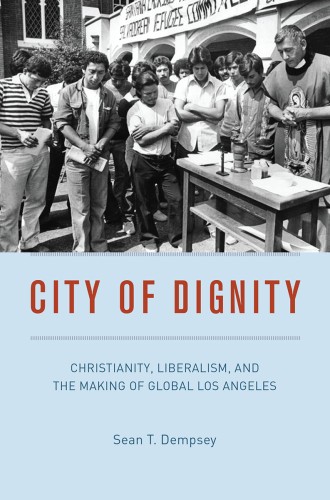
City of Dignity
Christianity, Liberalism, and the Making of Global Los Angeles
These days it would be easy to suppose that the story of Christianity in the United States is Christian nationalism all the way down. The religious right is reveling in its ascendance to the mountaintop, and historians have spent much of the last two decades—at least since the reelection of George W. Bush—trying to understand how it managed to amass so much political and cultural power. Their efforts, only redoubled since the 2016 presidential election, have yielded a wide and deep vein of literature tracing the roots of our contemporary plight back into the distant past. The books that have found a popular audience have most often been the ones promising to explain how Christianity became so entwined with toxic masculinity, White supremacy, and runaway greed. Who could be blamed for wondering if it has always been this way—and, by implication, always will be?
Progressive Christians who find themselves caught in a powerful tractor beam of despair would do well to pick up a copy of City of Dignity. Sean Dempsey tells the story of liberal Christians—Protestant and Catholic, Black and White and Latino—who fought for justice in late 20th-century Los Angeles. They did not win every battle, but their moral and theological witness often broke through, capturing the attention and arousing the conscience of people all over the country and world.
Dempsey’s narrative extends from the end of the Second World War to the mid-1990s. Along the way he introduces a variety of characters who are not household names but who, in their day, did the small faithful thing right in front of them, often to great effect. The Jesuit priest and academic George Dunne is one case in point. He came to Los Angeles from Saint Louis, Missouri, where he had gotten into hot water with the president of Saint Louis University for his outspoken opposition to Catholic segregationism. It would have been easy for Dunne to shrink from controversy upon assuming a new post at Loyola University, but instead, in 1945, he published an article in Commonweal entitled “The Sin of Segregation.” At a moment when countless White Catholics were intent on maintaining the racial homogeneity of their neighborhoods, Dunne became the first Catholic clergyman to denounce segregation as a sin against charity.