
News

United Methodists borrow Catholic fish fry tradition to serve hundreds during Lent

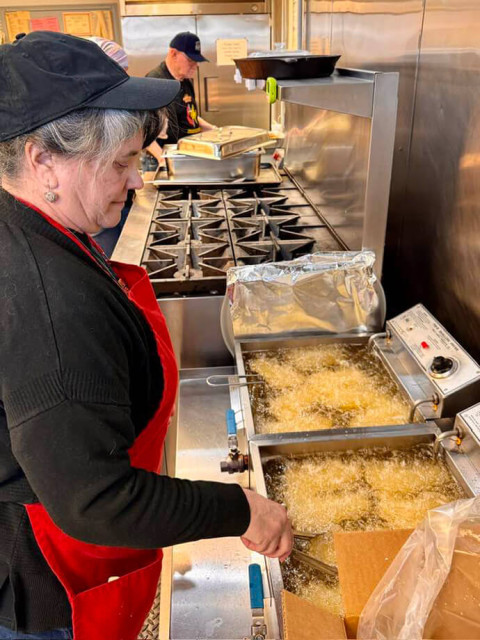
Tim Scaife doesn’t even like fish. Yet every Lenten season for the past 14 years, he has overseen a six-night series of Friday fish fries for his church in Kittanning, Pennsylvania.

With 30 people in the pews on Sunday morning, Scaife and his volunteer crew feed as many as 180 people a week with tender-crisp fish as well as French fries, baked potatoes, macaroni and cheese, and homemade pies.

“I never ate fish, but I do eat the potatoes,” said Scaife, a member at First United Methodist Church, where Lenten fish fries started in the early 1990s. The Kittanning United Methodists borrowed the fundraising idea from the Catholic church located just across the alley.


“It’s a friendly thing,” said Scaife, referring to the Catholics who still fry fish for their community on the way to Easter. “They get a good crowd, and we get a pretty good crowd.”

In United Methodist churches in Pennsylvania, Michigan, New York, and New Mexico—among other places—Lenten fish fries are an annual community event.

Some are on the massive side, like the one at Christ United Methodist Church in Bethel Park, Pennsylvania. The church takes in as much as $100,000 every year, with lunch and dinner for the six Fridays leading to Holy Week. On February 20, the church served 1,100 meals, some sit-down, some drive-through.

“It’s a pretty big operation,” said senior pastor Chris Morgan, who can be seen in the kitchen window on Lenten Fridays, calling out food orders to the preparation team.

The daily volunteer team at Christ United Methodist Church numbers in the 90s. The 65 percent to 75 percent profit the church receives from thousands of $16 dinners goes toward feeding local unhoused people and the support of a fast-growing congregation of 800 to 1,000.

“Fish fries in the South Hills of Pittsburgh are huge because this is a really big Catholic area,” Morgan said. “We’ve found our niche.”

United Methodist congregations that have caught fish fever are borrowing from a tradition in the Roman Catholic Church, one that provides a “built-in market for folks who are abstaining from eating meat on Fridays,” said Beth Forrest, professor of liberal arts and applied food studies at the Culinary Institute of America in Hyde Park, New York.

“Before Vatican II, in the 1960s, the fasting period for Catholics were Wednesdays and Fridays—and in some places on Saturdays—as well as all 40 days during Lent,” Forrest said. “During these days, one was expected to eat one meal and completely abstain from eating meat and ‘white meat,’ which meant dairy products and eggs. Fish, alternatively, was fine to eat during the fasting days.”

In parts of the US with large Catholic populations, especially those descended from Central and Eastern European immigrants, Lenten fish fries evolved to be favorite fundraisers and community-builders—not just for Catholic groups but also organizations such as Veterans of Foreign Wars posts or volunteer firefighters, Forrest said.

United Methodist Wayne Shirley saw the potential for adopting Lenten fish fries after his sister’s funeral 16 years ago in Delmont, Pennsylvania.

“The funeral coincided with Lent, and my sister’s church had a fish-fry dinner,” he explained. “I was impressed by how much the community was involved,” he said.

Shirley took the idea for Lenten fish fries back to his church in Albuquerque, New Mexico. He sold the idea to fellow church members and started planning. In 2012, St. John’s United Methodist Church fired up the fryers for the first time, serving about 160 folks each Friday night in Lent.

After years of growth, St. John’s is now plating dinners of fish, coleslaw, potatoes, green beans, and fruit cups for between 585 and 650 people on each of the six Fridays before Easter. People come from 60 miles away to chomp on cod and catfish and enjoy entertainment from a local bluegrass band or high school flamenco dance group.

“We want the community to know that St. John’s wants to reach out,” Shirley said. “The money goes back out beyond the walls of the church.”

In 2025, St. John’s cleared more than $21,000 on its Lenten dinners, after expenses. The funds were distributed to 10 local organizations serving food-insecure neighbors.

At Romeo United Methodist Church in Romeo, Michigan, blue bins of North Atlantic cod arrive every Thursday morning during Lent. Judy Engwall, known to her volunteers as “Alpha Fish,” orders 600 pounds of cod a week so her church can serve as many as 600 people a night.


Wayne Shirley shows of the list of organizations receiving the ,000 in profit from last year's Lenten fish fry dinners at St. John's United Methodist Church in Albuquerque, New Mexico. (Photo by Joan Shirley)

“Using fresh fish makes a difference,” said Engwall, who has coordinated Romeo’s show for the past 16 of the church’s 60-year fish history.

A side-dish tradition at Romeo United Methodist Church is a German, vinegary coleslaw. Devin Smith, Romeo’s pastor, said the handed-down recipe is laminated and taped inside a kitchen cabinet door, “and if anyone took it down, they would be run out of town.”

At Community United Methodist Church in Irwin, Pennsylvania, diners look forward to a side of haluski, an Eastern European dish with cabbage and noodles, along with their fried cod. Community’s 21-year, fish-fry legacy also includes the serving of “secret recipe” crab cakes.

Lenten fish fries are all about the food and fundraising, United Methodists say, but they also represent teamwork and community, as well as a show of faith.

“It’s fish. It’s fun. It’s fellowship. It’s an event,” Romeo’s Devin Smith said.

Engwall admits she sometimes panics as Lent rolls around each year, knowing she will need to recruit 100-125 volunteers to pull off Romeo’s fish fry.

“Our congregation seems to ebb and flow, but God always provides. It’s a labor of love for me.”

Community UMC’s Betsy Smith takes pride when neighbors start lining up for dinners an hour before kickoff time: “It’s socialization. It’s a night out.”

In North Tonawanda, New York, Louie Bobsein said he doesn’t like calling the 100 or so people who make the fish fries happen at his church “volunteers.”

“We’re all disciples. To me, ‘volunteers’ doesn’t catch it.”

At Pendleton Center United Methodist Church, north of Buffalo, community members have been coming by the hundreds to dine on German coleslaw and fried (or baked) haddock since 1991. The fundraising was important for building “bigger spaces for new people” during a recent growth spurt, Bobsein said.

But his pastor, Scott Johnson, recently reminded his congregation of the primary focus.

“He said, ‘We have to know why we do this. We are showing love to our community,’” Bobsein said. “This is a reflection of God’s love. That’s why we do it.” —United Methodist News

Annette Spence

All articles »