Laura McMasters, a longtime campus minister, performed her first baptism in February—welcoming an international student into the Christian faith and United Methodist community.
McMasters, a deacon, had assisted United Methodist elders in services of communion and baptism before as minister of campus and community engagement at First United Methodist Church in Pulaski, Tennessee. But this service was special.
For the first time, McMasters could offer the sacrament of Holy Baptism as a deacon on her own, without getting a special dispensation from her bishop or waiting for an ordained elder to be available.
“I had tears of joy for the student whose life was being transformed,” she said, “and for the lives of my deacon colleagues continuing to experience God’s transformation in ministry.”
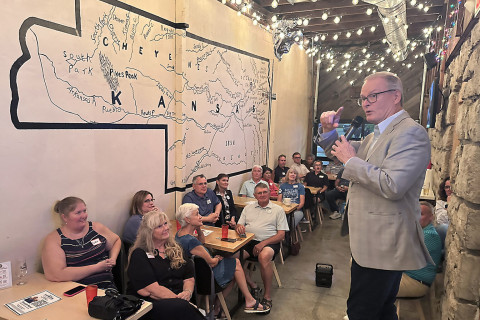
McMasters was among nearly 150 United Methodist deacons, provisional deacons and deacon candidates who joined in discussing the sacraments at the September 22-24 Deacons Gathering hosted by the United Methodist Board of Higher Education and Ministry. Those gathered both in Nashville and online were grappling with a significant change in denominational life.
In what many consider a historic moment, last year’s UMC general conference—by a vote of 448-240, a 65 percent majority—granted ordained deacons the authority to preside “at the celebration of the sacraments when contextually appropriate.”
The change to the Book of Discipline, the denomination’s policy book, goes on to say that deacons have sacramental authority for the sake of “extending the mission and ministry of the church and offering the means of grace to the world . . .”
Meg Lassiat, Higher Education and Ministry’s executive director of ministry and a deacon herself, emphasized that she does not see this new authority as a right.
“I believe it is a responsibility,” she told those at the event, “and we are stewards of the gift to the church and to the people we serve.”
Emily Kincaid, executive pastor at First United Methodist Church in Pensacola, Florida, and a deacon who, as a general conference delegate, helped move the change forward, shared a similar sentiment.
“I think where we get into trouble is when we try to own the sacraments, when we try to hoard the sacraments,” she said. “And so, we remember that the sacraments are a gift from God, and that the action in the sacrament is God’s action. We are simply the vessel through which God is working.”
Kincaid and other general conference delegates worked with Higher Education and Ministry to put together a document of guidelines and best practices for deacons. However, questions remain about the new policy that took effect January 1—both among the deacons themselves and within the wider denomination.
Chief among those questions is what counts as “contextually appropriate.” In fact, deacons say they still face confusion about their context within the larger UMC.
That’s in part because the order of deacons, as currently constituted, is still relatively new. Next year will mark 30 years since the general conference instituted deacons as a separate, permanent order of ordained clergy.
The move abolished the previous two-step ordination process of deacon and elder and opened the opportunity for diaconal ministers, lay people serving in specialized ministry, to become ordained. Ten people in the first class of deacons attended the September gathering.
Margaret Ann Crain, a retired Garrett-Evangelical Theological Seminary professor who has written books on the ministry of deacons, was among that first class in 1997. She told those in attendance that during the negotiating period, a deal was made where the sacrament was given up in order to get deacons’ ordination approved.
Since then, she said, every ministry study “has danced closer and closer” to saying deacons’ ordination should be accompanied by sacramental responsibility. The most recent study, presented at last year’s general conference, said ordination has a “sacramental nature.” As such, the report said, deacons and elders bear responsibility for leading the church’s sacramental life.
“I think it’s missional,” Crain said. “And if you look at the setting you’re in, and you say, ‘This is part of the mission of the church here. I want to offer this,’ then you’re fine.”
Not all geographic regions of the UMC have adopted the order of deacons and the relatively new system for ordination. But in the US and Europe, United Methodist deacons should not be viewed as elders in training. Instead, they answer the call to “a lifetime ministry of word, service, compassion and justice.”
Sandra Steiner Ball, president of the Higher Education and Ministry board and bishop of the UMC’s Western Pennsylvania Conference, described deacons as a “tether” or “ligament” between the church and the world.
“Being withdrawn from the world is no answer for Christians. That makes the church irrelevant,” she said in the opening sermon. “Oh, how we need the ministry of our deacons!”
Today, the General Council on Finance and Administration reports, there are 1,023 active United Methodist deacons.
In addition to campus ministers like McMasters, deacons serve as hospital chaplains, therapists, social workers, attorneys, nonprofit directors, music ministers, Christian educators, professors, pastors, and church planters.
Any of these ministry contexts could potentially be appropriate for administering the sacraments, deacons said.
Julie Wilson, a deacon who co-wrote the legislation, said that even before the change, she presided at communion on mission trips and as an interim pastor. But each time she had to first get her bishop’s permission.
“I have always ministered with marginalized communities,” she said in an interview. “And every church I’ve been in, there have been situations where I have thought, ‘Wow, this would be the perfect time to have communion.’ But there was no elder around.’”
At the same time, many at the gathering stressed the need to continue collaborating with elders in sacramental responsibilities—especially in shared ministry contexts.
“I think we as deacons, we have to work with our elders and respect each other’s ministries,” said Leo Yates Jr., a deacon and Wilson’s co-writer.
Yates, pastor of Magothy United Methodist Church of the Deaf in Pasadena, Maryland, has worked with an elder in officiating at six baptisms this year. At the same time, he celebrates that he now can consecrate the communion elements whenever he visits Deaf residents at a local assisted living center.
Deacons, like elders, must have a master’s or equivalent degree with graduate level studies in theology. Nevertheless, their vocation is different from that of elders, who fill the majority of United Methodist pulpits. Elders are called to preach, provide pastoral care, administer sacraments, and order the life of the church. Elders also itinerate at the behest of their bishops, who in turn are elected from the elder ranks.
The UMC also has a third order of clergy—local pastors—who are licensed but not ordained. Licensed local pastors can administer baptism and communion, but only in their appointment setting. The Higher Education and Ministry agency plans to explore local pastors’ ministry more in the next few years.
Quinton De Beer, associate pastor at Carlisle United Methodist Church in Pennsylvania, a provisional deacon who attended the gathering said the gift he takes away is a better understanding of sacraments as a means of grace available to all.
“I think it dismantles some of the religiosity of the church and allows all people to have access to Christ,” he said. —UM News