The bible is often treated as an answer book, yet its pages are thick with unanswerable questions: What does Jesus write in the sand? What is the name of the concubine in Judges 19—and, while we’re at it, the name of Pharaoh’s daughter, the fortune-telling slave girl, and the Syrophoenician woman? Where is the garden of Eden?
One question I can’t resist is why editors tacked on extra verses to the end of Mark’s Gospel. Mark’s is the oldest gospel and the shortest. Most scholars believe it was written around 70 CE and ended at verse 8 of chapter 16. Decades later, unknown editors added 11 more verses. Their reasons are equally unknown, though many think the goal was to create a more cohesive image of Jesus across the gospels.
Read our latest issue or browse back issues.
Almost certainly, this is not what Mark intended.
If we look at it through a wide lens, the original ending of Mark doesn’t compromise much. The major plot point—that Jesus rises from the dead—remains. The tomb is empty and the resurrection proclaimed to three women.
But it isn’t proclaimed in the same way as in the other gospel narratives. Mark is abrupt. The disciples experience no joy upon seeing Jesus because they never encounter him. There’s no postmortem dialogue, no galvanizing Great Commission. Instead, Mark offers the biblical equivalent of a poem that ends with an ellipsis or a dinner party where the host ushers the guests out the door before dessert. The effect is our untethering.
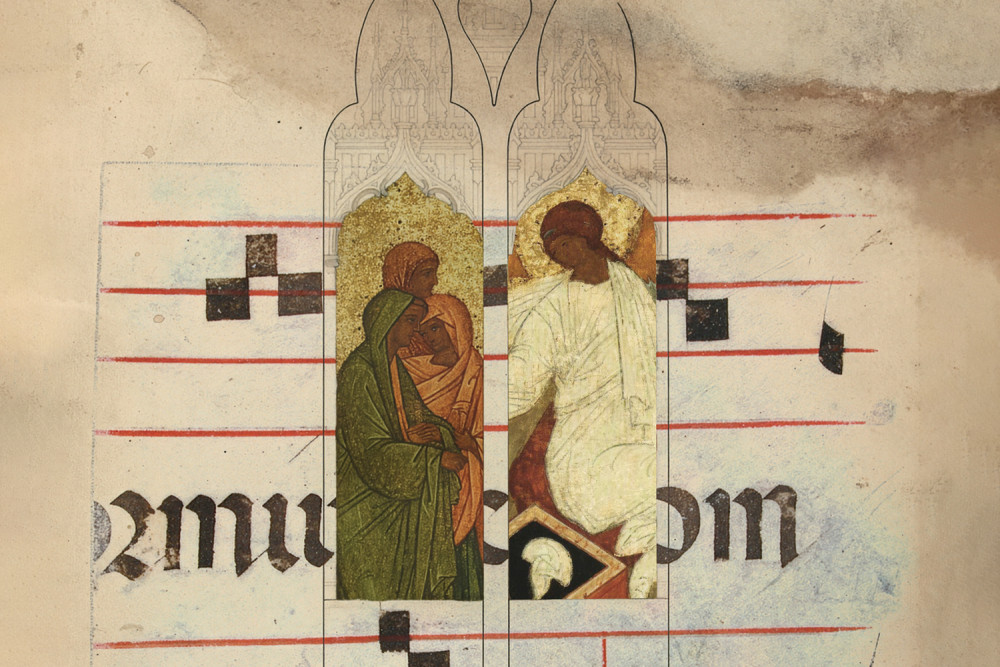
Then there’s the matter of how the women at the empty tomb react. The young man—not an angel, as in the other gospels—assures them all is well. He says Jesus rose. He tells them to find the disciples and let them know. He assures the women that they will see Jesus again. He tells them not to fret.
The women respond by running away, and Mark’s final words describe them not as overjoyed but as too petrified to speak. Who wouldn’t be? They witnessed the undoing of their world through the slow, painful, public death of their friend. They saw the truth twisted. They watched power abuse. They were helpless in the face of the ancient equivalent of a lynching, unable to stop a death deliberately designed to torture not just the one who must die but also the ones who must watch.
I’ve spent more than 15 years serving as both an Episcopal priest and a theological trauma scholar. While I’m often hesitant to apply contemporary categories to ancient realities, it does seem as if these women are exhibiting classic trauma symptoms.
The inability to speak is one of these. Bessel van der Kolk, psychiatrist and author of The Body Keeps the Score, describes how trauma reduces activity in the part of the brain that controls language, making it difficult to describe a traumatic event and express emotions. The brain simply can’t coordinate itself enough to form words, sizzle them through synapses, and shape the lips to speak.
Perhaps this is what Mark is trying to tell us when he says the women are terrified. Perhaps this is why they say nothing.
Yet, while this resonates with our modern, psychologically attuned minds, there are two problems: The first is that no one wants a gospel to end this way. The second is that Mark does indeed end his gospel this way.
Trauma may be real, but it doesn’t preach. No one purchases pastel dresses, irons checkered shirts, or fastidiously fastens bows into their children’s hair to be told about how the women were traumatized on Easter morning. We show up at church for the rousing resurrection sermon. We expect our spirits to be raised along with Jesus’ body.
How gauche would it be to bring down the mood at the parish Easter egg hunt with talk of big T and little t trauma? No one wants to hear it.
In some ways, the comfort we might find in Mark’s additional ending says a lot more about us as readers than it says about Jesus’ legacy. It’s a reminder that we don’t like instability. Homeostasis appeals for a reason, and we aren’t fans of difficult emotions. We crave closure and pay heartily for entertainment with happy endings. We want our suffering to matter—everything happens for a reason!—and we believe that purpose dulls psychic pain.
Often, we turn to our churches for this medicine of meaning. We expect religious leaders to provide it for us. If our church doesn’t rise to the occasion, if parishioners don’t walk out the door feeling more joyous and hopeful than when they arrived, what is its purpose?
Our desire for a happy ending isn’t so different from our instinct to turn away from or minimize other people’s suffering. Too often, we fail in our duty to witness. To face a trauma survivor or someone freshly bereaved is to be faced with vulnerability, theirs and ours. It is to be reminded that suffering is sometimes impossible to understand. It is to remember that something similar could happen to us. Sometimes, the vulnerability and senselessness are too much to bear.
Like Mary, Salome, and the other Mary, sometimes we are too petrified to speak.
Silence is a theme in Mark’s Gospel. Jesus tells everyone from a leper (1:45) to Peter (8:29–30) to demons (9:9) to his own disciples (3:12) not to reveal his true identity. Scholars call this the “messianic secret.” It’s easily the worst-kept secret of all time.
But Jesus has his reasons. He requests silence because he knows the stakes are high. People often misunderstand what he means when he calls himself the Messiah. They believe he wants to replace one worldly power with another, but that is never the point. Jesus wants to unmask Rome’s oppression. He wants people to know the difference between Rome’s idea of justice and God’s. Jesus is both the Word made flesh and someone who changed what words mean. He redefines messiah as one who wields power through service, who gives his life for his friends.
That’s not a comfortable truth. No wonder the women were terrified.
When we breeze past the original ending of Mark, we run the risk of forgetting all this. We forget that for Mark the entirety of Jesus’ ministry was as intense, transformative, and painful as it was precarious. It was a legacy in the process of becoming, not one whose purpose was presumed. At the time Mark wrote, there were no throngs at St. Peter’s Square on Easter morning. There were no parish Easter egg hunts. Mark told Jesus’ story in the wake of the Second Temple’s destruction. Roman propaganda threatened both Christian and Jewish lives. Nothing was stable, and homeostasis was nonexistent. To proclaim a happy ending so loudly, well, perhaps it was too dangerous to dare.
As a writer, I struggle with the changes the editors made to Mark’s original conclusion. I understand the desire to create consistency among the gospels. I know the added verses signal growing consensus about Jesus’ resurrection in the decades after Mark’s Gospel was shared. The ethics of writing were also different then. The ancient world was not a literate world, and Mark was likely written to be performed. His words were passed down, until his story became the community’s story, belonging to the people. There were no copyright laws. It was an acceptable practice for people to redact and combine texts.
It’s still a lot for my individualistic, modern mind to grasp. When I think of how painstakingly I choose every word I write, it strikes me that I see those words as mine. I would be infuriated if someone altered one of my endings or altered my intended meaning.
But other writers might respond quite differently—they might appreciate the editorial oversight. They might point out that meaning emerges in community. They might prefer the alternate ending, and maybe that’s the point. Maybe the greatest gift in knowing Mark’s Gospel has more than one conclusion is that it gives us an opportunity to reflect on how we project onto the text, affirming what’s convenient and discrediting what’s not. It’s an invitation for us to wrestle with Mark, to let the endings reverberate within our faith and see what they shake up.
Nonetheless, if I could meet those editors, I would make a case for keeping the original ending. It prompts us to find value in what is liminal and unfinished. It leaves us wondering. It demands that we imagine ourselves in the bodies of the two Marys and their friend Salome as they encounter an empty tomb. It encourages us to empathize with the disciples as they rise from their beds that Easter morning, aching from poor sleep wrought by shock and searing tears. It turns us all into a version of Doubting Thomas, unable to see the resurrection wounds yet asked to believe that what Jesus did mattered. It offers us an opportunity to embrace the fear in those moments when hope is stated but not realized.
Perhaps most importantly, it gives us a chance to see ourselves reflected in the gospel. We too live liminal, unfinished lives. Very few of us get closure, though we seek it. The original ending of Mark shows what hope looks like for us in those despondent moments when words can’t be found, when all that can be offered is a daring promise to go and “see” Jesus in some way that makes no sense. From a trauma perspective, the added verses blunt that reality. They also silence the early Christian community’s liminality by adding meaning and purpose.
I wish we hadn’t done that.
Writers make choices. They made them in ancient times, and they make them now. Mark is no exception. He had something in mind with that original ending, and the editors had something else in mind when they changed it. These facts are nothing for Christians to be threatened by. They’re part of our collective spiritual history, a history that reflects both who God is and who we are in complicated, sophisticated, and awe-inspiring ways.
To name that history is to give words to the complexity of this world that God created. It is to accept that Jesus’ resurrection is both a terrifying reality and the happiest of endings. It is to offer our respect to the writers and editors who wanted us to remember the story of the Son of God. It is, at the end of the day, an attempt to make meaning out of something we can never fully understand.