When I moved back to my hometown of Seattle in my early 30s, after living in California since age 18, I was an exvangelical—the kind NPR correspondent Sarah McCammon writes about in The Exvangelicals: Loving, Living, and Leaving the White Evangelical Church. I still wanted to connect with a faith community. But I was looking for a different kind of church from the ones I’d been a part of for the previous 13 years.
I hoped to find a church that was fully supportive of women and LGBTQ people while also being racially and economically diverse. Did all of this exist in the same place? I wasn’t sure. But I knew at least where to look for queer-affirming churches, which felt like a good place to start. My searches on the Church Clarity website lined up with what I’d gathered from meeting people from a variety of Christian backgrounds while in seminary: Protestant churches from the historic mainline denominations often fit the bill.
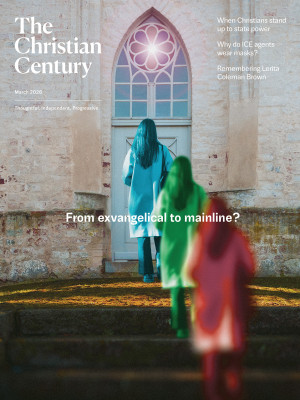
Read our latest issue or browse back issues.
Then a friend posted a video of a Korean American Presbyterian pastor talking about the racial justice pilgrimage his church had embarked on in the US South, learning together about chattel slavery, Jim Crow, the civil rights movement, and White supremacy today. I was intrigued. I pulled up the church’s website and saw that the senior pastor was a Pacific Islander woman and the leadership consisted primarily of women and people of color. I need to visit this church, I thought. Five years later, I’m still a part of the community there.
I’ve been reflecting on this journey while also speaking with fellow millennials about their own experiences searching for a faith community after leaving evangelicalism. It is not an easy road. As McCammon writes in The Exvangelicals, such a departure “often comes with an accompanying sorrow and a loss: of identity, community, and sometimes family.” Many of us have left churches for similar reasons—their unwillingness to have crucial conversations around White supremacy and racial justice, their exclusion of LGBTQ people, their prohibition of women in leadership, their discomfiting coziness with right-wing politics that go against our deepest convictions of what love for neighbor might look like. Not all of us still want to be connected with a church community. But some of us do. What does it look like for former evangelicals to search for and perhaps find a new home in mainline Protestant churches?
In the evangelical world I belonged to for 13 years, mainline churches tend to carry a particular reputation. People say they’re dying, or they’re dead already. Sometimes this reputation bears out in experience. I spoke with one White woman who, upon moving to rural Ohio with her husband and young children, searched for a church that “felt spiritually alive and helped us want to grow,” but the local mainline churches she visited “felt pretty dead.” She missed the “sense of personal relationship and devotional life” she had experienced in evangelical churches, even though she now disagrees with much of their theology. Plus, being new to the area and looking to build community, “it just felt too hard to go somewhere where everyone was retired.”
Another White former evangelical woman who lives in a small city near Portland, Oregon, spent some time in a mainline church at the invitation of two friends. But when these friends left the church, she and her family were the only people under age 60. The church couldn’t meet her and her husband’s need for peer relationships.
According to the 2023 PRRI Census of American Religion, the average White mainline Protestant in the United States is just two years older than the average White evangelical: 56 versus 54. But age varies widely from church to church, and millennials who visit mainline church communities often feel that they are in a distinct age minority. Further, the impression that younger adults are not involved in mainline churches is sometimes part of what keeps former evangelicals from checking out these communities at all. One mixed-race woman reflected on her search for a new church in the Boulder, Colorado, area: “I wanted to find a young adult-specific community, and whether it’s fair or not, I had a view that mainline churches would be an older audience.”
This is not an unreasonable view. At the same time, as Christian ethicist David Gushee writes in After Evangelicalism, “mainline churches vary dramatically, and they are also evolving in response to their own challenges and the new landscape of American religion.” Some millennials have been surprised by what they find. Aaron, a White man from Kansas City, Missouri, initially had a mental image of Episcopal churches as “stuffy and full of old rich people.” But a Facebook ad for a local Episcopal church caught his eye. Though he drove by its historic brick building all the time, he “didn’t know it was an actual functional church.” When Aaron visited on a Sunday, he found himself deeply moved by the “gorgeous Gothic” space, the full choir, and especially the genuine kindness of the people. “Something about it felt sacred and like home,” he said.
Each person I spoke with who made a transition from evangelicalism to a mainline congregation did so in a different way. For one Filipina American woman, Linet, it was an invitation from a trusted friend and mentor from her college days. She had recently left her longtime Southern Baptist church for a number of reasons—including sheer exhaustion from years of frustrating conversations about women in leadership and years of pushing for deeper engagement with racial injustice without significant results. Linet’s friend said of her multiethnic mainline church, “I think you and your husband would really like it here.” They gave it a try, and she felt refreshed by the church’s willingness to speak and pray about injustice in our world. “Being very explicit about genocide and very specific about oppression—even just saying those words, you could not do that at my former church,” she shared. And it was powerful to see a female pastor leading freely.
Michelle, a Black woman living in Charleston, South Carolina, recalled her first time walking through the doors of the predominantly Black mainline church she now attends. “Everyone was so friendly,” she told me. “I was really moved by something about the energy in the room. And then I realized”—in contrast with her experiences at previous, mostly White evangelical churches, and especially in leadership there—“I didn’t feel scared.” It was the first time she didn’t feel like she “needed to present a certain image” at church. As New Testament professor Angela Parker explains in If God Still Breathes, Why Can’t I?, “Black and minoritized bodies attempt to contort themselves to fit within evangelicalism, usually without success.” Michelle’s current church, in contrast, is a space where she feels she can be fully herself. These days, church “feels like a family reunion.”
While 90 percent of mainline clergy surveyed by PRRI in 2023 reported that their congregations are primarily White, 5 percent said that their congregations are multiracial, like Linet’s, and 2 percent said their congregations are predominantly Black, like Michelle’s. For millennials of color who have left evangelical churches—often predominantly White evangelical churches, where many struggled to belong or felt fundamentally unsafe—these churches feel like sanctuary.
White millennials, too, often thrive in multiethnic mainline communities, recognizing the strength of diverse experiences and perspectives that help us see God more fully. One White woman shared that she and her family visited multiple churches when they first moved to New Jersey, “reeling from the aftermath” of a new sexuality policy from her parachurch ministry employer, plus Trump’s election in 2016. After visiting all sorts of churches, both evangelical and mainline, one particular mainline congregation instantly felt like home. “You can feel the Holy Spirit as soon as you walk in,” she said. “And part of that is because the leaders”—particularly the pastor, a Puerto Rican woman from New York City, and the worship leader, a Black woman with Baptist roots—“unabashedly love Jesus.”
While diverse mainline churches exist, not everyone has access to one. One White woman shared that she was surprised to find that all three mainline churches in her small city were all White. “Only one had a non-White person in the building at all,” she reflected, and it was “one or two people out of two hundred.” She also hoped that more churches would be led by people other than White men. Her kids attend Catholic school and see a male priest at mass every week, and she doesn’t want them to grow up thinking that spiritual leaders are always men. One church’s pastor, in particular, was unbearably condescending—“not intentionally so, but he was raised in an era where what he says is true and he’s in charge and he’s going to tell you what to do.” The “White male energy” from the pulpit was too much for her.
When we speak of the faith journeys of former evangelicals, we’re often speaking of people who have been traumatized, or at least exhausted, by their previous church experiences. One person I spoke with was shunned by his friends after questioning the way his church treated a lesbian woman who wanted to join; another was going through a rough patch in her marriage and sought help from a Christian counselor who told her that her husband needed to function as the “spiritual leader in the household”; a third went through an experience of depression and felt that her faith community had little to offer her in that time. As we search for new kinds of communities, carrying these sorts of trauma with us, we’re often looking for spaces of emotional safety.
Safety can mean not feeling like we have to conform to a certain set of beliefs in order to belong. “I feel like it’s very clear to me,” one woman told me, that in her current mainline church community “it’s okay to have questions, or to not have all the answers.” Another man realized, after a few weeks, that in his new mainline community “they’re not going to ignore me or turn on me for asking a question.” It can also look like being encouraged to care for ourselves in healthy ways. One woman recounted a conversation she had with her pastor while she was very pregnant. “I was so big and could barely walk,” she recalled, and so she wasn’t going to church much. “My pastor said, ‘It’s fine.’ I said, ‘Really?’ And she was like, ‘Yes, take care of yourself!’” People at her previous churches, she reflected, might have said similar things but wouldn’t have really meant it.
While churches vary widely—and the options differ dramatically depending on where we live—I have not given up hope that mainline congregations could serve as the community-building, justice-seeking, emotionally safe places that many exvangelical millennials are searching for. The adjustment is not always easy; as Gushee writes, depending on the church, we might feel like “everything is different”—“the buildings, worship services, church calendar, robes, music, prayer books.” But while “different” might feel jarring for some of us—and some mainline churches may need to rethink some of the trappings of their services to become a comfortable home for people of my generation—for others it might be exactly what we need.
What looks and feels like spiritual home differs from person to person. But I heard a consistent theme in my conversations with former evangelicals: It’s less about the form of church and more about the people. Are they warm? Are they genuine? Do they care about me and my family? Do we share our most basic values in common? Is this a safe place to ask the questions on my mind or hold the views I hold? Can we make a positive difference in our broader community together? Ultimately, I’m with the interviewee who said of her church, “It’s not perfect, but it’s reminded me of what’s possible.”