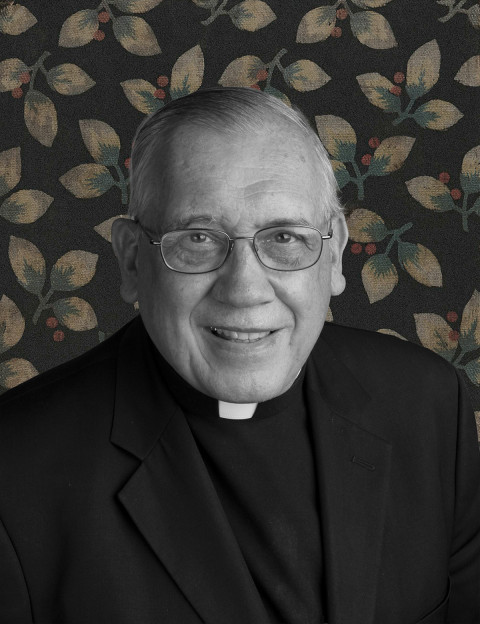
John T. Pawlikowski, who died earlier this year, was a pioneer in Christian-Jewish relations, ecumenical and multifaith dialogue, and global ethics. I first encountered the fruits of his life of partnership with Jews and Christians in 1996, when I found his 1982 book Christ in the Light of the Christian-Jewish Dialogue at a religious supply store. I didn’t know how to pronounce his name properly. But a Jewish philosopher had recently invited me into an interfaith study of the scriptures, and looking at John’s book I knew I needed to learn from his wisdom.
A few years later I joined the faculty of McCormick Theological Seminary in Chicago, and I realized that John was teaching a few blocks away at Catholic Theological Union. I first met him after 9/11 at a gathering of the Council for a Parliament of the World’s Religions. John invited me into circles of ecumenical, interfaith, and interreligious dialogue and partnership with Jews, Catholics, Muslims, and people of other religions. His worldwide network of colleagues and friends was one of his fields of ministry, along with teaching at CTU. Among the students in his courses was the young Robert Prevost, whom we know today as Pope Leo XIV.
Soon I became involved in a project to invite theological students to attend an international gathering of the Parliament of Religions in Barcelona in 2004. Along with John, I was in meetings with other scholars and organizers in interreligious relations. John’s passion for interreligious gathering, dialogue, and deep reflection on our encounters with other sacred traditions and practitioners was compelling. His practice of ministry included all of humanity in all our cultural and religious differences, and the earth as our shared homeland. He was an advocate for women and young people to join the field of Christian-Jewish relations and scholarship. His openness to others included representatives of so-called New Age spiritualities on the parliament’s board. His deep sense of justice as fairness and equity for all included both Israelis and Palestinians, with no room for classic Christian anti-Judaism, modern racism, or xenophobia. He was deeply opposed to the doctrine of Christian superiority to other religions. And he modeled by his way of life how other sacred paths—especially Jews and Judaism—are essential to our repentance and discipleship as Christians today.
Born in 1940, John grew up in Chicago and attended St. Philip High School. He first encountered Jewish peers in the eateries and grocery stores of the Logan Square neighborhood. In 1958, he entered the Order of Friar Servants of Mary, also known as the Servites, and his studies carried him through institutions in Milwaukee, Northern Ireland, and Lake Bluff, Illinois. He furthered his studies at Loyola University (Chicago) and Mundelein Seminary. After his ordination to the priesthood in 1967, he enrolled as a doctoral student at the University of Chicago Divinity School, where his courses with J. Coert Rylaarsdam, Martin Marty, and Norman Perrin guided him to focus on Catholic-Jewish relations in the wake of the Holocaust and Vatican II.
John was one of the founding faculty members of Catholic Theological Union. He was the author of ten books, and his collected articles, chapters, reviews, invited lectures, recorded lectures, and unpublished papers fill 30 boxes carefully cataloged by the Servites. When invited to make a presentation, whether before other academics or in civic groups, he spoke without notes, drawing upon his photographic and encyclopedic memory. He was always up to date on new research, the state of formal relations between Catholics, Jews, and other religions, and the cutting edges of global ethics, including environmental ethics. He responded to questions and comments with grace, reserving his concerns about the future of Christianity and the interreligious movement for informal conversation.
He took the fruits of dialogue and interfaith partnership into reinterpreting basic Christian doctrines and reforming the presentation of biblical studies, catechesis, liturgy, and theological ethics. John criticized two of the classic streams in Christology: the notion that Jesus’ life and ministry fulfilled ancient prophecies in the Hebrew Bible (e.g., Matthew’s Gospel and Justin Martyr) and what he called “blood Christology” focused on Jesus’ passion and crucifixion (e.g., as depicted in Mel Gibson’s popular 2004 film, The Passion of the Christ).
Instead, he found in the incarnational Christology of John’s Gospel a new vision of humankind in close relations with our Creator-Redeemer, inclusive of the historical Jesus as a Jew, Mary his Jewish mother, his Jewish apostles such as Paul the Pharisee, and all of us gentiles over time and history. The incarnation isn’t just about Jesus as the one and only Savior of Christians exclusively. It is about new ways of being human considering God’s everlasting covenant with the Jewish people, God’s redeeming outreach to non-Jews through the Christ event, and God’s grace and holiness for all creation. Other religions and our natural environment communicate God’s grace, wisdom, and holiness shared with all, in all of our particularity and distinctive ways of life. We are all invited to become God’s created cocreators and co-laborers (as John Paul II emphasized) for the fulfillment of creation.
A coworker in the field of Christian-Jewish relations once said to me that John’s theology was thick on history and experience but thin on metaphysical concepts. But that thickness and thinness reflect a transition in Catholic theology in the 20th century, as well as John’s wisdom as a teacher which made his presentations, lectures, and writings accessible to a wide audience of people formed in more secular societies.
John went beyond his research and the classroom to embody his calling to better Christian-Jewish relations in institutions and organizations. He was a charter member in 1969 of the Christian Scholars Group on Christian-Jewish Relations, which published “A Sacred Obligation: Rethinking Christian Faith in Relation to Judaism and the Jewish People” in 2002 as a response to the National Jewish Scholars Project’s 2000 statement Dabru Emet: A Jewish Statement on Christians and Christianity. Twice he was president of the International Council of Christians and Jews. Presidents Jimmy Carter, Bill Clinton, and George H. W. Bush appointed him to serve four terms on the United States Holocaust Memorial Council, which oversaw the development of the US Holocaust Memorial Museum in Washington, DC, as a major center for research and international education.
In the late 1980s, members of the Vivekananda Vedanta Society of Chicago contacted John about their dream of a centennial Parliament of the World’s Religions. Their project was to celebrate the history-making 1893 Parliament of Religions that occurred during the World’s Columbian Exhibition in Chicago, at which the Hindu reformer Swami Vivekananda (1863–1902) gave a historic address on religious pluralism. John worked with the Vedanta Society, former McCormick Seminary president David Ramage, and many of Chicago’s religious leaders to bring about the 1993 Parliament of the World’s Religions, which launched a new international organization. John served on the board of the parliament as it launched additional gatherings in Cape Town, Barcelona, Melbourne, Salt Lake City, Toronto, an online parliament, and then back in Chicago. He was instrumental in inviting other Christians and church-related institutions into the relational work of the parliament.
As a result of his deep investment in this work, his own research in Christian-Jewish relations moved into the wider field of global religious relations. For example, he worked with Hans Küng and others to prepare the 1993 document A Declaration Toward a Global Ethic. He also became involved in environmental ethics at the United Nations in response to the crises of global warming and Pope Francis’s 2015 encyclical Laudato si’.
Even as John’s interests moved in global ethical and theological directions, he continued to emphasize that Christians should be nurtured by our historic origins in Jewish civilization and covenantal theology—as well as our living relations with Jewish neighbors and communities, including the wealth of Jewish wisdom for life in the Mishnah, Talmud, modern Jewish thought, and biblical scholarship.
John was a devoted fan of the Chicago Cubs, one who knew the stats of individual players. With his friends he enjoyed theater, shopped for the groceries and filled the dishwasher at Assumption Priory, and was a member of the top echelon among the frequent flyers of a major airline. (When his flights were delayed, the airline CEO would call his cell phone to apologize.) His friends and colleagues included James Carroll, Thomas Moore, Amy-Jill Levine, Susannah Heschel, Yehiel Poupko, and Irvin Ungar.
John received four honorary doctorates and awards from numerous institutions, including the Catholic Theological Society, the Anti-Defamation League, the American Jewish Committee, and the Polish government. Despite all his academic and institutional achievements and his worldwide ministry, John wasn’t always fully aware of how much he positively impacted others. In 2015, we met for dinner and I shared with him that preparations were underway for a Festschrift in his honor. He was stunned by this news.
Some months later, as my coeditor Elena Procario-Foley and I were working up to an editorial deadline, news about the book leaked out. We couldn’t include chapters by all of John’s leading colleagues in the field of Christian-Jewish relations. But two of them contacted Elena and persuaded us that they should be included. Our publisher was gracious, and two of the best chapters of the book were soon submitted. We prepared the book (published in 2018 as Righting Relations After the Holocaust and Vatican II) to collect “the wisdom of the elders” (Elena’s phrase), honoring John as one of the wise practitioners of the transformative fruits of Vatican II and a testimony to how its promulgation improved ecumenical and interfaith relations after the horrors of the Holocaust.
On July 9, 2026, the evening before John’s funeral mass, an interfaith service in his honor was held at Assumption Catholic Church in Chicago. Michael Siegel, rabbi emeritus at Anshe Emet Synagogue, gave the eulogy. Drawing upon a sacred text in the Mishnah, Siegel described John as a true friend of the Jewish people. When a controversy would erupt between local Christians and Jews, Siegel explained, John was unafraid to confront his fellow Christians with what was at stake for the Jewish community. He was willing to stand between the two communities as both a bridge and a self-critical voice calling for deeper listening, repentance, and renewal of relations.
We all lament how some religious leaders and institutions have for centuries failed to safeguard the safety and autonomy of all people. We painfully remember the ways our institutions have persecuted people, and we grieve the resurgence of antisemitism and Islamophobia around the world. Despite this tragic legacy, many of us know Christian leaders who truly embody the church’s high calling to become the sacramental presence of the risen Christ. Friedrich Schleiermacher argued that theological education should prepare a student to become a “prince of the church.”
John Pawlikowski was graced to be such a person, and his ministry transfigured Christians’ understanding of who “the people of God” includes. Remembering his life witness, those of us who knew John pray that God’s new world becomes more tangible even in our times of international conflict, as we hasten and wait for the renewal of all creation.