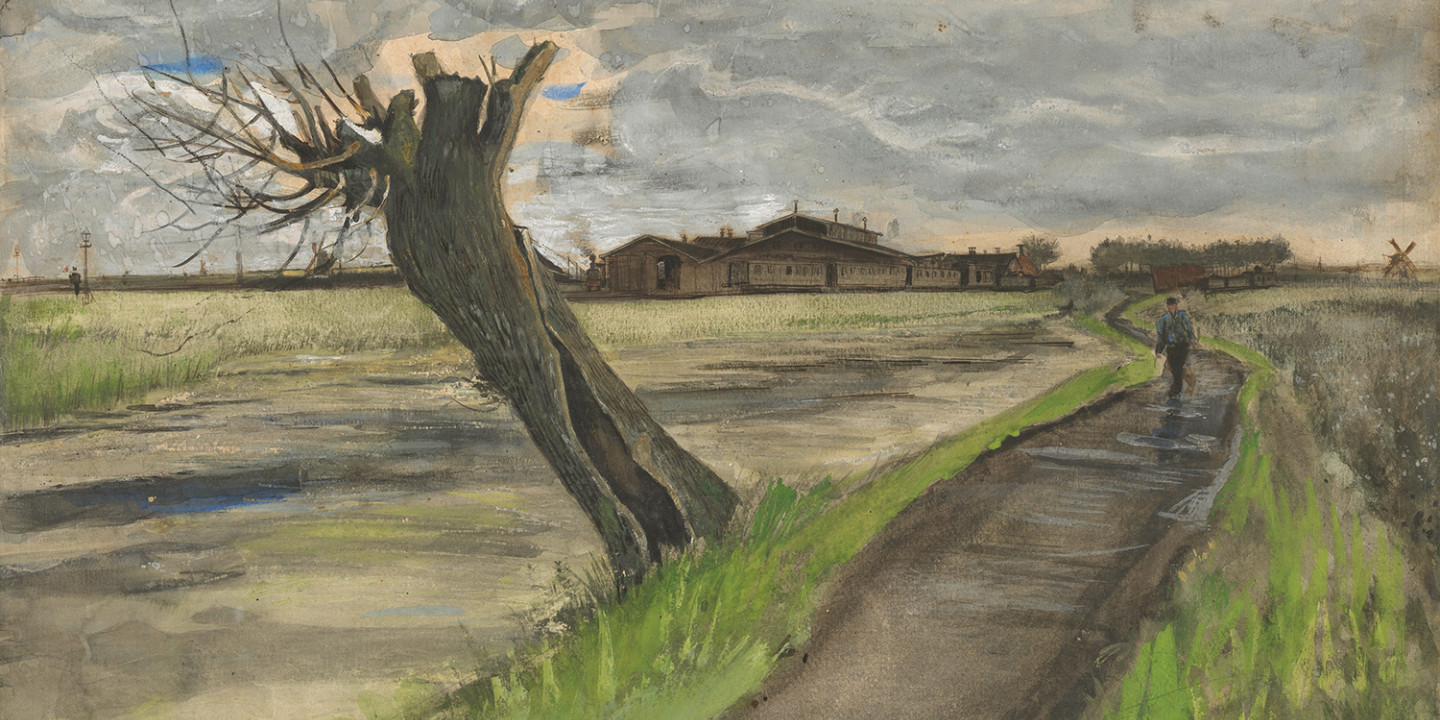
From a filthy, soot-stained London, in the depressive depths of the dark winter of 1874, a 20-year-old Vincent van Gogh—still seven years away from picking up a paintbrush—wrote to his younger brother Theo with the following advice: “Find things beautiful as much as you can, most people find too little
beautiful.”
This advice complicates my long-held assumption that we walk around in a basically ordinary world, and every once in a while we get interrupted by beauty—by a sunset, the laughter of a child, the year’s first snowfall. We have our own tastes, to be sure, determined by intricate combinations of genetic predispositions and culturally inculcated affinities that make one prefer, say, the ocean over the mountains or Picasso over Matisse. But still, I’ve always thought that beauty is something “out there,” and that every once in a while, when we’re lucky, it breaks in—a cycle of good fortune the frequency of which we cannot control.
Read our latest issue or browse back issues.
I’ve been reading Van Gogh’s letters, which are available online through the Van Gogh Museum. It has helped me uncover a deeper, more textured understanding of the word beauty. The dictum “find things beautiful as much as you can” is not merely a rephrasing of “beauty is in the eye of the beholder.” The beholder matters to Van Gogh specifically as an agent with the capacity to will themselves into seeing something as beautiful. Seeing beautiful things is, in other words, a matter not of taste but of a cultivated discipline of the eyes and mind. Nor is it something to be found within specially marked-out boundaries of the sacred, over against the secular or mundane. Van Gogh explodes those distinctions by giving us strategies for wresting beauty from quotidian moments themselves.
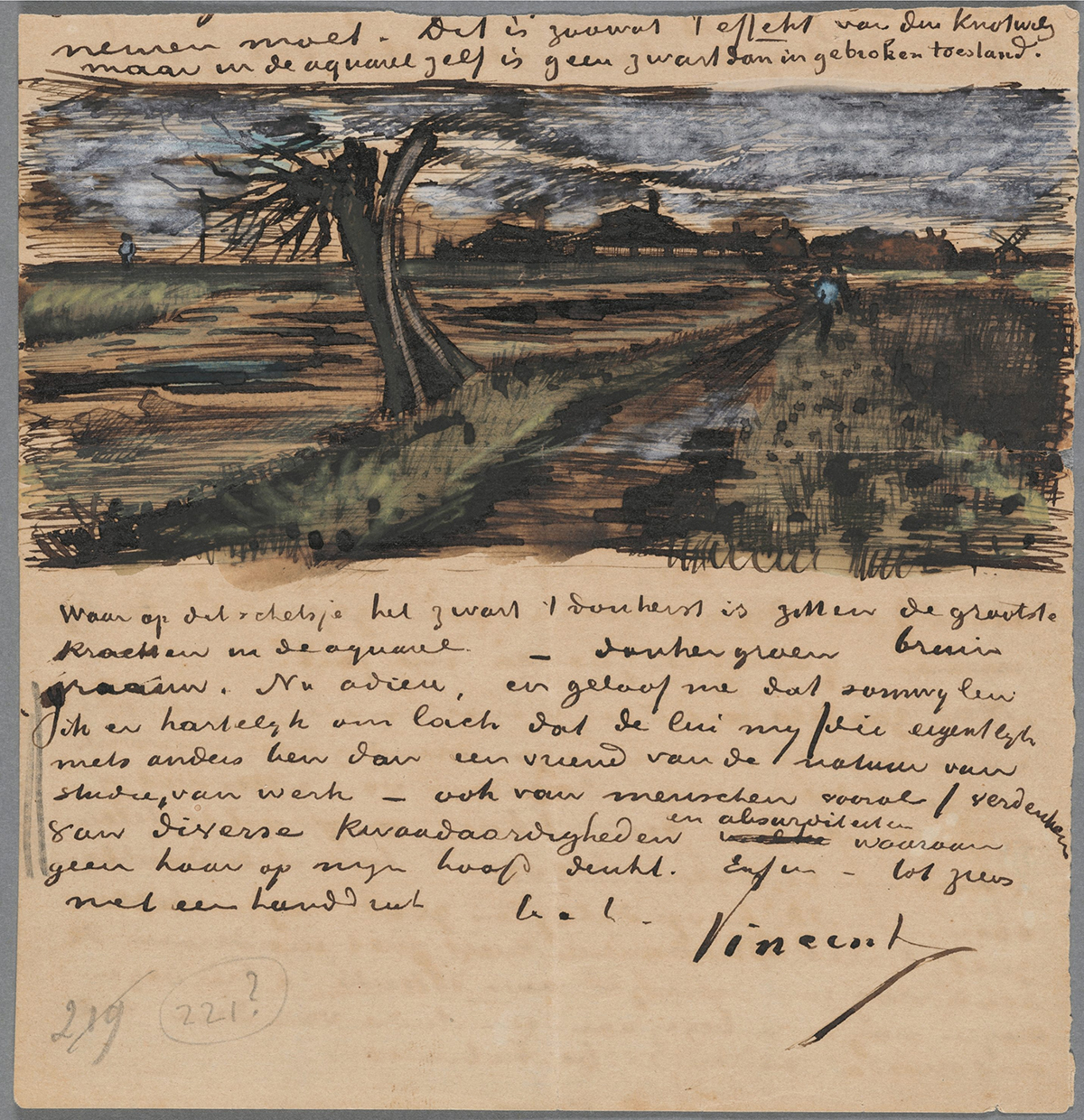
A sketch for Pollard Willow included in a letter from Vincent van Gogh to his brother, Theo (Courtesy of the Van Gogh Museum, Amsterdam [Vincent van Gogh Foundation])
He doesn’t exactly flesh out this process by offering step-by-step instructions at any one point. Instead, the road map is threaded subtly through his letters as a whole. Cultivating this ability comes down to two practices that are surprisingly simple and accessible to many people: walking and writing.
If Van Gogh was anything in life besides a painter, he was a walker. And he walked, as he would later paint, with ascetic intensity—walking for hours most days of the week for most of his life. He didn’t hesitate to get up and start a walk at 4 a.m. to hear a particular preacher on the other side of the city or to walk three or four hours to a nearby village to meet a distant relative and then return home the same day. Once, he walked 50 miles in one go—besting another famous walker, Charles Dickens, whose record was 30—from coastal Ramsgate to central London, stopping only to sleep for a few hours in the middle of the night under some trees before starting off again at 3:30 a.m., when “the birds began to sing upon seeing the morning twilight.”
One might point out that it’s not like he had a choice. Walking is an age-old concomitant of being poor, which Van Gogh certainly was. But his letters make clear that for him walking was a consolation more than a source of resentment. In another letter to Theo, he writes:
My journey began with a walk of more than 6 hours—mostly across the heath—to Hoogeveen. On a stormy afternoon with rain, with snow. This walk cheered me up no end, or rather my feelings were so in sympathy with nature that it calmed me down more than anything else.
Likewise, he commended the activity as consolation to others. Concerning a despondent fellow painter, Paul Gauguin, who was dragging his feet on moving south to Provence, Van Gogh prescribed the following medicine: “to eat [and] to walk with me in some beautiful countryside.”
Van Gogh moved house frequently, was ostracized from his family, and struggled to maintain many friendships beyond a few weeks or months—which is all to say, he was an enduringly lonely soul. His letters are littered with longings for companionship, and in these, one notices an illuminating habit of speech. Van Gogh often yearns not simply for reunion or embrace but specifically to go on walks in the company of others. This letter is typical: “Dear Father and Mother,” he writes, “Thank God Theo continues to get better, and bully for him, already walking in the snow to Het Heike with Pa, how I’d have liked to walk along with you both.”
When he’s calling to mind sweet memories, they’re also often of walks he took with friends or family. He writes to his parents of how wonderful it is to walk the streets of London in the evening with his sister. He wistfully recalls “many a walk that we took together last summer” to a prospective patron. Again to Theo, he writes: “I’m already looking forward to Christmas, two years ago we took that walk in the snow in the evening, do you remember it, when we saw the moon rise above Mariënhof?”
Van Gogh struggled when navigating his face-to-face relationships—he expressed his opinions too directly, his insecurity often erupting into scalding anger. Perhaps walking took the pressure off, like the stereotypical psychoanalyst’s chaise lounge, releasing the analysand from the tension latent within direct eye contact encounters. Walking instead facilitates a particular kind of side-by-side communion, where direct confrontation is opened out into a space for the mutual exploration of wider horizons, furnishing a posture for the imagination to search, wonder, and dream.
More than consolation, more than a mode of communion, Van Gogh occasionally even hints at walking as a discipline of moral formation. In another letter to Theo, he speaks in the imperative: “Always continue walking a lot and loving nature, for that’s the real way to learn to understand art better and better. Painters understand nature and love it, and teach us to see.” He sounds like Robert Macfarlane, writing 150 years later, who speaks of walking as an especially powerful tool for facilitating and enhancing one’s sight and thought, rather than what most assume it to be—a discipline primarily concerned with retreat and escape.
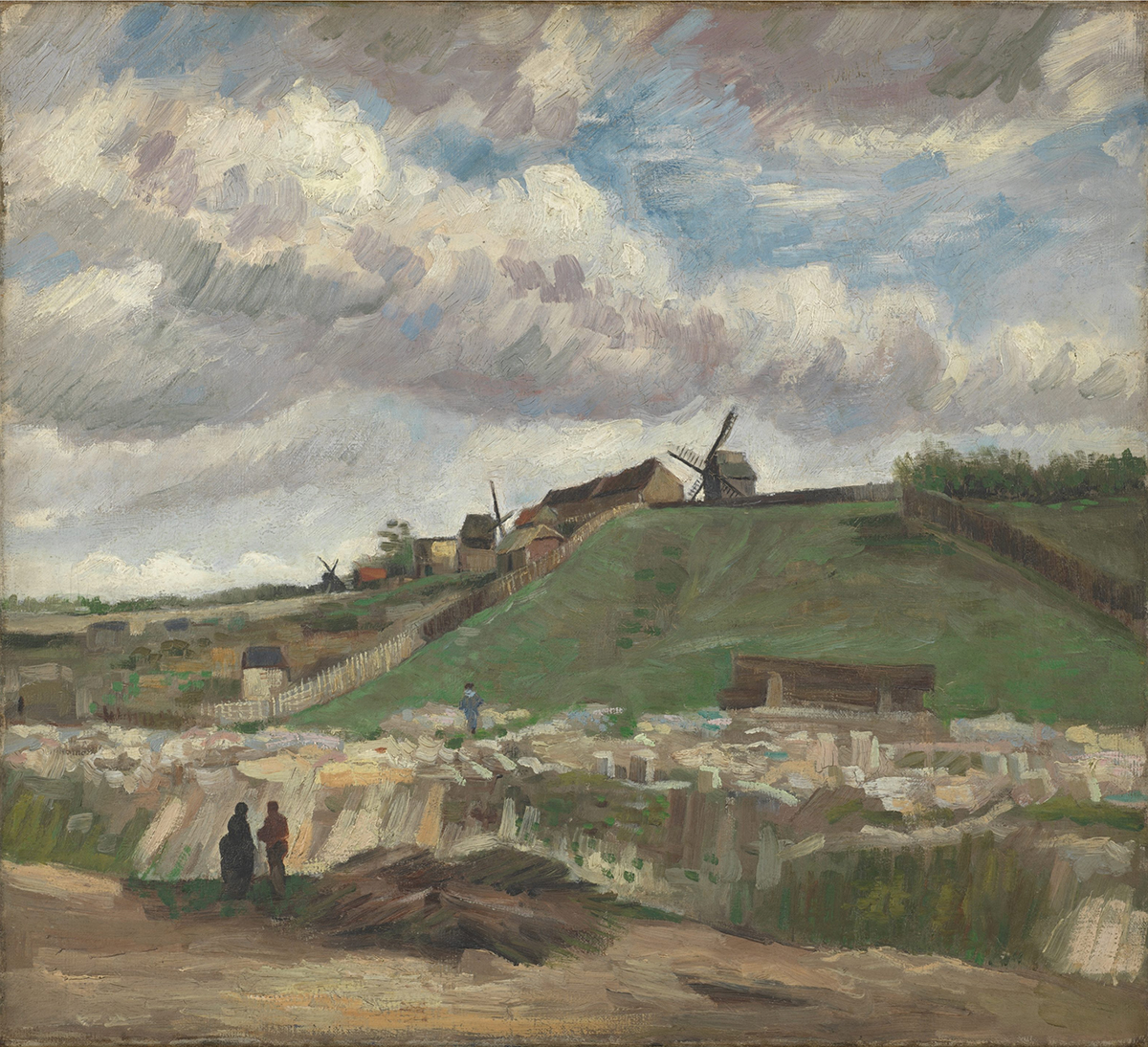
The Hill of Montmartre with Stone Quarry, by Vincent van Gogh (Courtesy of the Van Gogh Museum, Amsterdam [Vincent van Gogh Foundation])
For Van Gogh, perceiving beauty isn’t a matter of luck or even taste. It’s a cultivated discipline.
One further turn of the dial: in Van Gogh’s brief career as a preacher, walking takes on an even theological significance. In the first paragraph of his first-ever sermon, he proclaims plainly: “We are pilgrims, our life is a long walk.” Then he continues (for some 3,000 words!) to meditate on the Christian life as a journey and pilgrimage. Quoting God commissioning Abram toward the Promised Land, he writes to Theo: “Be blessed these days. Take a good look at the things around you—don’t forget them—walk through the land again, as it says: in the length of it and in the breadth of it.” Walking is not only a discipline of moral formation; it is a special, elevated mode of knowing and seeing.
The other determinative habit of Van Gogh’s life was writing, and letter writing in particular. Even in a day when writing letters was much more widely practiced, Van Gogh was, as ever, uniquely obsessive. He wrote voraciously—nearly a thousand letters, most of which are quite long, in the span of 18 years. The overwhelming majority of them were addressed to Theo, but they are also to fellow artists, including Gauguin, Émile Bernard, and Paul Signac. Van Gogh’s letters are many things: They are reflections on art, society, family, religion, and romance. They are pleas for help and for money. They are longings for companionship, and they are lies obscuring personal mistakes and professional missteps. But one feature common throughout them is this: They are a running documentation of what Van Gogh saw on his walks.
“Now let me tell you about a walk we took yesterday,” he writes to Theo.
It was to an inlet of the sea, and the road to it led through the fields of young wheat and along hedgerows of hawthorn etc. When we got there we had on our left a high, steep wall of sand and stone, as high as a two-storey house, on top of which stood old, gnarled hawthorn bushes. Their black or grey, lichen-covered stems and branches had all been bent to the same side by the wind, also a few elder bushes.
In another letter, Van Gogh describes the “sea of [sand] dunes, gleaming white in the sun,” the “black fields” of “morning twilight” littered with “oak trees with dark branches and grey, moss-covered trunks,” which gave way to “the sun, so simple and as big as possible, a real Easter sun,” the result being that “the sky was light blue, burnished and without a cloud.” Of course, his observations weren’t limited to walks. In one amusing example, Van Gogh records the story of a day his flat flooded: the frenzy of activity, the tragic consequences for the grocer who lived on the ground floor. He interrupts his own telling, however, to mention “the moon shone through the rain-clouds and reflected in the canals” and the fact that “the wind was blowing hard in the elm trees.” He can’t help himself, even in describing misfortune, from cataloging the beauty that glittered alongside it.
Such inventories of scene, color, light, and shape are in letter after letter. And what reads at first as meandering page-filler takes on a radical significance when you step back and reckon with its cumulative effect. All these examples quoted up to now are taken from letters written before he began painting, and yet they betray a distinctly painterly patience and regard. It’s not just a sun; it’s an Easter sun. His mind was already an index of art historical reference. He wrote of one specific rainy urban walk that it looked like a painting by Jacob Maris, of another over a dyke through meadows and farms that it reminded him of etchings by Rembrandt. He was already transposing the outside world into brushstroke.
As a matter of daily habit, he offered the world his deliberate attention, by putting himself in nature’s intimate proximity and by slowing down enough to describe its color and shape and life. Walking and writing are not a new combination, of course. “The compact between writing and walking is almost as old as literature,” writes Macfarlane in The Old Ways. But when Van Gogh finally picked up a brush at age 27, he brought these ancient, intertwined, wizening habits with him. He brought an imagination soaked in decades of walking and writing, his particular discipline of attention.
Once you understand Van Gogh as a walker you have a new filter through which to view his paintings. One might look at his several still lifes of shoes, such as A Pair of Shoes, with a touch more tender affection, pondering how many miles those soles trod and the imagination they fueled over the course of their use. One notices, too, a fair number of walkers charting a pedestrian course across his landscapes—surprisingly, often in pairs, as in Starry Night Over the Rhône, Les Alyscamps; Road with Cypress and Star; Landscape with Couple Walking and Crescent Moon; Village Street and Steps in Auvers with Figures; and Two Women Crossing the Fields.
But most importantly, scrolling through any catalog of Van Gogh’s work, it becomes almost obvious which scenes are themselves ones he discovered on walks. He often lugged along with him a cumbersome perspective frame, made of wood and wire, so he could more easily capture scenes he came across. His many late-career wheat field paintings from Provence come quickly to mind, as do the cypresses and the olive groves. But these walking scenes are scattered across the ten years that he worked, from the pollarded trees and steeple-dotted rural landscapes of his earlier years in his Dutch home, to the street views of Montmartre, through to the backyard gardens and country fields of Auvers, where he died.
However, these scenes are not true-to-life representations. What sets Van Gogh apart as an artist is not technical prowess or avant-garde subject matter; he was, for the most part, an unaccomplished draftsman, and the subjects he painted were categorically ordinary: wheat fields, potted flowers, cypress trees, and the working poor, all of which had been done before (Jean-François Millet, Charles-François Daubigny, Claude Monet). What has made Van Gogh one of history’s most beloved and popular artists is instead how he applied his imagination to each canvas. Each painting is a manifestation of his long-cultivated sight, one that is willfully noticing—drawing color, shape, beauty, and meaning out of every sunflower, every cloud, every star, and every human face; one that is finding in everything as much beauty as possible.
Van Gogh famously refused to paint from his imagination. As with many of the Impressionists, he insisted on painting en plein air, and as the cutting edge moved toward the symbolism of Gauguin, Van Gogh held firm. “I cannot work without a model,” he wrote to fellow artist Bernard. But he follows up this remark with an instructive qualification: “I won’t say that I don’t turn my back on nature ruthlessly in order to turn a study into a picture, arranging the colors, enlarging and simplifying.” For each canvas he would sit before his subject and open himself to the particular communion of delights available in the space between him and it, gently interrogating, pressing in, and leaving space until it gave its beauty up to him. “For my part,” he wrote, “I know no other way but to wrestle with nature until such time as she reveals her secret.”
This is Van Gogh’s magic. He places himself before his subject—whether human, plant, or meadow—and determinedly asks it: What is your secret? What about you is most beautiful? And then he waits for his brush to intuit an answer. As a painter, he communes with nature in the way he loved to commune with a human soul on a walk—an open-ended, side-by-side conversation, searching and wondering toward beauty. When Van Gogh wrote about his six-hour walk that his “feelings were so in sympathy with nature,” he captured exactly the collaboration that is embodied in his work as a whole. This is the method through which Van Gogh was able to see the coal mining district of the Borinage as “every bit as picturesque as old Venice, as Arabia, as Brittany, Normandy, Picardy, or Brie.”
His paintings and letters are left to us as an antidote to a world hollowed by a lack of beauty—or, better, a world that has lost the eyes to see the beauty that is already everywhere. If asked, many an average citizen of our secular age would say that we believe the world is beautiful in some kind of abstract, detached way, and at the same time, on a day-to-day, moment-to-moment level, we rarely experience it as such. Who wouldn’t want the experience of sitting before a sunflower to be as mesmerizingly enchanting as Van Gogh makes it to be for us? I fear we simply lack the discipline and the patience to get there. We are in too much of a rush to walk. We are too distracted to sit down and write. And so we don’t find much beauty.
I am a preacher, and if I might step into the pulpit for one moment: We don’t find much God, either. Many of us say we believe in God, but far fewer would say that we reliably or regularly see or experience God’s presence. What if this too is something we can change? What if this too is not a matter of God’s inactivity but a consequence of our uncultivated eyes? God’s presence need not be the unexpected interruption of a burning bush, nor limited to arenas specially delineated as sacred. God’s presence charges all creation with grandeur. The name of Jesus might be specifically invoked and recognized in the breaking of the bread, but it doesn’t change the fact that Jesus was still with the disciples every step of their long, side-by-side walk to Emmaus.
To put it more directly: What if what we suffer from is not too little of God’s presence but too much? Bonaventure wrote of St. Francis that he pursued God everywhere, through the divine traces impressed on things. Bonaventure could just as well have said that St. Francis found God in things as much as he could. Most people find too little God.