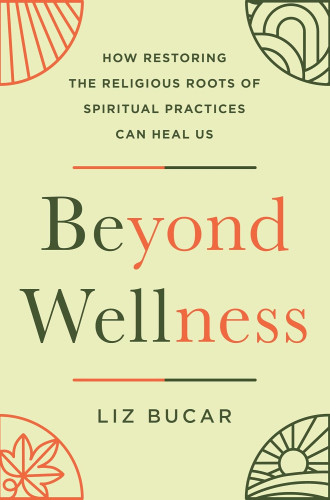
Beyond Wellness
How Restoring the Religious Roots of Spiritual Practices Can Heal Us
Spiritual but not religious. It’s been a truism for at least two decades: the rise of a cohort of people who are unaffiliated with any historical religious tradition and yet drawn to practices that offer an entrée into transcendence, or simply a way to feel more fit and whole. In Beyond Wellness, Liz Bucar argues that if the people who take up these practices go deeper—deep enough to understand their religious roots—they will find that the practices do more for them and ask more of them.
Bucar addresses seven practices many of us will recognize from contemporary culture: yoga, mindfulness meditation, twelve-step programs, religious foodways, fitness activities like SoulCycle, sound baths, and psychedelics. Each chapter opens with an overview of how the practice appears in American life. Some—like yoga—Bucar already engages in; the rest she takes up herself for at least a season. She then investigates how each practice has roots in a religious tradition or sensibility, and how popularizing the practice obscured that tradition. Her introduction frames this as a three-step process: learn how a practice’s religion was hidden from its practitioners, restore it by reconnecting the practice to its traditional meaning and communities, and apply those insights to our lives. The book, Bucar promises, goes deeper than the wellness these practices offer, pointing instead toward well-being—something that requires “conviction, discipline, and community.” In short, religion.
Read our latest issue or browse back issues.
Each chapter stands alone, connected only by the book’s introduction and conclusion, and each offers an intriguing look at its practice—especially the history by which the religious roots were obscured. Bucar’s treatment of yoga traces how South Asian religion vanished from the American understanding of the practice; she examines Sedlock v. Baird, the 2013 California case (upheld on appeal in 2015) that found the yoga taught in one school district to be secular, with no religious underpinnings. For Bucar, this demonstrates how thoroughly Americans equate religion with belief rather than practice. She shows instead how yoga inculcates religious understanding through posture and stance, a reading the ritual theorist Catherine Bell would endorse.
This is Bucar’s best chapter. It’s thorough, with a sound account of yoga’s religious roots: community, an awareness of both the Divine and the needs of those around us, the very union the word yoga names. It works, I think, because Bucar is a certified Kripalu instructor who trained for years, in community, under teachers—something the book elsewhere suggests practitioners needn’t do.
The other six chapters fall short of the standard the yoga chapter sets. In them, Bucar samples the practices, moving through these wellness movements like a spiritual-but-not-religious tourist. And touring is, in a sense, the very method the book recommends: understand a practice’s roots, reconnect it to community and ethics, but stop short of joining. Her readings are perceptive, but none carries the force of her material on yoga, and some feel hurried. The chapter on deep listening, for instance, opens with sound baths—particularly those using Tibetan singing bowls—and then turns to listening to sermons on cassette tape. The two are connected only by their aurality. A sound bath works differently from comprehending a sermon, however much both require listening. Bucar concludes that what matters is listening to sound in community rather than in pursuit of one’s own goals—but that is true of every practice she examines. The community matters, not the individual pursuit of wellness in isolation.
The book’s conclusion supplies the context these chapters need, gathering Bucar’s top ten religious insights into well-being, including the centrality of community, the need for ethics, the role of discipline, and the alignment of values. Our culture denigrates the religious, she argues, out of a deep distrust of religious institutions—and in stripping the religion from these practices, we leave ourselves less able to reach their wisdom and their power to transform.
Bucar is right that stripping the religion from these practices leaves us with less than we could have. The question her book raises but doesn’t fully reckon with is whether you can put the religion back in without putting yourself in too. Her own chapters supply the answer. The one on yoga works because Bucar submitted, over years, to a teacher, a discipline, and a community; the other six are thinner because she toured the practices they cover. That asymmetry tells us more than Bucar seems to intend.
Understanding a practice’s roots, however, is not the same as being rooted. You can read your way to the history, but the depth Bucar wants requires the one thing the wellness marketplace is built to spare us: joining something, and staying. Her best chapter is not the proof of her method. It is the exception that reveals its limits.