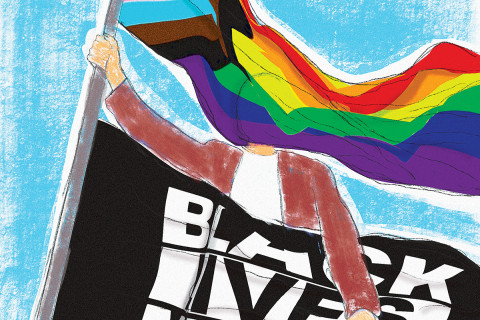
How Ableism Fuels Racism
Dismantling the Hierarchy of Bodies in the Church
In popular imagination, racism and ableism are often problems of isolated individuals, people here and there who do or say bigoted things. Conversations about intersectionality—the ways different marginalized identities get linked together within broader social structures—have only just begun to enter the mainstream. In much of the church, these conversations are still rare, although they are as necessary as ever.
Lamar Hardwick’s latest book thus comes as a vital contribution. Hardwick, a disability scholar and a Black autistic pastor, crafts an insightful examination of disability and racism in the church, focusing on the ways the two are entwined. His work is the rare introduction that is both accessible and detailed, making How Ableism Fuels Racism crucial reading for Christians seeking to do the work of justice. Weaving together personal experience, theology, and history, Hardwick presents a compelling case that ableism and racism support each other and must be tackled together.

Read our latest issue or browse back issues.
Hardwick begins with an approachable overview of ableism and racism. He defines ableism as a “hierarchy of bodies” in which nondisabled bodies are seen as superior. Of course, social structures perpetuate ableism, and historically, few have been as accommodating to it as the church. Here, Hardwick’s history is powerful, filled with illustrative examples across time. Early in the history of the United States, Puritan theology taught that children born with disabilities resulted from God’s punishment of “sexual deviance by the mother,” with several women even being put on trial for their “monstrous births.” At the same time, Hardwick demonstrates, White colonists justified slavery by casting Africans as “effectively disabled” and slavery as a kind of Christian charity. The ties between religion, race, and disability have been strong since the beginnings of American society. This story is not often told in classrooms, but it deserves to be—and Hardwick tells it with clarity and precision.
Even in more recent history, the church has been at the forefront of ableism and racism in the United States. When the Americans with Disabilities Act was passed in 1990, “religious institutions could exempt themselves . . . on the grounds of religious liberty,” which later became a model for avoiding racial discrimination laws. And contemporary Christian ideas of desirability play a role in shaping ableism and racism alike, Hardwick argues. Using evangelical theologian John Piper as a case study, Hardwick examines the “assumptions below the surface” of the church’s aesthetics, which often implicitly associate beauty with Whiteness and able-bodiedness. While we might think of beauty and ugliness as a matter of individual taste, Hardwick makes the case that our social structures shape what we consider beautiful, to the detriment of Black and disabled people.
What starts as an idea can quickly take on tangible consequences. Hardwick details the real cost of ableism and racism in contemporary society. Describing how “Blackness has been pathologized because of its historical connection to disability,” he explains the higher rates of mortality Black patients face across illnesses. Here his own personal experience comes into play, as he tells the story of a time when he was treated “as a drug-seeking patient” and sent home from the hospital for what were actually complications from cancer treatment. Social ideas of race and disability, spurred on in part by the church, cost people their lives. Passages like these reflect the power of Hardwick’s approach of setting personal stories alongside statistics and history to illustrate complex problems.
Although the church bears some of the blame for ableism and racism today, Hardwick points to reasons for hope within the church as well. While White Christians have fueled racism and ableism, the Black church has historically “provided a sanctuary for bodies . . . deemed deficient or abnormal” and serves as “a model for creating antiableist spaces.” Its “institutionally prophetic ministry . . . mobilizes the marginalized and gives voice to their experience of God,” even as there remains room for the Black church to grow with respect to disability.
New theological perspectives, too, might open the door to greater inclusion. Drawing from theologians such as Nancy Eiesland and James Cone, Hardwick challenges the church to counter oppressive theologies and work instead for liberatory ones. What the church needs, Hardwick says, is the “imagination that aids in seeing the connection” between Jesus and the marginalized. While these ideas will not be new to readers of liberation theology, for the uninitiated, How Ableism Fuels Racism offers a clear and intelligible introduction.
This is a compelling work. In less than 200 pages, it covers vast ground in its interdisciplinary approach, from the history of ableism and racism in the United States to how the church might respond. Study groups and individuals will profit from Hardwick’s work, emerging better prepared for the work of justice. This book is an important gift to the church—one that ought to prompt reflection and change.