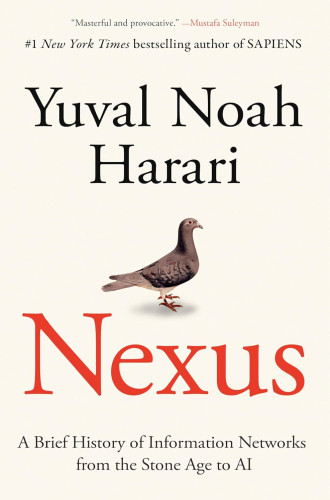
Nexus
A Brief History of Information Networks from the Stone Age to AI
As demonstrated in his best-selling works Homo Deus and Sapiens, Israeli historian and philosopher Yuval Noah Harari understands that the best way to empower readers—lost as we are in a maze of technological developments and social and political challenges—is to tell a story broad enough to embrace diverse elements of global culture, long enough to go beyond contemporary obsessions, and detailed enough to provide a compelling narrative. In his awesome and visionary Nexus, Harari amply accomplishes all these things and completes the achievement with apt illustration and intriguing contention.
Among the arguments Harari articulates, two stand out. First, he suggests that all societies must balance order with truth. Institutions tend to value stability and order. They cultivate stories not least to foster common identity and purpose. But often these myths aren’t true. Stalin’s Russia and Hitler’s Germany were swathed in fake history and false stories. In an account chilling in its pertinence, Harari shows how bureaucracy emerges as a system to facilitate the retrieval of information but, like mythmaking, imposes its own kind of order. To be caught in a tangle of procedure is to experience what happens when a system sacrifices truth to conform to its imposed order.
Read our latest issue or browse back issues.
You’d think the answer to oppressive regimes would be for disruptive innovators to come forward to proclaim truth. But it’s not so simple. Truth isn’t as straightforwardly liberating as it might appear. Prophets jeopardize order. Jeopardizing order often fails to yield the desired result; this has been the story of one violent revolution after another. The secret is to find the right balance between order and truth. That balance is what Nexus seeks to describe.
Harari has a second key theme: the key to a healthy society is its capacity for self-correction. His model for self-correction is the progress of science. When a theory is found to be inadequate, it’s superseded by a more accurate theory. Thus the Newtonian physics that was accepted in the 19th century was modified in the 20th by insights from relativity and quantum mechanics. Meanwhile, whereas homosexuality was understood by psychiatrists in 1952 as a mental disorder, by 1974 that perception had been dismissed. That’s how self-correction should work.
By contrast, Harari laments that religions tend to assume the infallibility of a holy book. He maintains that the Roman Catholic Church has demonstrated no capacity for self-correction. It struggles to identify institutional failure or doctrinal flaws. Instead it can only pin shortcomings onto individual misdemeanors. He makes the same point about centralized totalitarian regimes. A system that so prioritizes order over truth thereby lacks the facility for self-correction. It inevitably relies on oppression in the medium term and is doomed in the long term.
Harari’s theses are insightful and persuasive, but his assessment of Christianity is depressing. It’s bleak because Harari has little notion of faith other than the employment of myths to overcome existential fears and thus create order, and it’s disheartening because he sees the church as the imposition of order rather than the cultivation and practice of truth. While I think it behooves the church to lament and confess the reasons why someone as perceptive and insightful as Harari might have come to such conclusions, this description is at best sweeping and at worst prejudicially dismissive.
Rather than challenging the accuracy of Harari’s description, I think it’s more valuable to ponder how churches may hear his profound analysis as an occasion for renewal. After all, Harari himself says the most important takeaway of his book is “to commit ourselves to the hard and rather mundane work of building institutions with strong self-correcting mechanisms.” This feels like his version of Alasdair MacIntyre’s celebrated call for a new and very different Saint Benedict. Leading churches is about fostering an order that upholds truth.
With admirable patience, and with significant similarities to Mustafa Suleyman’s 2023 book The Coming Wave, Harari prefaces his discussion of artificial intelligence, the pretext for the whole project, with a deft and wide-ranging exploration of information more generally. He’s bewildered by the confidence of comparisons to previous transformations such as the Industrial Revolution. With fascinating acuity, he points out how the print revolution led not just to scientific breakthroughs but also to witch hunts and wars of religion, while the advent of newspapers and radio was not an unequivocally democratizing force but was exploited by totalitarian regimes. Harari has a sharp eye for the unforeseen negative consequences of apparently benign developments—and a critical judgment of any who assume AI will simply be a blessing.
The most remarkable part of the book is the way he describes, most uncannily, almost all the key features of the first year of the second Trump presidency—despite the book being written before the 2024 presidential election. It seems he can do this because of his unflinching capacity to look straight into the heart of power, human dynamics, and historical processes and never choose what he would personally prefer over what these three phenomena tell us. As the world faces timeless challenges in new guises and unprecedented technological manifestations that threaten new forms of tyranny, it seems we have no surer guide to our capacities and callings than Yuval Noah Harari.