Etna
A Novel
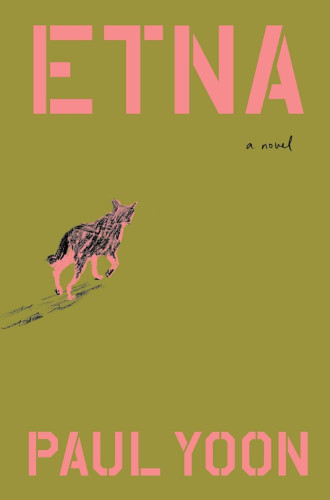
In a war-torn fictional country, a young dog is taken from a farm near the coast and trained by American military advisers to sniff for landmines, locate enemy soldiers, attack, and kill. At war’s end, amid continued fighting, Etna tries to find his way back to that farm, if it still exists. This is not a heartwarming children’s tale of a dog’s journey home, such as The Incredible Journey by Sheila Burnford. It’s a harrowing story with a bare thread of faith running through it.
Paul Yoon has written before about refugees and homeless people, inspired by his grandfather, a Korean War refugee who started an orphanage. (While Etna’s contemporary setting is not named, its geography does suggest Southeast Asia, and there is mention of an orphanage.) In his afterword, Yoon acknowledges John Berger’s novel King, about a dog who lives among the unhoused people of a fictional city. The similarities between these books extend to their layouts, with white space after each paragraph. They share apocalyptic landscapes in which simple kindnesses stand out.

Read our latest issue or browse back issues.
Like King, Etna can communicate with a few humans telepathically. At first we marvel at his sophistication, but once we suspend disbelief and accept that a dog can be told about travel books, then we can accept other literary conceits. A doctor named Soojin names him Etna after the volcano in Sicily, just as she has named another dog Fuji for the holy volcano in Japan. Yoon underlines allusions thickly, particularly to Greek mythology. One of the soldiers is named Achilles, another is Jason, and Etna’s journey home will bear parallels to the Odyssey.
The history of literature has seen so many homecomings from war that we can only guess why Yoon seeks these comparisons. He’s a prize-winning author who measures himself against the best. His athletic prose wants to run and pounce. Not all that long ago, he was named one of the best writers under 35; now at 46, he may identify with an old, scarred war dog.
With Etna, he has given himself an extra challenge: a narrator whose understanding of the world is only sensory. Etna sees, hears, tastes, smells, and suffers but cannot imagine something unfamiliar. Not all canines in the book have this limitation. A dog named Semeru (volcano in Java, abode of gods) tells Etna that he has been dreaming of a well deep in a forest:
For a long time, it was all I dreamed. Then I met another dog one day who dreamed the same thing and I thought it must be something we all dream. . . .
Semeru looked down at his reflection.
I’ve never seen a well, he said. In person. I just know what it is because of the dream. . . .
Faith, I said. It’s faith.
Yes. Faith. What do you believe in?
The coast, I said. I believe in getting to the coast.
(“All dogs dream of forests, whether they’ve ever been in one or not,” says Berger’s King. “Even Egyptian dogs dream of forests.”)
This well is just one of the signs that Yoon is taking us into spiritual realms. Before the tale is done, Etna will see this well, too, but first he will drink from all kinds of foul sources, lose his fur and a lot of blood, and become a shadow of himself. Yoon’s prose remains about 18 inches off the ground, so spare that its ribs sometimes show:
All the men we were with killed other men and sometimes animals, and I killed, and Fuji killed, and the other dogs killed. We lost men. We lost dogs. We met up with more men and their dogs from other units, and we worked and traveled and fought and killed.
This reader would have been glad for more dog-consciousness, that is, more passages that show another way of apprehending the world, as when Etna says, “I listened to the fabric of the young woman’s uniform moving across her thighs as she walked around, the leafy smell of the back of her neck suddenly everywhere in the air.” More often, the sentences just do their job with brutal efficiency.
Yoon’s spiritual tale uses a dog’s lifespan as shorthand for human mortality, although the people in it also age rapidly. Soojin, “in her late twenties, still young for a human” at the start of the novel, reappears after four years of war as an old woman.
As Etna’s suffering increases, so do the signs of something beyond. In a curious detail, he hears a bullet fired before it hits the windshield of his car—as if the bullet has traveled more slowly than sound, or as if he is in two places at once. Near a forest, he and Semeru find an otherworldly stone well that smells of “far water. Earth water. Ancient water.”
Back on the farm, there were birds everywhere, and one in particular hovered near when Soojin gave Etna his name. By war’s end, they have all but disappeared, save for one, perhaps the same bird, whose wings have “bright sound” and “infinite span”:
What kind of bird are you? I say.
The bird blinks, sits up straighter, and puffs up her feathers.
The best kind, she says. An ancient kind. The forever kind.
Etna’s dialogue with this enigmatic bird lasts longer than any other in the book, like certain other passion narratives. It is not clear whether this is the end of life or the beginning of afterlife, whether Etna has reached home or gone home. Earlier stories have sown doubts, so this bird may be a mere illusion, though the dream logic of the book says otherwise.
Yoon asks this brief novel to carry a wide range of allusions, from the Odyssey to theodicy. Despite exceptionally clear prose, however, he leaves the ending ambiguous. And that is true to our experience. We may better understand what it means to be human, he suggests, if we see through the eyes of dogs, trying to apprehend a world that is not quite our own.