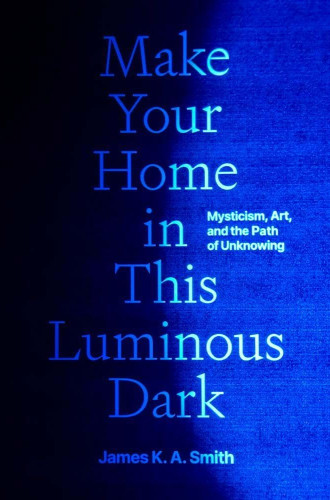
Make Your Home in this Luminous Dark
Mysticism, Art, and the Path of Unknowing
As a former Twitter obsessive, I vividly remember the weeks after I deleted social media for good. I read books in one sitting for the first time since childhood; I felt binary extremes fade from my mind; and a deeper peace settled over me. Reading Make Your Home in This Luminous Dark, I found myself thinking of those weeks and what it meant to rediscover attention and calm. Philosopher Jamie Smith takes on the spiritual malaise of our day—extremism, anger, loneliness—and turns to the timeless wisdom of Christian mysticism. Ultimately, he argues, we need to let go of black-and-white absolutes and dwell in the serenity of the luminous dark that faithful unknowing can bring. Yet frustratingly, with his own stark dichotomies between mysticism (good) and reason (bad), Smith doesn’t quite escape the problems he so well diagnoses. What results is a book that wavers between dazzling and disappointing.
The core of Make Your Home is its faith in the value of mysticism, rooted in Smith’s own life story. As a philosopher, Smith spent most of his life honing fine-pointed distinctions and ultra-abstract arguments. Then he went through a period of depression, and all his knowledge was no help at all. Instead, he found solace in his family’s support, as well as in the Christian mystics, who spoke of unknowing, of the powerful places that lie beyond human reason. It’s a moving, vulnerable conversion story from a lifeless philosophy to one that breathes, or, in Smith’s words, a journey from “either-or” philosophy to “both-and” mysticism. Smith learned to trust in humility and intimacy rather than mastery and analysis.
Now, Smith wants to bring “a mystical attunement back to philosophy.” He admires philosophers like Edmund Husserl but draws more from Christian mystics like Teresa of Ávila, as well as artists of all stripes. Smith makes a compelling case that philosophy has been too narrow-minded. A good painting can teach just as much as a Platonic dialogue, so why don’t we value both as sources of wisdom? And Smith practices what he preaches. Academic philosophy can sometimes treat gorgeous ideas with the dull prose of a science textbook, but Smith’s writing flows smoothly. Sometimes he is elated over love (where “subtraction is gain”), sometimes caught in tranquil wonder over our “infinite cosmos.” Make Your Home demonstrates that the mind cannot flourish without the heart.