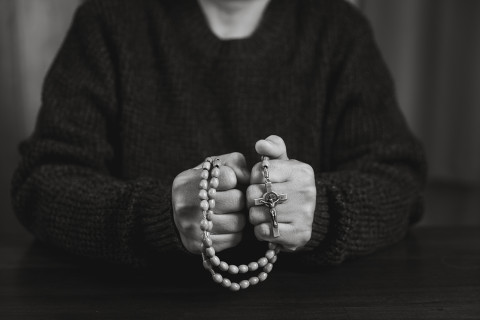
Sometimes we carry wounds for a lifetime, and then something happens that breaks our hearts enough to let us know that it’s time to speak. I no longer feel that I can be silent about the pain I’ve experienced as a woman in the Catholic Church.
Maybe it’s because I have a daughter now, and she’s full of both faith and fire. Maybe it’s because I believed Pope Francis when he stood in front of thousands of people and chanted “todos, todos, todos,” promising a church with space for all of us. Or maybe it’s because ecumenism is real. As I’ve watched Sarah Mullally, the first woman to serve as archbishop of Canterbury, meet with Pope Leo, listen to Palestinian Christians, and address church leaders in Jerusalem, I can’t help but reimagine the rooms that we as faithful women might belong in.
Read our latest issue or browse back issues.
All I know is that something is shifting inside of me. To tell the truth about what we’ve been living is the only way I know to be faithful now.
In June, the Dicastery for Divine Worship and the Discipline of the Sacraments at the Vatican issued a response to a request made by the German bishops. The bishops had asked “to permit, in exceptional circumstances, a duly commissioned lay member of the faithful to preach in place of the homily during the celebration of the Eucharist.” This would have allowed Catholic women, including women religious, to preach during the mass. They might have preached about Martha and Mary, about Mary Magdalene spreading news of the resurrection. Women who are theologians or spiritual directors would have shared their gifts.
The Vatican Dicastery rejected the request, arguing that the homily is linked to the sacramental nature of the liturgy and as such can only be given by an ordained priest or deacon. Since women cannot be ordained, we cannot preach during the mass.
When I read the response, I experienced an unexpected wave of grief. We live in a world in which women lead countries, travel to space, win Nobel prizes. For many Catholic women, the church is the last place in our lives in which we experience this degree of inequality. It is also confusing, because the church is our home. Clericalism might begin with the priesthood, but it normalizes male authority in a way that affects all other aspects of life in the church. The result is that women are often sidelined and dismissed.
It is no secret among Catholic women that we’ve been hurting. We have long spoken quietly among ourselves. I have heard from women who were told by male priests that God wants them to suffer. I’ve heard from qualified women who have applied for jobs in the church and been passed over for clergy and from others who have not bothered to apply. I have watched women from other churches engage in ecumenism in our church and walk away startled by how they’re treated. On one occasion, a female volunteer I knew was even asked by a priest to iron his shirts. These things are often experienced by the most faithful women, those who you might least expect are hurting.
One of the main tasks of our spiritual lives is to resist internalizing this negative image of ourselves or carrying it into the other spaces of our lives. The problem is that once that image—of belonging on the side, of not being considered—gets into the most intimate part of your life, it is very hard to get rid of it.
Even when the Catholic Church allows for women to participate, it doesn’t necessarily happen. It caused a minor stir when Pope Leo was assisted by altar girls during a mass. And although it’s permitted to wash women’s feet on Holy Thursday, most Eastern Rite churches don’t do it.
My own church is one of them. This year my daughter turned to me and asked, “Why are only the men having their feet washed?” She was ten years old.
Many of us fear talking about our pain, afraid of being silenced or sanctioned. I’m a writer, and even I’m afraid. Our starting point is often dismissed: We are told that what we experience is not in fact inequality. We are told that women and men are equal in the Catholic Church, made in the image of God and endowed with equal dignity but that we have different gifts. Yet that argument wouldn’t be accepted in any other context. What’s more, doing theology from the ground up means that our wounds have something to say in this matter. We’re a church on pilgrimage, and if so many of us are still hurting, I can’t believe that we’ve arrived yet.
Keeping silent about this power imbalance in the church is not just dangerous for women. It creates a culture in which we become less inclined to notice or speak up when we see injustice in other contexts—with the poor, with migrants, with people suffering from war or structural violence. These issues are inseparable and require the same moral courage, a muscle we learn either to use or to suppress.
I am writing this with a request. If you have Catholic women in your lives and you care about them, take the time to sit down and ask them if they’ve been wounded by the church. But please, only ask them if you want to hear the answer. You might consider holding something in your hand while you listen—maybe a stone or a cross—and squeezing it any time you are are tempted to dismiss their words, to become defensive, to offer explanations, or to provide reassurances. Just listen.
Perhaps those you ask will never have been wounded, in which case a conversation might occur about gifts in the church. That’s lovely, too. Nothing has been lost in the asking. But there might be others who feel invited to speak about the burdens they’ve been carrying for too long, often alone.
To listen is friendship. It is church. But it is only a beginning. I also ask that you carry any wounds you hear into the rooms we are not invited to enter. Carry the witness of our pain. Or even better—insist that we be present in those rooms, so we can finally speak for ourselves.
It’s long past time. Our wounds have something to say.
The deck at the top of this article, immediately after the title, was edited on September 10 to clarify that the German bishops’ appeal was about lay preachers generally, not women preachers in particular.