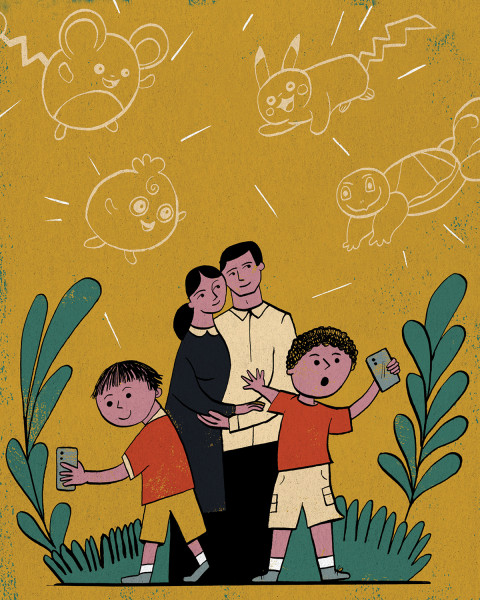
“Can you pull in here? There’s a shiny!” Several years ago these excited requests echoed from the two boys in the back seat of my SUV. I’d just navigated the afterschool pickup, and a few blocks later they were begging me to turn into the parking lot of a nearby church to pursue something shiny that I could not see. But the boys could see it. They were playing Pokémon GO on the older one’s phone, and they had happened upon a “shiny,” a rare, coveted, version of one of the creatures that inhabit the game.
Since then I’ve learned far more about this augmented reality mobile game, in which hundreds of species of imaginary creatures can be seen, caught, evolved, and traded as they move through their virtual terrain layered upon the physical landscape. I often think that Pokémon is a late-capitalist venture in creating an enchanted world.
Read our latest issue or browse back issues.
I use the term enchantment following philosopher Charles Taylor and his work as mediated by theologian Andrew Root. Root, following Taylor, describes our time in the Christian West as a time of fragile belief, in which the sacred no longer sets the agenda for the whole of a society, in which fewer people express or enact faith in public ways. Taylor has noted that our age is the first in human history in which religious unbelief has become not only possible but prevalent—because the Christian West has cleaved the transcendent from the immanent and the public from the private. Exploring the benefits of the secular age is another subject. What interests me here is the ache, the loneliness, the displacement and anxiety that follow the loss of enchantment—and the ways that Pokémon’s world seems to bridge the gaps that brought about our disenchantment.
It turns out that our surroundings are inhabited not just by the Pokémon many of us cannot see but also by crowds of people pursuing them. The regular players near our home are parents and kids, older and younger siblings, Gen X and Gen Z and Boomers. If you’ve seen people walking slowly en masse, phones out and heads down, you’ve probably encountered Pokémon players. When Pokémon GO first emerged in 2016, it was accompanied by significant reports of pedestrian injury and distracted driving.
But the draw of playing Pokémon together persists. We’ve allowed our older Pokémon player to take the train to downtown Chicago to participate in public events with thousands of other players. He comes home footworn and exhausted, having crossed multiple miles on this meandering public pilgrimage. My husband took up the game, solely as a reason for our teenagers to hang out with him. They take walks around the neighborhood in pursuit of their prizes. Some weekends they join groups of people playing at our local park or snaking their way through the center of the village while traversing the mythical, mystical landscape generated by the game.
The game blurs the boundaries between secular and sacred. Players have been known to wander or trespass onto private or sacred property. Arlington National Cemetery and the United States Holocaust Memorial Museum have both asked the public to refrain from pursuing Pokémon on their grounds. When we first moved to the parsonage where we live, I’d notice pedestrians stop and linger, glancing at their phones at a certain spot on the sidewalk adjacent to the church play yard next door. It turns out that there is a PokéStop on church property. Unbeknownst to most of the congregants save my husband, the boys, and possibly the other kids in the youth group, Pokémon “spawn there and you can get [useful] items,” as our older son explained it to me.
The transcendent has been cleaved from the immanent and the public from the private. But Pokémon seems to push in the other direction.
I appreciate the way Pokémon draws people outdoors, invites people to traverse their neighborhoods, and draws people into real-life encounters with one another. As Andrew Root notes, for the church, the antidote to the diseases spawned by the secular age is not further busy-ness, valuing an accelerated existence inflated by the secular age itself. Rather, like German sociologist Hartmut Rosa, Root suggests seeking something quite different: resonance, a feeling of attunement to others, a feeling of being fully at home in the world, and a timelessness that overcomes a sense of life as just a busy series of events. My hunch is that Pokémon players experience some of this resonance with one another, as hours spent outdoors with others pass in an instant.
After a few years adjacent to the Poké world, I view it with fascination for its enchantment and with the affection our family has for its creatures: Snorlax, Lanturn, Kubfu, and my two favorites, the turtle-like Squirtle and Turtwig. And yet, Pokémon’s enchantment has limits. It is a capitalist product of a disenchanted secular age. Those with money to spend can gain access and succeed in a way that evades those who play only for free. Like real-life resources, Pokémon resources are located disproportionately in urban and suburban areas rather than rural ones. And everyone playing the game is tracked by surveillance software.
Thankfully, the players in our household also live in the world of the church, baptized into its community, nurtured by congregations that offer their own deceleration and resonance—that speak a language of apostles, ancestors, and angelic creatures who inhabit a spiritual landscape we perceive not with our eyes but with our hearts. This summer, one of those congregations called our older Poké player forth, laid hands on him, and blessed him before he departed for his first term in college. He’ll be among the Pokémon players on campus. He’ll also be surrounded by the cloud of witnesses who are here with us right now, even in our secular age.