Books

When ecumenism foments hate

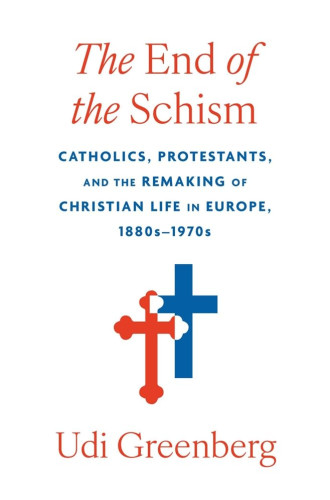
Udi Greenberg’s history of the ecumenical movement locates the errors—such as colonialism—that underlaid the project from the start.

In 2017, La Civiltà Cattolica published an article arguing that American Catholics and evangelicals were engaged in an “ecumenism of hate.” The coauthors, an Italian Jesuit and an Argentine Presbyterian, were both close associates of the late Pope Francis. Their article, highlighting American initiatives such as Evangelicals and Catholics Together, argued that such movements perversely utilize the language of ecumenism to propagate ideas that run counter to the gospel. How could ecumenism—once viewed as the way out of centuries-­old schisms and divisions to some kind of understanding—have spawned new kinds of hatred?

Udi Greenberg’s The End of the Schism provides an answer to this contemporary problem by way of a prequel. A historian at Dartmouth, Greenberg provides a historical tour of the ecumenical movement in Europe, focusing on four distinct periods. These periods, constituting the prehistory and phases of the ecumenical movement, delineate the movement’s great success yet also demonstrate the ways in which the seeds of today’s problems were planted at its first flourishing.

Given that missiology and global Christianity are key sources of ecumenical collaboration and tension within the churches today—particularly in places like Latin America, where evangelical missions have upended centuries of Roman Catholic dominance—it is not surprising that Greenberg highlights colonialism within the European roots of ecumenism. In the 19th century, competition among both colonial powers and churches—in Asia and Africa especially—led to poor denominational relations and a desire to improve them. The imperialist “great game” gave way to a patronizing “civilizing mission” that could be shared, sometimes uneasily, across denominations. Only at the end of the period Greenberg highlights did the process of decolonization become an ecumenical cause.

The Nazi era in Germany famously provided moments of both witness and shame for various Christian churches, and this was also the case for the ecumenical movement as a whole. One of the most shocking points of Greenberg’s book for some readers will be his emphasis on the way in which the Nazis spurred on the ecumenical movement for their own reasons. The co-optation of the Catholic and Protestant right are well known, but the way in which that very moment fostered ecumenical collaboration and understanding has been less emphasized. At the same time, figures such as Yves Congar and Roger Schutz began to establish the basis for an ecumenical anti-fascism. This movement undergirded others such as the French Resistance and bore out in ecumenical collaboration among elites in postwar democracies such as West Germany, as well as ultimately in substantial church reforms such as Catholic openness to ecumenism at the Second Vatican Council.

The book’s discussion of “radical ecumenism” focusing on political theologies and movements of the 1960s represents a kind of truncated path, ended by secularization and the end of the Trente Glorieuses (Europe’s three decades of prosperity following World War II). Greenberg’s temporal framing closes off discussion of ecumenical responses to advancing secularism in Europe; its geographical framing also tends to remain on the Western European side of the Iron Curtain. It is in the former Soviet bloc—particularly Hungary under Viktor Orbán, a denominationally diverse country led by a Protestant which has become a haven for an ecumenical assortment of Christian nationalists—where these political dynamics have played out most acutely.

Greenberg’s European focus makes the scope of the book manageable but also misses some ecumenical elements more specific to the American scene. The influence of World War II in this country was also crucial for ecumenical relations, with the distinct addition of a shallower and faster-­fading antisemitism that allowed for Will Herberg’s classic “Protestant, Catholic, Jew” consensus. At the same time, defensiveness at elite and institutional levels, combined with the lesser shock of the war, continued to sustain both genteel anti-Catholicism in figures such as Paul Blanshard and Norman Vincent Peale and the general coolness of triumphant institutional Catholicism toward Protestants until at least Vatican II. Uniquely American figures such as Billy Graham and Robert Schuller who bridged denominational divides (among Protestants but also with wide admiration from Catholics) also highlight the influence of mass media on ecumenism in the American context.

In a time when the United States and Europe are once again facing crises of democracy and versions of Christian nationalism are finding broad appeal, Greenberg’s book highlights an essential history. It would behoove American Christians especially to learn this history and to think about how the German examples in particular might serve. Read alongside other recent works such as Tim Alberta’s The Kingdom, the Power, and the Glory, Greenberg’s history suggests that perhaps what is most needed at the moment is less a denominational than an ideological ecumenism. Crises make for uneasy alliances, and the present is a time that may require evangelicals, liberal Protestants, and Catholics of various stripes outside the far right to find ways of working together even where some of them may have sharply differed in the recent past. The End of the Schism offers not so much a road map as a cautionary yet hopeful tale.

Daniel Rober

Daniel Rober teaches Catholic studies at Sacred Heart University in Fairfield, Connecticut.

All articles »