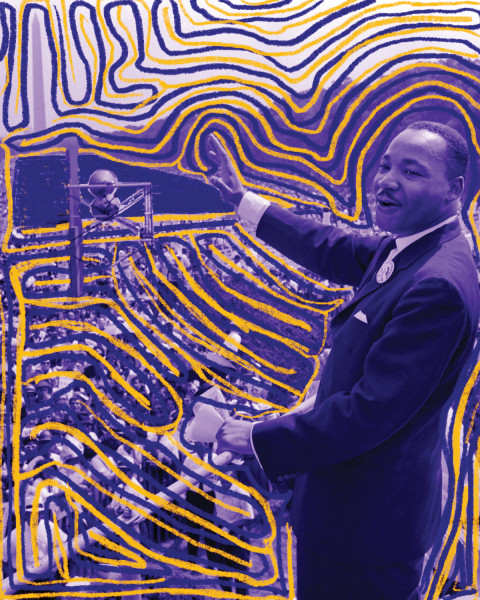
On August 28, 1963, standing before the Lincoln Memorial, Martin Luther King Jr. delivered one of the most important speeches in American history. While remembered primarily for his dream of racial equality, King’s address at the March on Washington was also a profound reflection on the nation’s
contradictions.
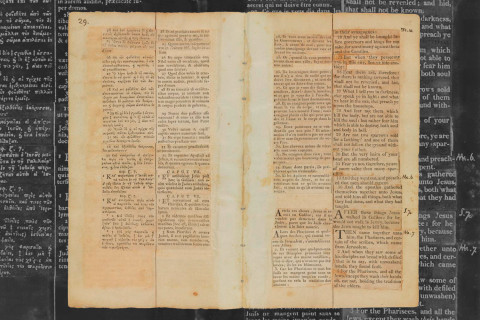
Early in the speech, King reminded his audience that the nation’s founders had written what he called a “promissory note” to which every American was meant to inherit. The Declaration of Independence and the Constitution, he argued, embodied a promise of liberty, equality, and justice. Yet for millions of Black Americans, that promise remained unfulfilled.
Read our latest issue or browse back issues.
The date itself carries a deeper significance. Exactly eight years earlier, on August 28, 1955, 14-year-old Emmett Till was abducted from his relatives’ home in Mississippi, brutally murdered, and discarded in the Tallahatchie River after being accused of offending a White woman.

That the lynching of Emmett Till happened on the same date as King’s “I Have a Dream” speech, eight years apart, is more than a historical coincidence. Together they illuminate a central truth about America: It is grounded in two contrasting narratives.
One is the narrative that has become the nation’s “official” story. It is the one we are encouraged to teach in our schools, the one we commemorate on our national holidays, the one that is invoked to demonstrate the greatness of America. It is the story of a nation founded on the “self-evident” proclamation that all people are created equal and endowed with “certain inalienable rights” such as “life, liberty, and the pursuit of happiness.”
The other narrative is far less glorious. It is the one we are called to discard in our teaching, the one that is effaced in our public celebrations and memory. It is the story of conquest, slavery, exclusion, and the denial of humanity to entire groups of people. It is the story of a nation whose founding ideals coexisted with the buying and selling of human beings. It is the story of a country that proclaimed freedom while millions remained unfree. It is a story that imagined equality and inalienable rights as applying only to White, propertied men.
These are not mutually exclusive versions of American history. Rather, they are two truths that have existed simultaneously. Nowhere is this more evident than among the nation’s founders.
More than 40 of the signers of the Declaration of Independence enslaved human beings. Thomas Jefferson, who wrote that all men are created equal, enslaved hundreds of Black men, women, and children during his lifetime. In his Notes on the State of Virginia, he argued that “blacks, whether originally a distinct race, or made distinct by time and circumstances, are inferior to the whites in the endowments both of body and mind.” George Washington, commander of the Continental Army and the nation’s first president, also enslaved hundreds of people.
These were not incidental flaws or isolated failures of individual founders. Nor were they merely the shortcomings of a particular generation. They were embedded in the social, political, and economic fabric of the nation itself.
King understood this. He neither ignored the nation’s failures nor dismissed its ideals as meaningless. Instead, he exposed the distance between what America professed and what America practiced. His dream was not rooted in historical fantasy. It was rooted in truth.
The point of the matter, which King no doubt understood, is that the truths a nation ignores often reveal the injustices and inequalities it is willing to accept. What is left unexamined can become normalized, woven into the fabric of everyday life. These injustices persist when people become more committed to embracing the more comforting historical truths than to facing the more difficult ones.
As the nation celebrates its 250th year of existence, the challenge is not deciding which version of the American story to preserve and which to discard. The challenge is whether we are willing to tell the whole story—whether we are willing to confront the truth in all its contradictions.
And so, as we remember King’s speech, we must also remember Emmett Till. To remember only one is to misunderstand both. Honest history requires us to hold them together. Only then can we understand that the same nation capable of producing the racial terror that claimed Till’s life was also capable of producing a movement that challenged that terror in the name of justice—and thus commit ourselves neither to a romanticized view of history nor a cynical one but instead one that compels us to close the distance between its contradictions. The challenge for this 250th year of our nation should be one of confronting the truth of our history so as to fully understand the nation’s past and better realize the ideals it has long claimed.