I was scrolling on my phone as the gate agents worked through the preflight boarding groups. “Families with children under two. Those who need extra time to board.” As usual, one or two people or families presented their boarding passes and disappeared into the jet bridge. “Active duty military are now invited to board, thank you for your service.” I didn’t notice them at first, but after the third beep of a boarding pass, I looked up out of curiosity to see a line of at least 50 soldiers, the men with tan rucksacks and sharp fades and the women with long hair wrapped into almost identical buns. They couldn’t be past their early 20s, but they carried themselves like they had done this trip before. They were not scared new recruits. And every one of them had brown skin like mine.
The war with Iran had just begun. I don’t know if they were coming or going, but I couldn’t help but wonder what brought them all into that life. Was it necessity or a sense of call or duty? Were the options before them so few that they were willing to take risks and make sacrifices for an administration that would so readily deny their citizenship? Or did they believe in an America I didn’t see? I wondered if they were fulfilled, or conflicted, or numb, or just trying to do a job.
Read our latest issue or browse back issues.
Eventually, my boarding group was called. I found my seat and there I was, sitting in their midst as they flicked through movies or dozed off or scrolled through their phones or chatted with their fellow soldiers.
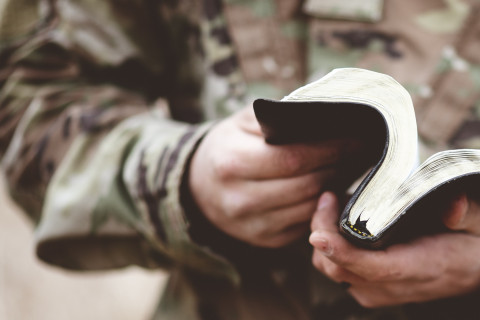
I thought about them throughout the flight, and in the days and weeks since I have continued to think about them. I see their faces and their tan backpacks and wonder where they are now. Where are they serving? Who are they fighting? Maybe in the bubble of my academic world I would have thought about theories of just war or pacifism or the state of a country perpetually at war. But there, on a plane in the middle of 50 young adults about the same age as my children, I could only think about what hopes or dreams or commitments or lack of options led them into military service. Without realizing it, I found myself praying for them, for all of us.
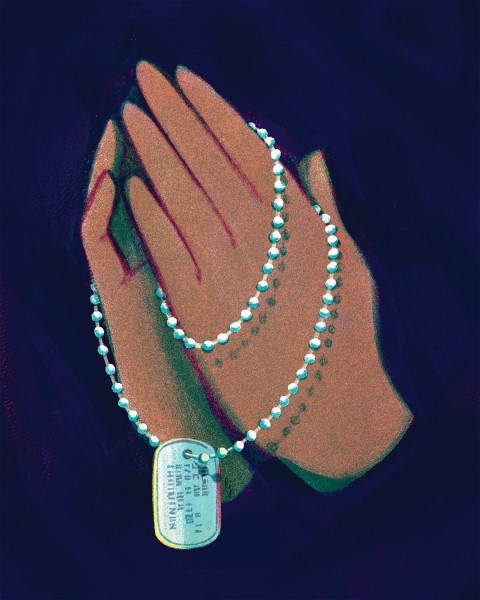
Gracious God, we find ourselves in a world not of our own making, I prayed. Sometimes it feels like we are creatures utterly different from cardinals or the deer that I see every morning. We so often believe we are free to do and be whatever we imagine for ourselves. But today I am reminded of everything we cannot control, the choices we have to make and live with in a world that offers us so few options.
I do not know what brought these young brown faces to this place of service, but I pray for a world that does not ask them to give up so much of themselves. If they are asked to sacrifice, I pray for a world that asks them to do this for a nation that pours more money into its schools than its weapons, a nation that at the very least invests more in research to cure disease and cultivate everyone’s good health than in oligarchical interests and racist fantasies. I pray for a government that will see them and their families as citizens, as people with possibility regardless of when or how they came to this land.
I pray for them and all of us who have little choice over our participation in these rhythms of violence and consumption. When opportunities to disrupt the machine arise, let us see clearly and have the courage to throw wrenches into the cogs of these deathly inventions. Let us recognize what wholeness could look like and create little slivers of belonging wherever we find ourselves.
Mostly, I ask forgiveness. It is easy for me to look at these kids in their uniforms and wonder, In this moment, how could they choose the military? But in truth, I am complicit, too. I am a citizen of a country that wars endlessly, that rationalizes its own innocence and sends arms to nations that confine and hunt and kill people as though they were cattle. Forgive me, and by your Spirit, may we all have the courage to take the opportunities that arise in our lives to create spaces of peace, belonging, and even flourishing. Amen.
I think what continues to sit with me since I got off the plane with those kids has been just how easy it is for me to rationalize my silence, my inaction, my numbness to the atrocities that have now become mundane. But at the very least, I am called to find ways—big and small, every day and in vital moments that matter—to work for a world where people have more choices than to serve a country that wants to either consume or exploit them.