Voices

Looking out the window in wartime

We still have power: We can choose whether to give violence the last word.

By the time you read this, I hope that the war will be over. But as I write, weeks have passed since the war between Israel and the United States and Iran began, a war that has drawn in surrounding countries. I try to see these days of devastation from God’s vantage point. Girls killed at school, a priest killed caring for his parishioners, children killed in a bomb shelter. Humans made in God’s image. The Vatican newspaper L’Osservatore Romano said it most plainly, decrying 1,100 minors already killed or wounded in “collateral damage.”

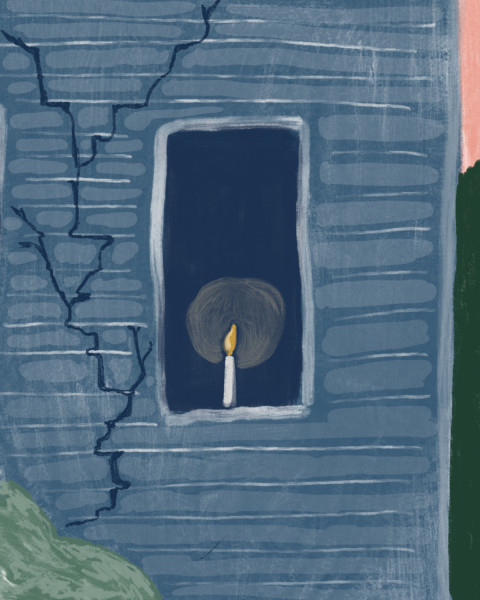
We are worn down after years of war. Like so many others, I live with the question of how to remain human in times like these, how to build a life, a family, and a faith in the face of such inhumane realities. In Bethlehem, where I am writing this, it is largely quiet, save for explosions and sirens in the distance. We mostly shelter in place, and I often remind myself to look out the window. On some days, looking out the window feels like a prayer. On others, it feels like resistance.

A line from Glimmerings, a recently published collection of letters between poet Christian Wiman and theologian Miroslav Volf, has stayed with me. “Attention enables God’s presence,” Wiman writes. “The life and love that are God are catalyzed by the life and love we expend in his direction, whatever form that expenditure takes.” Though I wrestle with “enable,” his words help me give weight to the choice to look out the window, to trust that something is at stake, and to experience it not just as gaze but as encounter. God looks back at us. God grabs hold of whatever space we are given and makes of it a world.
My oldest son is studying in Amsterdam, and perhaps because I miss him I’ve found myself meditating on the lives of two Dutch men. The first is Vincent van Gogh, who spent a year in an asylum in Saint-Rémy-de-Provence in 1889–1890. Despite struggling with his health, he completed some 150 paintings that year, including Almond Blossoms. On some days, he was able to paint in the garden or countryside. On others, he was confined to his studio, where he painted the view from the window. A plowman, tilling the many-hued soil. At night, the moon and starry sky. It was enough.

Early Christians saw the created world as an icon. Not only do we look at it, but God looks at us through it, and we receive God’s gaze in our act of contemplation. To look out the window becomes prayer. It is a choice to engage—with God, with the world, and with expansive possibility when it seems that everything else is closing in.

The other Dutchman I’ve been thinking of is Jesuit priest Frans van der Lugt, who spent decades living in Syria. I met him on a few occasions, but I know him through stories of those who loved him. A tireless pastor, in Syria he became known for leading Christian and Muslim youth on annual walks. During those journeys, these young people came to know one another and God, forging friendships.

When the war in Syria began, Fr. Frans chose to remain in Homs. He rode his bicycle to bring bread to his neighbors under siege and said the mass for the few remaining Christians. Even when most of his neighbors could escape, he stayed with the last who could not. One day there was a knock at the door, and Fr. Frans was killed.

Many of those young people who walked with him became refugees, escaping to Europe. There they found one another and continued annual walks in his memory. They often said that Fr. Frans chose the hardest path between two places during his walks, much to the chagrin of those who knew there was a faster way. Only later did they understand that he had been teaching them to walk the harder path. They also discovered that they were capable of it.

I think about this harder path in times like these. It means not just loving our neighbor but noticing Zacchaeus in the tree and the stranger at our door. It means rereading the gospels until they ask something of us and being willing to take those demands seriously. In Bethlehem, where everyone was fasting at the same time because Ramadan and Lent coincided this year, I’ve watched my neighbors inviting God into the smallest choices of everyday life, the bakers praying maghrib in the stairwell, the parishioners walking the Way of the Cross.

I'd like to believe that these small acts are both complete in and of themselves and also part of the larger fabric of the choices we make. Maybe opening a door builds the muscle to love one’s enemy or to think of them as a friend. Lighting a candle might build the muscle to fight off despair. A longer walk may build the muscles that give the courage to survive war by escaping by sea—or to die by remaining with one’s neighbors. Looking out the window might lead us to notice the man plowing his field, the yellow of the earth beneath, and to see in it a miracle.

We still have power, even if only to look outside. That gaze means choosing how we orient our lives and refusing to give violence the last word. Someone once told me that “regard the lilies of the field, the birds of the air” is not suggestion but commandment. I have chosen to believe it, just as I trust that the Sermon on the Mount contains not just teachings by which to live but reminders of the choices we can still make. We can love. We can imagine. We can remain. To notice an almond tree is solace and defiance but also fidelity. To see every human being as sacred is a decision to remain human ourselves.

All this is incarnation. God still finds us through the narrow windows we are given. Even if we cannot go out, the sky will come to us. 

Stephanie Saldaña

Stephanie Saldaña is author of What We Remember Will Be Saved: A Story of Refugees and the Things They Carry. She writes from Jerusalem and Bethlehem. 

All articles »