
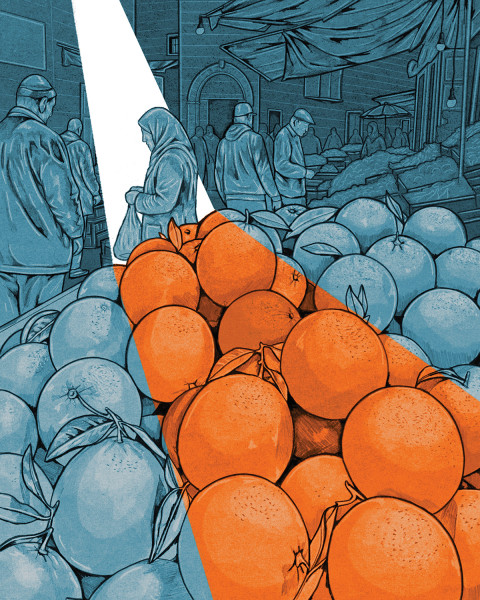
Last winter, I was shopping at the Bethlehem farmer’s market when a pile of vibrant oranges came into view. “Abu Surrah!” the vendor called out, so I asked him what this Arabic phrase means. He pointed to the indentation on the side of an orange. “Abu Surrah means the ‘father of the bellybutton,’” he explained. “All of us are linked to the same bellybutton of Adam.” I smiled. Now, whenever I hold a navel orange in my hands, I am reminded that we belong to one another.
There’s a word that I meditate on to remind myself of the work we must engage in if we hope to live together: disarm.
At first glance, this verb seems to be about undoing more than doing. But just as we must till the soil before we plant, to disarm is about creating the space to let God into our histories. Today, disarm seems to be everywhere in Catholic discourse.
Read our latest issue or browse back issues.
After Pope Leo’s election his first words to the public were those of Jesus after the resurrection: “Peace be with you all!” He then described this peace as “disarmed and disarming.” Since then, Leo has asked us to disarm our speech to one another. He has said that “goodness is disarming.” In Magnifica humanitas, he writes that the word disarm is dear to him and asks that AI be disarmed to prevent it from “dominating humanity.”
The verb disarm and the lesson of the orange are intertwined, and I’ve spent weeks trying to name how. For us Christians living in the Middle East, disarm is not just any word. It is a prayer—and one with its own beautiful, devastating history.
During the civil war in Algeria in the 1990s, a community of French Trappist monks were living in a monastery in a village called Tibhirine. Their prior, named Christian de Chergé, was a student of Islam and was moved by the piety of the Muslim villagers. He liked to call the monastery “a place to pray among those who pray.”
Before he became a priest, Brother Christian had been deployed as a French officer in Algeria, where at one point a Muslim friend had intervened to save his life and had later been killed as a result. It was a formative experience for Brother Christian and a source of his monastic vocation. He would always be aware that he was not innocent of violence in the world. When his military service ended, he entered religious life and returned to Algeria, this time offering his own life to God and to Algeria as a monk.
He stayed for decades with his French brothers, who prayed and lived in solidarity with their neighbors, offering dialogue and medical care and receiving hospitality and friendship in return. When the civil war broke out, the monks discerned that they would remain with their neighbors. As violence escalated, they prayed for both fighting sides as family, calling the rebels the “brothers of the mountain” and the Algerian army the “brothers of the plains.” Prayer is also hospitality.
On Christmas Eve 1993, a militant named Emir Sayah Attiyah came to the monastery demanding medicine and money. Brother Christian told him that he could not enter with weapons, reminding him that it was the feast of the Prince of Peace.
“I didn’t know,” Attiyah said. He left.
Later, when Brother Christian reflected on that night, he reasoned that he could pray and ask God to disarm Attiyah. But in the prayer he wrote, he also asks himself, “Do I have the right to ask, disarm him, if I do not begin by asking: Disarm me and disarm us in the community?” That desire—disarm me, disarm him—became Brother Christian’s daily prayer.
Nineteen Christian religious were killed in Algeria during the war, alongside thousands of their Muslim neighbors. Seven monks of Tibhirine were killed, including Brother Christian. Their story, depicted in the film Of Gods and Men, spread across the world. Brother Christian’s prayer became my own.
In 2018, the 19 martyrs of Algeria were beatified by the Catholic Church. Their feast day is May 8—the date, in 2025, when Pope Leo was elected and then pronounced that sacred word to the world: disarm. Tears filled my eyes.
What makes this word powerful? It gives us a place from which to begin. None of us is innocent to the violence around us. We can ask God to help us examine our own anger and vengeance, the ways in which we have wounded one another with our words, our glances, our indifference, and to lay down those arms. To disarm is not only to refuse violence but to ask God to anchor us in its opposite: in listening, being vulnerable, loving.
To ask God to disarm us is to believe that we are connected, that the small things we do transform the big. To ask forgiveness is not apart from the global work of reconciliation. To disarm someone with a kind word is not apart from disarming a bomb.
The prayer “disarm me” is to invite Christ, who faced the cross disarmed and who in his resurrection disarms us, into our histories. During the civil war in Syria, I knew a priest who said that anyone of any faith could seek safety in his monastery so long as they did not bring weapons inside. His church became a place of healing. People found shelter, prayed, shared meals. They began to trust one another again. This is our core identity as church: to enter and greet one another, carrying the disarmed peace of the resurrection. Only then can we feel safe. We can admit our mistakes, be honest, and mourn.
A church that is disarmed is a place of possibility. It is a home in which to breathe, put down our loads, and finally rest.
*******************
Stephanie Saldaña speaks with the Century's community engagement editor Jon Mathieu about Christian de Chergé’s prayer and what it means to pray for our own disarmament.