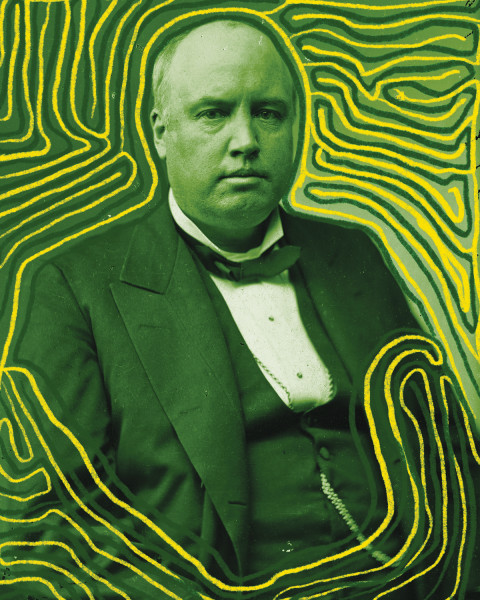
In one of John Updike’s novels, a minister finishes the last page of The Collected Works of Robert Ingersoll and, in less than the time it takes Updike to complete the sentence, loses his faith. This is absurd, of course—a person who quits believing in God that fast didn’t believe to begin with—but the scene gives some idea of the renown and infamy that once attached to the name of the 19th-century orator, lawyer, and agnostic. This was a man so famous a Texas town named itself after him, and so unpopular among most of the faithful that that same town renamed itself after one particularly fervid Christian revival.
The son of a liberal, abolitionist Presbyterian minister—by all accounts the sort of godly, midwestern left-wing radical that you read about in Marilynne Robinson novels and in the recent reports out of Minneapolis—Ingersoll was first embittered against Christianity by witnessing the way his father was treated by his congregations. (I’ve met many pastors’ kids with similar tales to tell.) He served in the Civil War on the Union side and was active in postwar Republican politics, back when Republicans were trying to abolish the Confederate style of government rather than enshrine it forever. The party tried to recruit him to run for governor of Illinois, on condition that he keep his unbelief a secret. Ingersoll refused—because he thought keeping secrets from the public was immoral. The gesture is unimaginable now.

Read our latest issue or browse back issues.
I happened into reading Ingersoll about a decade ago as I dug around in the obscure corner of the library where they keep the essayists—my people. I knew of his reputation as a critic of Christianity, and since I am an adherent of that religion, I expected not to like him. Then I read this passage, in which he reacts to the 1883 decision in which the thoroughly corrupt and racist Supreme Court struck down the Civil Rights Act of 1866:
This decision takes from seven millions of people the shield of the Constitution. It leaves the best of the colored race at the mercy of the meanest of the white. It feeds fat the ancient grudge that vicious ignorance bears toward race and color. . . . The masked wretches who, in the darkness of night, drag the poor negro from his cabin, and lacerate with whip and thong his quivering flesh, will, with bloody hands, applaud the Supreme Court.
Well, no one who wrote like that, in Jim Crow America, is my enemy, even if he has mistaken ideas about metaphysics.
So I read on. I read his critique of eternal punishment—“It is simply unadulterated revenge”—and found myself nodding in agreement. I read his defenses of free speech law and of first-wave feminism and women’s suffrage. His tone is unremittingly earnest; he is confident in his principles but not triumphalist; he is sober. He is, God bless him, cringe. His answer, repeatedly, in essay after essay, to the question, What is our purpose on this planet? is happiness—not one’s own, but other people’s.
Along with this, Ingersoll makes the usual lists of the Bible’s supposed scientific and moral mistakes, which he pursues at tedious but probably (for his audience and purpose) necessary length. It’s the sort of stuff that any mature faith has worked through and is better for having worked through. I believe God made us, but I’m not threatened by the idea that that didn’t happen 6,000 years ago on a Sunday.
At that time, when I first read Ingersoll, New Atheism was still a thing—it had not yet revealed itself as yet another face of Old Reaction. It struck me that Ingersoll, with his stout and consistent adherence to humanist principles, looked so much better than my own era’s public spokespeople for nonbelief that it was positively depressing. Ingersoll rebelled against God because he admired human beings, human intelligence, human goodness, and he saw the God of that day’s popular Christianity as having set his face against human flourishing. New Atheism was marked precisely by its inability to recognize or value the distinctive abilities or powers of humanity and by its enthusiasm for War on Terror policies that disrupted human flourishing. Ingersoll denied God, but he could still acknowledge God’s handiwork.
Ingersoll’s main fault, I thought then, is that he’s a tone-deaf, context-oblivious reader of the Bible. He can’t appreciate the irony by which Jesus’ transvaluation of human values makes possible the egalitarian, humanist convictions that ennobled him. He can’t see that such a transvaluation, attested to by the Bible itself not just amidst but through considerable contradiction and backsliding, is highly consistent with the idea of incarnation. He stands bravely on a limb that he is, at the same time, constantly trying to cut down.
So it seemed to me when I first read him—and so it still seems. But now we’re in a very different era, and what I most notice is that Ingersoll sounds a lot more Christian than do many people who talk about the subject for a living. It has taken me an entire lifetime to appreciate that his answer to the question of human purpose—to make others happy—is not a shallow one. It is certainly incomplete; we are here to learn to bear and then to embody God’s love and God’s forgiveness, which, much of the time, will look like making other people happier. But it is a far better answer, far closer to the truth, than you’ll get from many of the people who would deplore it as disenchanted utilitarian talk.