Screen Time

Paul Thomas Anderson’s biggest question

One Battle After Another explores what it means to find agency in a world we can’t control.

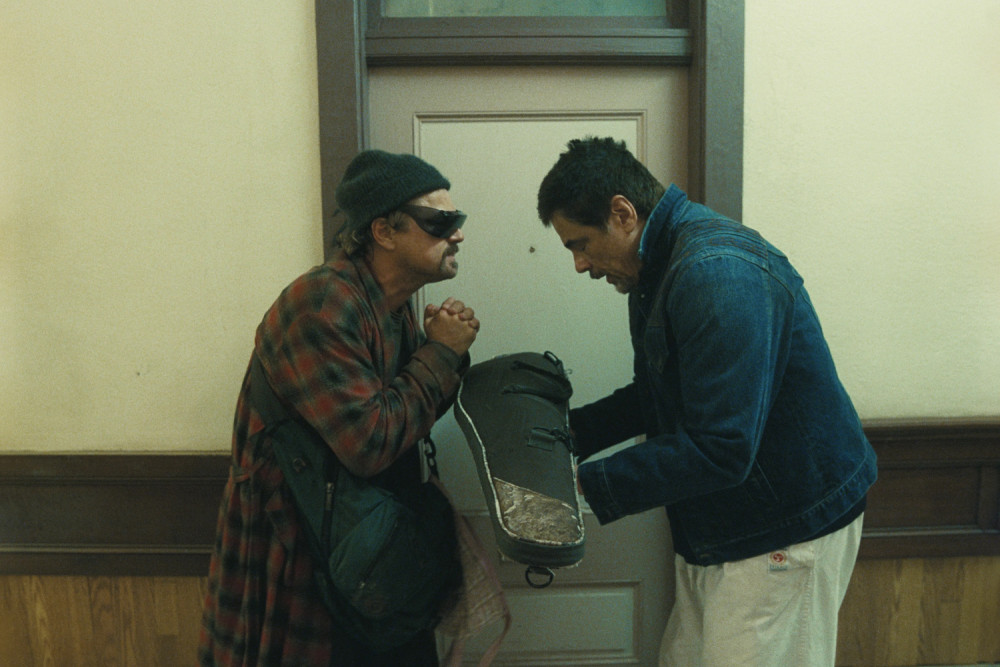
In an incredible sequence about a third of the way into Paul Thomas Anderson’s new film One Battle After Another, a terrified and paranoid Bob (Leonardo DiCaprio) is cowering in the living room of local karate sensei Sergio St. Carlos (Benicio Del Toro). Military special ops have descended on their small town to apprehend Bob and his daughter Willa (Chase Infiniti), who have been living undercover since Willa’s infancy. Bob is right to be paranoid. But his personal fear makes him oblivious to Sensei Sergio’s “Latino Harriet Tubman situation,” as he aptly describes it: While Bob flaps around in his flannel robe, Sergio is orchestrating a mass exodus of undocumented families through secret tunnels into a sanctuary church.

This is Bob’s usual mode in relationship to the more radical action unfolding around him: a bit clueless, waiting for others to tell him what to do. He and Willa have been in hiding for 16 years because he used to be part of a far-left militant revolutionary group—the French 75—that attacked sites of military overreach. Bob, whose real name is Pat, was the group’s explosion specialist. He clearly loved the thrill of blowing things up, but he loved the group’s spirited provocateur, Perfidia Beverly Hills (Teyana Taylor), even more. When he and Perfidia have a baby, he’s ready to put down some roots; she’s not. Eventually both their fragile union and the group’s explode like one of his homemade bombs, leaving indiscriminate destruction in its wake. Since going into hiding as a single dad, he has grown both more clueless and more paranoid, surrounded by a perpetual haze of marijuana smoke.

Perhaps because he was never very good at paying attention, perhaps because his commitment to the political cause was always a bit vague, Bob is unaware of his real enemy, Col. Steven J. Lockjaw (Sean Penn). Lockjaw is Bob’s exact opposite, a law-and-order fanatic whose ramrod vertebrae and precision buzz cut are the reverse image to Bob’s perpetual slouch and unwashed man-bun. In their younger days, however, he shared Bob’s fascination with Perfidia and obsessively hunted the French 75 so he could be near her, even while he was baffled and ashamed by his attraction to a radical Black woman who unmanned him in every way. Those conflicted entanglements come back to haunt them all when Lockjaw seeks membership in a secretive White supremacist organization that styles itself as protectors of western civilization. It turns out Bob isn’t paranoid enough.


If I tell you that the name of the White supremacist group is The Christmas Adventurers, you might get a sense of the film’s wild, exhilarating energy. It is loosely based on Thomas Pynchon’s novel Vineland, and it is saturated in Pynchon’s surrealist, prophetic comedy. It is both hilarious and absurd to watch a group of elite power brokers who manipulate world events in secret meetings greet each other “Hail St. Nick”—and yet it showcases the fragile mythology of White patriarchy better than any didactic speech could. The film is full of characters and situations that careen to the edge of the absurd—insurrectionist weed-growing nuns, an anarchist help line that quickly devolves into a bureaucratic parody, sleeper agents using pre-cellular technology and the opening lines of Gil Scott-Heron’s poem “The Revolution Will Not Be Televised” as a secret code. We are pulled back to this side of reality by the structuring drama of the plot: both Bob and Lockjaw, for very different reasons, are in a race against time, and each other, to find Willa.

This dichotomy between Bob and Lockjaw is emblematic of a theme Paul Thomas Anderson has explored across his many, varied films: a tension between domination and freedom, between people who require authoritarian order and even violence to survive (whether they enact the violence or suffer it) and those who just want to love and let go.

Anderson’s films are hard to pin down, moving between grand historical epics to tight familial dramas, carefully observed character studies to joyful teenage love stories, all set in different decades or even centuries. But domination versus freedom is a throughline that emerges in characters as diverse as Daniel Plainview (Daniel Day-Lewis), the oil-baron/authoritarian who lives and dies by the sword in There Will Be Blood, and Barry Egan (Adam Sandler), the brow-beaten middle manager who only wants the simple joy of love in Punch-Drunk Love. It emerges in the difference between the misogynist motivational speaker Frank T. J. Mackey (Tom Cruise) and hapless former child actor Quiz Kid Donnie Smith (William H. Macy), each of whom was wounded by a controlling patriarch, in Magnolia, or the happy-go-lucky self-confidence of high school schemer Gary (Cooper Hoffman) in Licorice Pizza.

These preoccupations come to a head in One Battle After Another. Lockjaw believes he can exert, through force of will or just plain force, whatever outcome he wishes on the world. Bob moves through the world with as little agency as possible. The film is unambiguously on Bob’s side, but that doesn’t mean Bob is a hero. When the movie opens, he is convinced that no meaningful action is possible, and his paranoia is just another way to exert control over a sense of helplessness. His paralysis prevents him from seeing all the people who continue to act with purpose, like Sensei Sergio’s underground railroad or the network of insurgents who are willing to give their lives to protect Willa.

The lesson isn’t that he is freer than he thinks or that revolution will change the world. If anything, as viewers we see the futility of both premises. The lesson Bob learns—and Anderson keeps exploring—is how to find agency that resists domination even when we realize just how little we can control. Bob, too, must learn to love and let go. It sounds like something Bob might say while high, but it takes him the whole movie to embrace it. When he does, it turns out to be a pretty radical way to live.

Kathryn Reklis

Kathryn Reklis teaches theology at Fordham University and is codirector of the Institute for Art, Religion and Social Justice.

All articles »