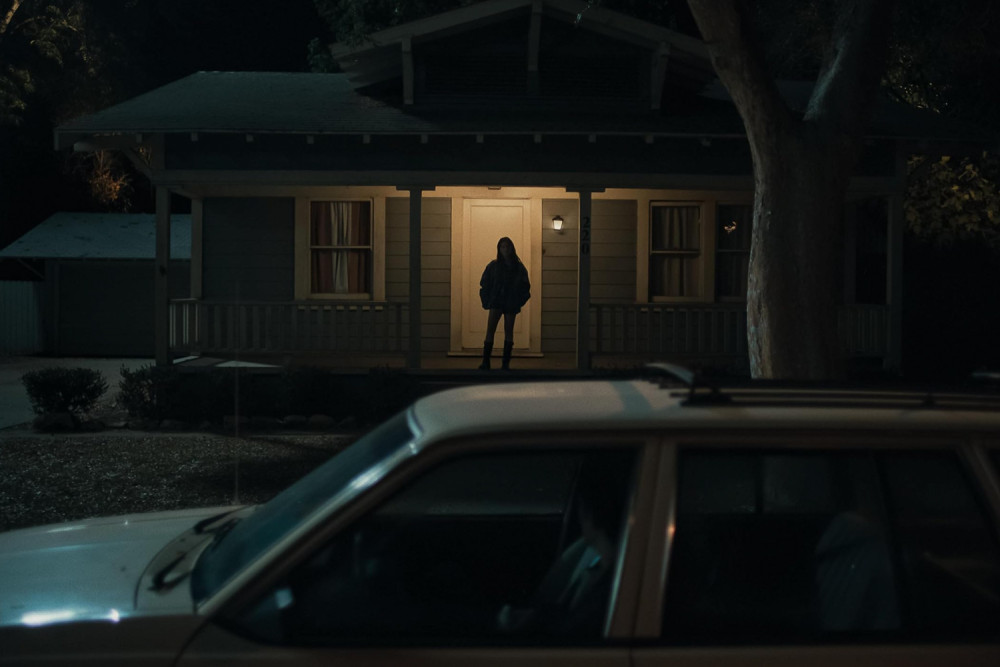
A little over halfway through the movie Obsession (directed by Curry Barker), Nikki (Inde Navarrette) starts acting strangely at a party. When she is separated from her new boyfriend Bear (Michael Johnston), she pouts and whines. When Bear draws a “dare” in the game the group is playing that tells him he must kiss the person on his left, her face contorts to an exaggerated frown and she silently crosses the room, moves the chair of the person on Bear’s left, and plants herself there instead. Creeped out by this behavior, someone jokes, “What kind of spell did you put on her, Bear?” and everyone laughs nervously—except Nikki, who laughs manically and for far too long.
We know, and Bear knows too, that he did put a spell on Nikki. High school friends now in their mid-twenties, they are colleagues at a struggling music store. Bear has long nurtured a crush on Nikki but can’t bring himself to ask her if she returns the feelings. Driven to despair by his own cowardice, he uses a One Wish Willow—a kitschy gag gift he bought at a New Age store—to wish that Nikki “loved me more than anyone else in the world.” You know what they say about being careful what you wish for.
Read our latest issue or browse back issues.
At first the magic is relatively subtle, and Bear is thrilled to get the girl. Nikki doesn’t just launch herself at him like a marionette whose strings are being pulled. She woos him, cautiously at first and then intensely, trying to convince him that she has been carrying the torch for him as well. Despite some very concerning moves on their first few dates, Bear keeps believing (hoping?) that her love is real. Even when he begins to suspect the One Wish Willow is involved, he wants to believe the wish merely opened a floodgate of affection that was already there.
That story is harder to believe the more obsessive and controlling Nikki becomes. Before the spell, she was funny, ironic, a little bit jaded. She had the aloof cool of someone who probably grew up too soon and is used to looking out for herself. It is what Bear loved about her. Under the spell, she starts to panic anytime Bear is out of her sight, screaming and crying and threatening self-harm. She stays awake all night watching him sleep. As her actions become increasingly unhinged and threatening, Bear realizes he is in a nightmare of his own creation.
Obsession has generated all kinds of hype because it is the first feature-length film by a 26-year-old director whose previous claim to fame was creating viral YouTube shorts. It has generated massive profits and proven that Gen Z will shell out for longform content in an old-fashioned movie theater. It is an almost perfect incarnation of an indie horror film: tightly constructed, magnificently acted by new, talented actors, simultaneously lightening and heightening the creepy action with well-placed humor. And like all good horror movies, it is meditating on longstanding fears in a new key.
A lot of the commentary has focused on the film as a meditation on Gen Z’s fear of commitment. The most horrifying thing Gen Z can imagine, the thinking goes, is someone loving you so obsessively they trap and control you. Monogamous love turns into a horror trope. The cool girl who turns controlling shrew once she gets the guy is not a new theme; one might argue it lies behind every bad stepmother or witch-disguised-as-a-princess in all our dark fairy tales. It is definitely part of what drives the jump scares and the dark humor in Obsession.
But the movie has far more interesting things to say about coercion and freedom than it does about the perils of commitment. Nikki’s friends interpret her behavior as sudden onset mental illness. The Nikki they know might fall in love, but she would never act so dopey and saccharine, so obsessive and clingy. In turn, they think Bear is taking advantage of her illness. Instead of trying to get her help, he is pretending that her new obsessive love is his proper due. They berate him, insisting that he do the right thing. But Bear sees himself as a nice guy who would never force himself on anyone. And how do you explain that you accidentally ensorcelled your best friend with a spell you can’t undo?
There are no takebacks with the One Wish Willow. Before long, Bear loses his freedom too, tethered to Nikki by forces that control and limit them both. Their story becomes a twisted inversion of Romeo and Juliet: Instead of suffering for their choice to love against the wishes of others, they suffer because they lose all ability to choose.
This is the real terror at the heart of the film, on which mental illness is just a modern gloss: losing control of one’s life to forces beyond one’s control. What’s at stake is control not just of one’s available options in life but of the very interiority of one’s mind and heart. This fear permeates almost all aspects of Gen Z life: parents who overly engineered their lives but can’t guarantee them any meaningful outcomes, technology that surveils and manipulates, social media that pushes everyone to curate their lives for likes. The young adults in this movie should feel free. They have been told the world is theirs for the taking. Instead, freedom has never felt so elusive. This, it turns out, is a terror no one in the movie can escape.