Cultural critic Nina Auerbach once quipped that every age gets the vampire story it needs. The same, it turns out, might be true for our Frankenstein stories. Although Frankenstein began as a very particular work of fiction, it has taken on the features of mythology, reworked for different adaptations in film, stage dramas, cartoons, and even opera, often with nothing but a slight thread tying it to Mary Shelley’s 1818 novel. In our own confused and unraveling age, we have two wildly different variations on the theme that reveal divergent mediations on the monstrous: Frankenstein (directed by Guillermo del Toro) and The Bride! (directed by Maggie Gyllenhaal).
Guillermo del Toro has spent much of his career playing in the shadows of dark fairy tales, investing monsters with sensitivity in movies like Pan’s Labyrinth and The Shape of Water, insisting that even our scariest stories tell us something about our capacity for courage, honesty, or love. He brings that sensibility to Frankenstein’s story. This adaptation is less a faithful return to Shelley’s source material than it is a riff on and rebuttal to the classic 1931 film directed by James Whale and starring Boris Karloff as Frankenstein’s monster. Gone are the neck bolts, square haircut, and sunken eyes that Karloff made synonymous with Frankenstein. In del Toro’s vision, Dr. Frankenstein’s creature (played by Jacob Elordi), not a monster, is lithe and tender, curious and meek—a mute artist seeking language to express his wonder at the world he so desperately wants to join and is so mercilessly denied.

Read our latest issue or browse back issues.
For all his sensitivity, this creature has the qualities of a superhero. Frankenstein’s monster has always been invested with more-than-human strength. In Shelley’s novel he can survive in harsher conditions and on less food, run and climb faster than an ordinary man. In the Karloff film, he is a lumbering, if sensitive, brute who doesn’t know his own strength, often killing more out of carelessness than malice. In del Toro’s version, the creature is preternaturally strong—he can dislodge a massive ship from a glacier with his bare hands, for instance—and he cannot be killed, no matter how many times he is shot, chopped, sliced, or bludgeoned, which happens so often I felt like I had wandered into a hyperrealistic video game.
Maybe it is not a superhero del Toro has in mind as much as a robot. Thanks in large part to the Karloff film, there is a fixed iconography for Frankenstein’s monster in most of our pop culture. He is brought to life by a mad scientist in a secret lab harnessing the power of electricity. Powered up by flashing machines, he is already something of a cross between robot and human (though none of this appears in Shelley’s novel). By ratcheting up his indestructibility and situating him in a computer-generated landscape, del Toro doubles down on these mechanistic associations. His creature is nothing so much as a machine that longs to be human.
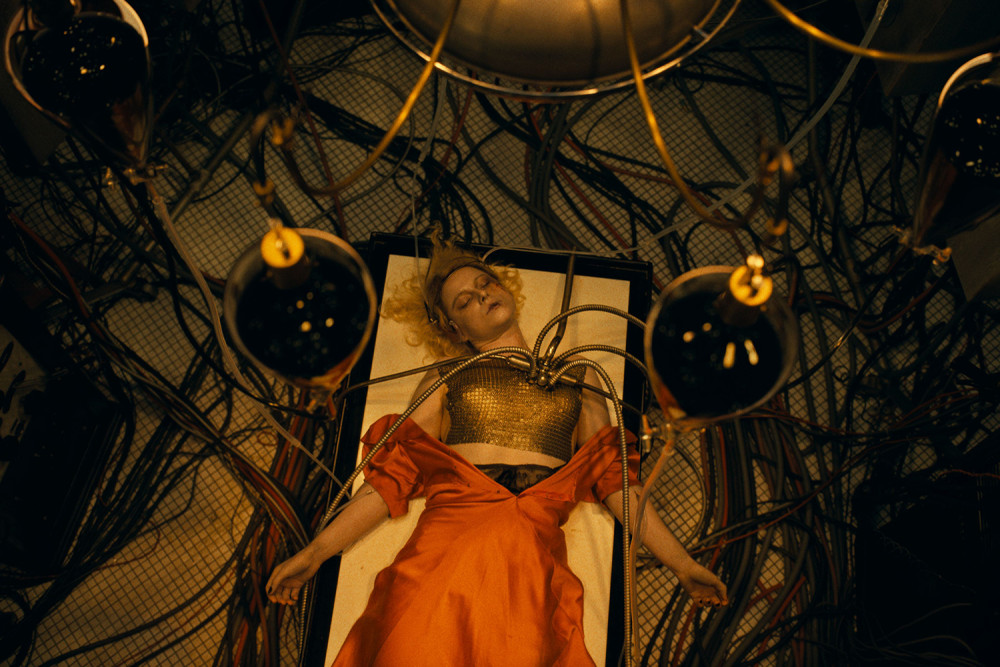
Maggie Gyllenhaal’s The Bride! is less interested in exploring the limits of human technology. Sure, there is a mad scientist in her movie too, along with two reanimated corpses, but her monsters are all flesh and blood. Gyllenhaal’s retelling is less an adaptation than a wild, chaotic sequel set, not incidentally, in the 1930s, right around when the Karloff Frankenstein film and its sequel, The Bride of Frankenstein, were made. The monster—here named Frank (played by Christian Bale)—has been wandering the world for a century or so, lately hiding out in movie theaters watching the same romantic comedies on repeat. On the brink of lonely despair, he persuades a mad scientist to finally make him the bride he’s been begging for since Shelley’s novel. Thankfully, a gangster’s girlfriend has run afoul of the mob, and her freshly dead body is ready for reanimation. With no memory of her previous life, the unnamed bride (played by Jessie Buckley) and Frank set off on a series of madcap adventures as the movie turns into a cross between a Bonnie and Clyde-style caper, a feminist consciousness raising event, and a MeToo revenge thriller.
This story is only loosely tied to the intellectual property of Shelley’s novel. But it is precisely the intellect of Mary Shelley that fascinates Gyllenhaal, who uses her as a character-narrator-ghost to frame her story. Shelley becomes a spokeswoman not so much for Frankenstein the novel as for all women who have dared to speak out beyond the confines of propriety or social expectation. The reanimated bride is her mouthpiece in more ways than one: When the bride jerks back to life, she spews magnetic fluid all over her face, leaving what looks like a permanent ink blot coming out of her mouth. The symbolism is clear: Women who wield the pen have always been a bit monstrous.
These are wildly different interpretations of Shelley’s novel. Like all Frankenstein stories, though, both films are fundamentally about where and how we recognize humanity: If humans unleash monstrousness on the world, who are we to judge when our monsters turn against us? It is hard not to think of our own impending robot apocalypse as we watch del Toro’s thinking-feeling creature-machine beg for moral recognition from his maker. Del Toro is aiming for redemptive integration, where humans will be saved not by guarding the lines between human nature and technology but by widening the circle. Gyllenhaal’s movie is less cohesive, and it is less fixated on the moral quandaries of human personhood, except insofar as she embraces monstrousness as itself a moral good. In her film, turning monstrous is a sane response to the forces of injustice—like misogyny and patriarchy—and maybe the only way to hold on to real humanity.
Shelley probably wouldn’t recognize her novel in either movie. But she probably would recognize the need for every age to confront its own monsters and tell the stories it needs to hear.