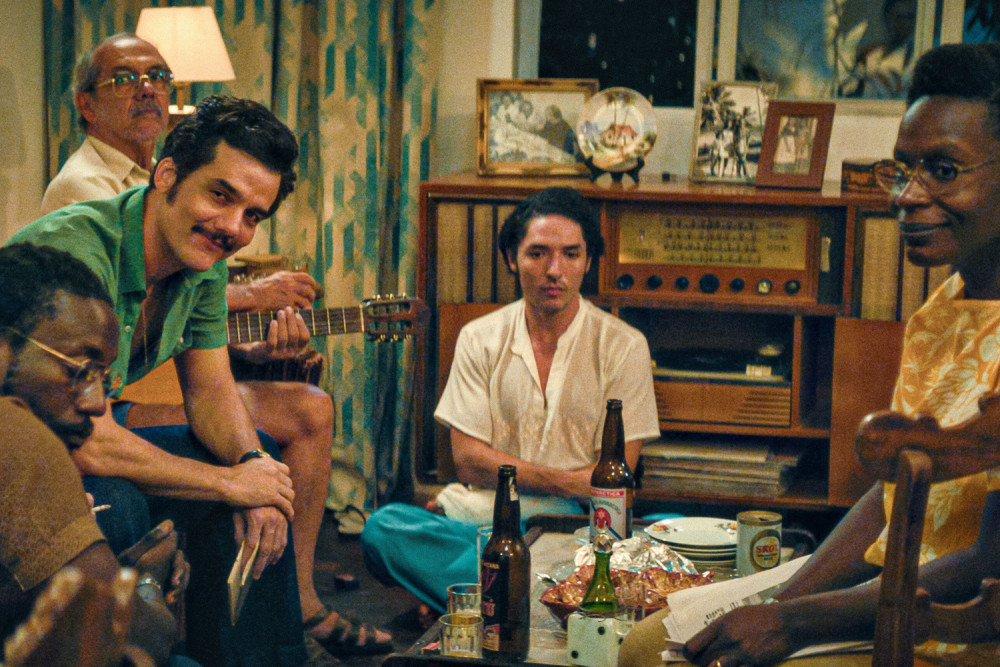
In the second half of the film The Secret Agent (directed by Kleber Mendonça Filho), a group of neighbors in the same small apartment building gathers in the home of Dona Sebastiana (Tânia Maria) to say goodbye to a couple, Tereza Victória (Isabél Zuaa) and Antonio (Licínio Januário). The character we have known for most of the film as Marcelo (Wagner Moura) shares with the group his real name, Armando. Everyone in the room is using an alias, and Armando’s disclosure startles them and makes them nervous. Many of the residents live under death threats and cannot leave the complex at all. They have lived in close intimacy for months, but they are not ready to share their real names.
It is 1977 in Brazil, “a time of great mischief,” as the opening title card tells us. The mischief in question is the military dictatorship that governed Brazil from 1964 to 1985. In this context, corruption, violence, and confusion have seeped into every interaction and every level of society.
Read our latest issue or browse back issues.
Mischief is a euphemism, of course, but it is also an apt description of the way corruption creates an environment of confusion and chaos. When Armando pulls into a gas station, the first thing he sees is a rotting corpse, which he learns has been sitting there for days, waiting for the police to come. When two military police officers arrive, the gas station attendant is hopeful he will finally get help. But the cops have no interest in the dead body—though they do force Armando out of the car and inspect every inch of it, without cause or explanation. Are they looking for something? Do they want the car? Money? They settle for a pack of cigarettes.
The head of the civil police in Recife, where Armando and his new friends are hiding out, is alternatingly clueless, chummy, and cruel, often without explanation. Armando is being hunted by a powerful corporate executive who wants to take over his university research. In the miasma of corruption and violence, everyone is a potential informant; everyone is a potential victim. This creates an atmosphere of dread, but it also creates situations so bizarre and confusing that they are almost humorous, or at least surreal.
We understand why Armando’s neighbors are nervous to share their real names, but their shared lives create different signs of hope and comradery in the madness. They make music and tell stories. They find love and provide comfort. They build their own networks to protect and support each other. All around them are signs of unruly life that refuse to be quieted by fear and suspicion. People stay up all night dancing; costumed revelry spills into the city streets and along the rural roads. In one bizarre sequence, a severed human leg found in the belly of a captured shark comes to life to enact its own vengeance (and to remind us that dictators will use any fabrication to distract from their crimes). Mischief, it turns out, is also a way to resist a regime of fear.
These are themes that Kleber Mendonça Filho explores in most of his films, using different genres and techniques to shake up our ideas about political violence and moral action. His previous film, Bacurau (2019), was a pulpy wild west parable, laced with psychedelics and Afro-Brazilian spirituality, that involves a group of wealthy White supremacists who get more than they bargain for when they attempt to take over a rural Brazilian town for their own pleasure. In his new film he injects the everyday violence of a corrupt and repressive society with the tension and style of a spy thriller, with flashes of the bizarre and surreal. Trying to survive political violence and corruption is more like living through a movie than a history textbook.
Mendonça’s movies, however, are also obsessed with history, with how knowing the past can make sense of the present and also with how much the past remains obscure and unknowable. The people of the small town of Bacurau keep urging their visitors to stop by their town’s museum, which tells the history of the town since it was settled by enslaved people escaping their bondage. If the visitors had done so they might have learned who they were up against before it was too late.
In The Secret Agent, the story is framed by both the past and future. While in hiding, Armando spends his time trying to investigate his own past, which is riddled with older and deeper injustices than the ones he is living through now. We learn that much of what we know of his story is discovered by a group of college students in our present day who are piecing together his story through archival sources for a university project. The lesson is clear: the mischief of 1977 was not the first of its kind, nor will it be the last.
In the United States we like our political resistance stories clearcut and morally pure: righteous resisters who know which side is which and fight against obviously evil bad guys. Mendonça resists these dichotomies. The people in his films find their solidarity not through moral purity but through their own mischievous diversity, which is demonstrated through racial solidarity and gender and sexual diversity. They do not fully understand what is happening to them or the role their own actions will play in the lives of others. Only those who resist the allure of purity can find the joy and friendship that will help them survive dictatorship. “To a better Brazil, with less mischief,” Dona Sebastiana says as she salutes her motley band of refugees. And in the meantime, she insists, to more of the mischief that will help us all survive.