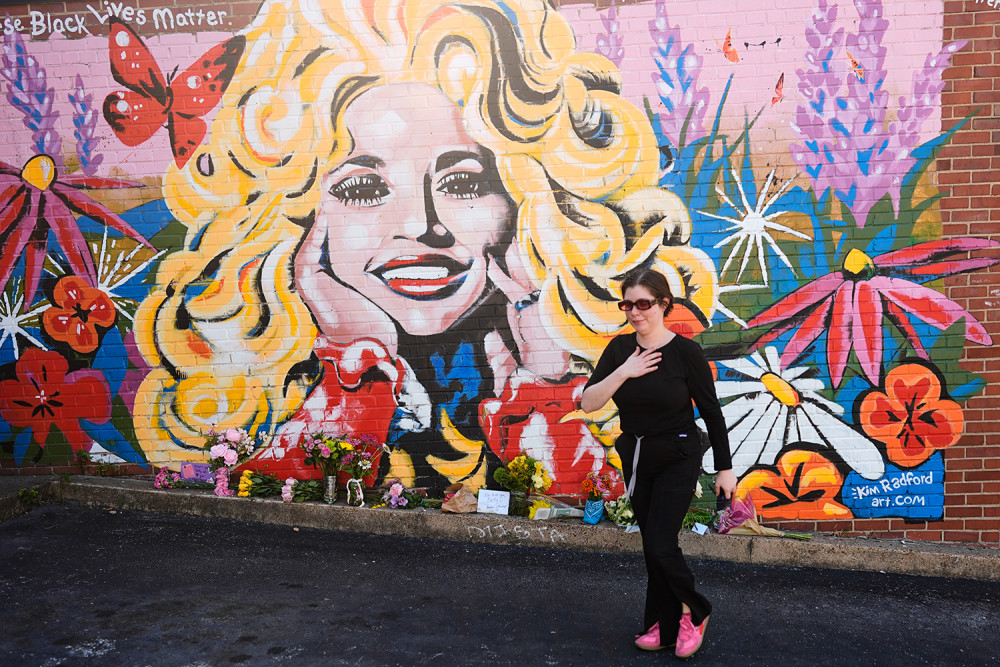
Dolly Parton has passed away at 80 years old, and celebrities, fans, politicians—people from all walks of life—are expressing gratitude for our Backwoods Barbie with a heart of gold. At a time when cultural consensus is nearly impossible, we can agree on one thing: Dolly made the world a better place.
Dolly is known for much more than her brilliance as a singer and a songwriter: there's her literacy program, her theme park, her wigs. She’s also known for her Christian faith. As she put it, she was born into a “Bapticostal” family. (Her grandfather was a Pentecostal preacher and her “daddy’s people were Baptist.”) The religion of her childhood stayed with her, sustained her throughout her life, kept her grounded, humble, and grateful, and inspired her to give generously and eagerly. She credited God with giving her a sense of purpose and a successful 60-year marriage to husband Carl Dean, who passed away in May 2025. “My faith is very important,” she said in 2018. “I do believe that through God all things are possible. I do believe that Jesus loves me. And I just use that. I’m never ashamed of my family. I’m never ashamed of my religion. I’m not trying to cram it down anyone else’s throat. I just think that everybody’s got to have something to believe in.”
One of my favorite lines comes from a 1984 interview she did with Andy Warhol:
Warhol: You could be a great preacher.
Parton: What do you mean? I am a great preacher.
She went on to tell Warhol that she was scared of the “fire and brimstone stuff” as a child, and decided to leave some of that behind. “I just remember the positive. I just thought, ‘I can’t deal with this shit. There cannot be a god that is that mean and cruel, and if there is then I’m too afraid to deal with him anyway.’ So I had to decide who I was, and what God meant to me.”
There’s a fabulously DIY quality to Dolly’s belief structure, as if she walked through a theological costume shop picking up what caught her eye and leaving behind what didn’t. Bedazzled ideas of angels and Heaven and prayer, yep, she’d take those along with a few hundred wigs. Forgiveness and free will? Give her some of that. Reincarnation? Why not? That might look nice with these bespoke heels. But ideas about hell and God’s wrath? They didn’t catch her eye. They didn’t sparkle. So she went home without them. Her God was friendly, her divine buddy. “Sometimes if something great has happened,” she said, “I just kind of raise my hand and give God a high-five or a thumbs up.”
As Jason Edwards noted in his tribute: “Dolly’s faith never fit neatly into any standard denominational framework … Some of what she said would’ve been difficult to reconcile with the theology of churches she knew, but that didn’t seem to trouble her too much.” It doesn’t trouble me much, either. Nor, if I had to guess, is God that worried about it. But some Christians are. Some thought her Christianity was too wishy-washy, not biblical enough, not well enough defined. They don’t like the thought of cobbling together one’s theology from the philosophical bric-a-brac flung around a flea market.
There’s a certain kind of Christian for whom faith begins with an exam (and doesn’t grow much beyond that). Their salvation depends on getting theological answers correct: Is the Son co-eternal with the Father? Does God’s knowledge of the future jeopardize human’s free will? Are the original copies of Scripture free from error?
But there are Christians who are not that concerned about these questions and nevertheless have decided to follow Jesus. Christians like, you know, the first generations of Jesus’ followers. To them, following Jesus meant trusting the God he trusted, meant continuing his ministry to the sick and the poor, meant never giving their complete allegiance to an earthly ruler, meant hoping for God’s future. I think this is the kind of Christian Dolly was. It’s the kind of person Jesus was—the kind of person he calls his followers to become.
I’m a theologian. I’m paid to overthink nebulous, inside-baseball theological ideas, ones that most of Jesus’ followers haven’t heard about and probably wouldn't ever care to discuss. I think theology is important. Theology is a gift to the church and the world the church is called to serve. But when I start to get bigheaded about my job, as if I’m part of an exclusive group that has been nominated by God to protect Christianity, I’m forced to remind myself that Jesus decided to build God’s kingdom with fishermen and sex workers, that he preferred to tell simple stories without opening a textbook, and that his God will not be bound by my ideas even when power-wielding, self-authorizing groups of educated people call them “orthodox” and “canonical.”
History is littered with dead bodies killed in the name of God. Wars are waged and justified, walls constructed or demolished, with reference to Scriptures. Parents often choose whether and how to vaccinate and educate their children based in part on their religious beliefs. Theological beliefs compel us to heed or reject climate science. Theology is incredibly important: the stakes have always been life or death, and therefore God is very interested in the ways we do theology. Not because God requires us to speak his name correctly — but because he demands us to speak it responsibly. To speak the name of God responsibly is to take up God’s cause in the world. God has shown us what is good and has made the demands upon us very clear: justice, mercy, humility. God does not require us to learn Greek and Hebrew, to understand and debate credal terms like consubstantial, or to be able to trace the redaction history of any of the written texts that bear witness to him. God requires us to be a neighbor to all, to proclaim the good news, to be joyful, to take the side of the oppressed, to remember that God is always with us.
Sure, Dolly quoted scripture and Shakespeare in the same breath, and sure, she had some theological ideas that I might’ve questioned had she ever walked into my classroom. But she loved people. She gave people her smile. She was charitable. She brought people from different walks of life together, if only momentarily. She reminded people that they could talk to God whenever they wanted, just like she did. When she saw God’s people in need, she worked to meet those needs. She heard God’s call and responded, leaving theology for other folks to worry about.
Dolly spoke the name of God responsibly because she made good on the promise contained in those three letters. To make good on the promise that harbors in the name God is what the entire theological enterprise is about. What, after all, is “orthodoxy” if not educating children and funding vaccine research? If not investing in run-down communities and offering people hope? As our Scriptures warn us, God tends to grow weary with our feasts and fasts, with our theological rhetoric, with our obsession with drawing lines in the name of “orthodoxy.” But God loves when we care for the poor, when we rescue the needy, when we pursue justice and mercy. That’s orthoDolly.