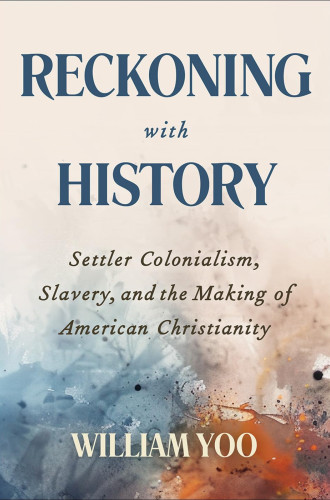
Reckoning with History
Settler Colonialism, Slavery, and the Making of American Christianity
Those who do not know their history are doomed to repeat it. Perhaps this is why Christianity, often hindered by an uncritical and incomplete understanding of its past, seems caught in a time loop of entrenched racial injustice. The way forward must begin with a look back. William Yoo, who teaches American religious and cultural history at Columbia Theological Seminary in Decatur, Georgia, offers just such a look.
In Reckoning with History, Yoo presents a sobering survey of how Christianity participated in the creation and upholding of ideologies that fueled systems of settler colonialism and slavery in the United States—and how those systems, in turn, fashioned American Christianity into their own image. Other recent scholarship, such as Jemar Tisby’s The Color of Compromise and Mark Charles and Soong-Chan Rah’s Unsettling Truths, have sought to shatter the myth of American Christianity’s spotless witness to the gospel through histories of oppression and subjugation. Yoo’s survey is a worthy addition to this conversation.
Read our latest issue or browse back issues.
Through Yoo’s synthesis of historical anecdotes, firsthand accounts, and secondary research, two stories emerge from the book’s overarching narrative: the failure of White American Christianity to resist racial oppression in the pursuit of power and the resilient courage of Indigenous, Black, and outlying White Christians who reckoned with those failures in real time throughout history.
Yoo weaves together various threads, including the imperialistic motivations of self-proclaimed missionaries migrating to “the New World,” the distortion of scripture that propped up settler colonialism, the weaponization of theology in support of slavery and segregation, and the complicity of pastors who chose influence over prophetic witness against racial oppression. In this way, he creates a textured portrayal of the insidiousness of American Christianity’s formation within the bounds of ethical concessions to systemic racism and other harms.
Though Yoo’s work is rooted in history, this formation is deeply relevant to the landscape of American Christianity in the present. Those wondering how churches can be complicit in the immoral treatment of immigrants as ICE terrorizes communities across the country need look no further than those past churches that believed opposing colonization “was to reject the open arms of God” and those pastors who declared that abolitionists were “torturing the Bible.” To understand the American Christianity of today, one must understand the American Christianity of yesteryear, no matter how hard that reality is to face.
For those already grappling with the deep inequities and injustices of American Christianity, perhaps the harder challenge is to face the histories that give us reason to hope. Although on the surface Yoo centers the complicity and participation of the church in oppressive systems, there is a persistent intrusion in his narrative of people speaking the gospel of love, mercy, and justice. For instance, he tells the stories of those who worked to resist the expulsion of the Cherokee Nation from Georgia and of the multiracial coalition that established the first Black church in Philadelphia. We should not erase such stories from our minds or our history books.
Even in deconstructing the failures of American Christianity’s past, Yoo’s desire for sources of hope shines consistently through the rubble. Even those who find themselves steeped in cynicism toward American Christianity may have the foundations of their beliefs shaken by the history Yoo uncovers.
Reckoning with History demonstrates that it is not possible to paint the history of Christianity in America with a broad, monolithic stroke. As Yoo writes, “to study the making of American Christianity is to confront the facts of conquest and domination alongside testimonies of courage and protest.” Still, these testimonies of courage—as important as they are—did not prevent the proliferation of racist ideologies that even to this day persist in integrating themselves into American
Christianity.
For this reason, Yoo’s examination of history transforms into an impassioned plea: He ends his survey with a call to action in a closing chapter titled “The Church That Never Was (But Still Could Be).” Here, he offers five insights for today’s Christians that not only reckon with history but seek to change the future.
It is one thing to confront the harmful histories Yoo uncovers in our minds; it is another to confront them in our communities, our institutions, and our congregations. If the church in the United States truly wants to make restitution for its history, we can no longer treat perversions such as Christian nationalism as mere aberrations of our faith. Rather, we must face the reality that our faith was forged in the fires of power, empire, and racial oppression. In addition, we must actively cultivate a broader and more proactive imagination for what American Christianity can be. These are the tasks to which Yoo calls us. Hope for the future, he reminds us, is found in an honest examination of the past—and in the intentional decision to write a new story.
This review was produced in partnership with the Narrative Project.