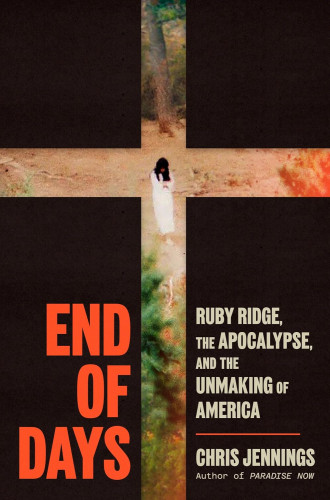
End of Days
Ruby Ridge, the Apocalypse, and the Unmaking of America
One of the claims in Chris Jennings’s new book is that the Ruby Ridge siege—the 11-day standoff between federal agents and the Weaver family in Boundary County, Idaho, in August 1992—set the stage for the conspiracy-laced politics of the Trump era. Having finished the book, I am not sure I buy that specific claim. However, End of Days is well researched (see the pages of endnotes) and well written (there were times I could not put it down), and it took me to places I did not anticipate and helped me make connections that are hard to argue with. For example: “Apocalyptic faith cannot, on its own, explain the ongoing crackup of American civic life, but it is nevertheless a potent and habitually overlooked ingredient in the blend of forces—material, demographic, cultural, spiritual—that have delivered us to our baffling present.” In part because of the rich history lessons in these pages, I now see Ruby Ridge as a hinge moment, one natural outcome of everything Jennings explains and the beginning of a time that would include the Waco siege, the bombing in Oklahoma City, and so much more.
The book begins with the marriage of Randy and Vicki Weaver in 1971 in eastern Iowa. The first third or so of the book is an interweaving of the Weavers’ story, the recent religious and economic history of the heartland, and the history of interpretations of the book of Revelation. And so, Jennings introduces readers to the Reorganized Latter Day Saints faith of Vicki’s childhood, to Amway, and to Vicki’s familiarity with “an underground canon of the conspiracist far-right in the 1970s and ’80s, much of it pitched directly to Christian fundamentalists.”
Jennings provides a solid overview of Revelation and how it has been read in the United States. Readers are introduced to (or reminded of) John Nelson Darby’s premillennial dispensationalism, Cyrus Scofield’s Reference Bible, and Hal Lindsey’s The Late Great Planet Earth. Jennings argues that the latter, published in 1970 and read by Vicki in 1978, changed the course of the Weavers’ lives: “The way that endtimes prophecy overlays the disorder of everyday life with an exciting narrative—a secret conspiracy to establish a One World Government! creeping Satanism! a shooting war between Good and Evil!—spoke to the mythic and literary tendencies of Vicki’s imagination and to Randy’s taste for anything combative or shocking.”
Jennings sets this syllabus alongside the farm crisis that began in the late 1970s, which propelled Iowans to kill themselves at four times the national rate. “For people steeped in prophetic faith, the cruel, invisible hand of the market looked like the world of more sinister forces,” he writes. The Weavers themselves were never direct victims of the farm crisis, but they were present when the ideas came to town. Returning to his original thesis, Jennings writes, “Of the various forces that contribute to the conspiracism that saturates American life, apocalyptic faith may be the most potent, the most widespread, and the least understood.” He also contends that the modern militia movement’s first rumblings were heard in the early 1980s in those places most scorched by the farm crisis.
What was it that brought the Weavers to northern Idaho in the mid-1980s? Vicki looked for places where homeschooling without a teaching certificate was legal, and Idaho was on the list. Meanwhile, in the Arkansas Ozarks, a White supremacist paramilitary church called the Covenant, the Sword, and the Arm of the Lord had a four-day standoff with FBI agents, “awakening American law enforcement to a new and baffling threat and paving the way for what was to come for the Weaver family.”
The book’s second section puts the Weavers’ Idaho years in context by telling the stories of many people from my adopted state: pastor Richard Butler and his Aryan Nations compound at Hayden Lake; Bill Wassmuth, the Catholic priest who organized efforts to push back against the Aryan Nations (the Wassmuth Center for Human Rights now sits eight hours south of Ruby Ridge near downtown Boise); the founders of the Boundary County Task Force on Human Rights. When the task force screened a documentary about the Aryan Nations, Randy attended and defended the Aryans during the Q and A, arguing that Jews were running the world economic system and stating that “religiously speaking, I don’t believe in mixing the races.” Building on arguments made in the first part of the book, Jennings paints a detailed picture of the lives of the Weavers, now a family of six, plus a friend, Kevin, and their dog. The one new theme introduced here is the use of firearms, including Randy selling two sawed-off shotguns to an undercover ATF agent.
Jennings, a former editorial staffer at The New Yorker, tells the story of the 11-day standoff in strong long-form journalism, leaning appropriately on both Randy and oldest daughter Sara Weaver’s book and Spokane writer Jess Walter’s seminal book on the siege. Much has been written on why the siege led to the deaths of Vicki and son Sammy, and Jennings knows that readers can turn to other sources for answers. His focus in the final third of the book is on who else, besides law enforcement, showed up at Ruby Ridge and what this led to. It is estimated that the crowd never grew past about 300 people, but the “organizing that came out of those days of grief and rage would be difficult to overstate. Nothing clarifies and accelerates a political movement like martyrdom.” The Weavers became the evidence of what many people already believed: “that a vindictive federal government intended to wipe out even the smallest pockets of resistance.”
We need books that help us think about history, theology, economics, and all of their intersections. End of Days does all of that—and it might also convince you to lead a Bible study on Revelation in your faith community.